
letho-, leth-
(Greek > Latin: lie hidden, secret; forgetfulness, forget, inactive through forgetfulness; also sleepy, drowsy, dull, sluggish)
An inability to forget past events: No matter how much Sophia tried to eliminate the memory of some bad things that happened to her before, her alethias continued to haunt her many times.
lethargic (adjective), more lethargic, most lethargic
Descriptive of physical slowness and mental dullness: After a sleepless night and having to get up very early in the morning, Jill was very lethargic and sluggish in getting to a good start in her daily activities.
When a person is lethargic, he or she is physically slow and mentally dull as a result of tiredness, disease, or drugs
lethargical (adjective), more lethargical, most lethargical
Pertaining to, affected with, or resembling, drowsiness: After Donald's long trip, he experienced a great deal of lethargical feelings.
lethargically (adverb), more lethargically, most lethargically
Descriptive of how a person possesses no energy, is lazy or indolent, and torpid: As a result of the hot weather, James was lethargically feeling unable to function as well as he usually did.
lethargize (verb), lethargise; lethargized; lethargizing,
To make someone have a lack of energy and to be unnaturally drowsy as a result of not getting enough sleep: When Paul was driving home at night from doing his business assignment in another city, his lack of concentration and tiredness started to lethargize him, and so he parked on the side of the highway to get a nap before he continued going home.
lethargogenic (adjective), more lethargogenic, most lethargogenic
Descriptive of a state of inactivity that indicates an unusual lack of vigor: Because of the hot weather, Joel lost sleep and suffered with a lethargogenic condition when he went to work.
A sleeping sickness or a sleep-like condition: Raymond, in his old age, often has lethargus during the day and so he takes a nap in most of the afternoons.
1. A condition of inactivity showing an unusual lack of vigor: Mary woke up much too early in the morning with symptoms of lethargy, feeling extremely tired with a headache and sore eyes.
2. The state of a person being drowsy and dull, listless, indifferent and lazy; apathetic or sluggish inaction: Jane didn't have any time for breakfast or lunch and fell into complete lethargy and fatigue in the afternoon.
3. Pathologically, an abnormal state of disorder characterized by overpowering drowsiness or sleep: Lethargy and a total lack of energy set in when the disease Mrs. Smith had became worse.
4. A situation of excessive fatigue or retardation, with diminished physical or mental activity: A person's lethargy might be a result of an organic disease or dysfunction of the nervous system or of a mental illness; such as, depression.
5. Etymology: From Late Latin lethargia, from Greek lethargia, "forgetfulness" from lethargos, "forgetful"; originally, "inactive through forgetfulness", from lethe, "forgetfulness" + argos, "idle".
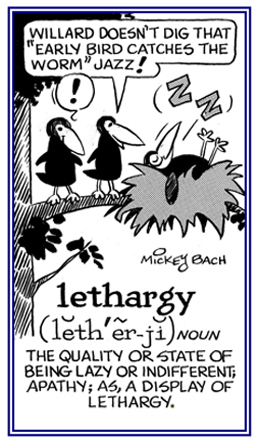
© ALL rights are reserved.
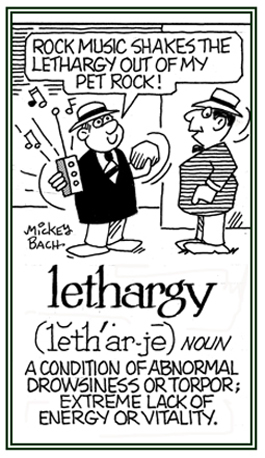
© ALL rights are reserved.
Go to this Word A Day Revisited Index
2. The state of a person being drowsy and dull, listless, indifferent and lazy; apathetic or sluggish inaction: Jane didn't have any time for breakfast or lunch and fell into complete lethargy and fatigue in the afternoon.
3. Pathologically, an abnormal state of disorder characterized by overpowering drowsiness or sleep: Lethargy and a total lack of energy set in when the disease Mrs. Smith had became worse.
4. A situation of excessive fatigue or retardation, with diminished physical or mental activity: A person's lethargy might be a result of an organic disease or dysfunction of the nervous system or of a mental illness; such as, depression.
5. Etymology: From Late Latin lethargia, from Greek lethargia, "forgetfulness" from lethargos, "forgetful"; originally, "inactive through forgetfulness", from lethe, "forgetfulness" + argos, "idle".
Go to this Word A Day Revisited Index
so you can see more of Mickey Bach's cartoons.
Lethe (proper noun)
The river of forgetfulness: The Lethe is one of the five rivers of Hades. The others were the Acheron, the Cocytus, the Phlegethon, and the Styx.
Those who drank from the River Lethe immediately forgot everything that had happened to them.
The expression "waters of Lethe" or the word lethean has been used to imply forgetfulness and complete oblivion of the mind which overcame the souls who drank from this stream in the "Lower World".
1. A total loss of memory or a mental oblivion of what has happened in the past or complete forgetfulness: Lethe was also the name of the Greek spirit of forgetfulness and oblivion with whom the river was often identified.
2. Etymology: In Classical Greek, the word lethe literally means "oblivion", "forgetfulness", or "concealment".
2. Etymology: In Classical Greek, the word lethe literally means "oblivion", "forgetfulness", or "concealment".
Pertaining to the inducement or to the cause of forgetfulness or to the oblivion of memory: Following the terrible car accident, Mrs. Smith was in a Lethean condition and couldn't remember what had happened.
The children pretended to drink from the mythological river Lethe, and acted as if they were in a Lethean state and not recalling who they were!
The effects of forgetting what has happened during one's present behavior: June's condition of lethegemonia and not remembering the things she did caused her much distress when she realized that she had a bad medical disorder which could not be cured.
An abnormal craving to forget what is happening in his or her current existence: Some people who have been unemployed and are very depressed can suffer from a condition of letheomania and lapse into taking drugs to lessen their helplessness.
letheral (adjective), more letheral, most letheral
A reference to not remembering what is going on in one's current life even when it has just happened: Jane was so depressed and unhappy that she decided to drink lots of alcohol and was then in a letheral condition and wanted to cross the middle of the highway.
The inability to recall a word or the right word that a person is trying to remember while talking to another person or people: Petra had lethologicas, or psychological disorders, that inhibited her ability to articulate her thoughts because she was forgetting certain terms, phrases, or names during her conversation with her friend on the phone.
Related "sleep" units: dorm-; hypno-; narco-; oneiro- (dream); somni-; sopor-.
Etymologically related "forget, forgetfulness" word families: aletho-; oblivio-.

Showing page 1 out of 2 pages of 18 main-word entries or main-word-entry groups.