
ad-
(From Latin: "to, toward, a direction toward, an addition to, near, at"; and changes to: "ac-, af-, ag-, al-, an-, ap-, aq-, ar-, as-, at-" and ad- is also combined with certain words that begin with the letters c, f, g, l, n, p, q, r, s, and t.)
The Latin element ad carries the idea of "in the direction of" and combines with many Latin words and roots to make common English words.
2. To inform, tell, notify, make known, communicate: Mary and Richard have been advised that the roads were too icy for the trip that they were planning to take.
3. To give an opinion or suggestion to someone about what should be done: Shirley advises the President on foreign affairs.
Howard's lawyer is advising him about whether he should buy the house under such financial conditions.
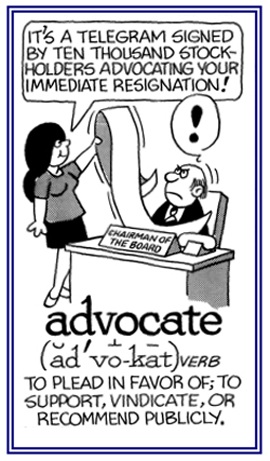
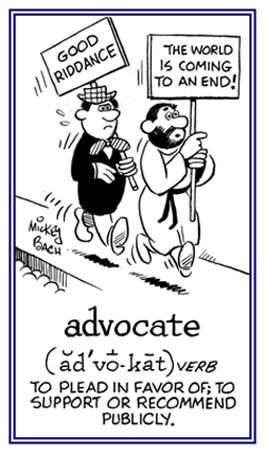
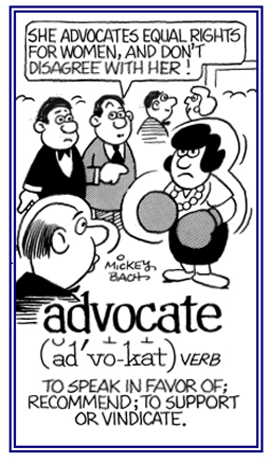
4. Etymology: from Old French avis, "opinion"; which came from Old French ce m'est à vis, "it seems to me"; or from Vulgar (common) Latin mi est visum, "in my view"; and originally from Latin ad-, "to" + visum; past participle of videre, "to see".2. The act of speaking or writing, in support of something, such as an idea, a cause, or a policy, and giving active support: Jane’s advocacy for the local animal rights group helped convince the public to donate more money for saving the lives of stray animals.

Go to this Word A Day Revisited Index
so you can see more of Mickey Bach's cartoons.
2. To put or to add on; to append: The salesman wanted Alice to affix her signature to the contract for the loan.
In grammar, a part of a word element that is affixed, such as a prefix, infix, or suffix, is added to a word element in order to form a different meaning. For example, the suffix, "-ed" added to "want" forms "wanted", or the prefix, "im-" connected to "possible" becomes "impossible".
When a poster is affixed to the wall, it is secured or tacked to the wall.
Natasha wanted to know if she was Rh positive, so the doctor told her that it would be so if the antiserum agglutinated in her red blood cells.
2. Deliberately unfriendly behavior: Sometimes aggression is shown by some football fans when their team loses a game and they verbally attack the supporters of the winning side.
3. The act of initiating hostilities: Because Timmy wasn’t happy at home, he turned his aggression towards the other kids at school by pushing them, taking their ball away from them during a game, or calling them bad names.
4. A disposition to behave contentiously or offensively: James had a very unhappy childhood while he was living in a bad environment and so he expressed feelings of aggression when dealing with other people.
5. A feeling of hostility that arouses thoughts of attack: A sensation of aggression developed in Jerry when he was falsely accused of stealing money from a woman's purse at a restaurant.
6. Etymology: from ad-, "to" + gradi, gressus, "to step"; from gradus, "a step".
2. To add an authorized signature to a bill, or an official agreement, as a final part of the ratification or agreement process: The lawyer asked the elderly lady to append her handwritten name to the will.
3. To attach, or to fasten, a thing to something else: Jane tried to append the jewel to her necklace.
4. Etymology: "to hang on; to attach, as a pendant", from Latin appendere "to cause to hang (from something), to weigh"; from ad-, "to" + pendere, "to hang".
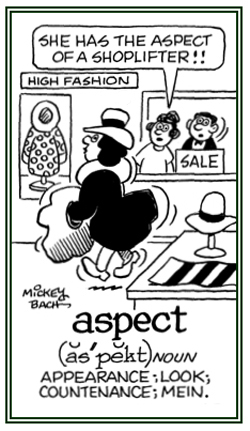
2. The view of something to the mind or the eyes: Suddenly the stone had a greenish aspect in the florescent light.
3. The way a person, place, or something appears: The old house took on a dark and lonely aspect or image.
4. Etymology: from Middle English, "indicating the action or the way of looking at or seeing something"; from Latin aspectus and aspicere, "to look at"; from ad-, "to" + specere, "to look".
Go to this Word A Day Revisited Index
so you can see more of Mickey Bach's cartoons.
2. To send someone to work in a particular place or with a particular group of people: The firefighters were assigned to be at the industrial section of the city.
3. To determine that someone or something has a particular quality, name, use, or category: He was assigned a high employee rating based on his high attendance on the job.
4. To put a soldier, military unit, or military material under a particular command or duty: The army garrison and equipment was allocated, or assigned, from the temporary location to another long-term and secure place.
2. To wait on; minister; to serve: Mrs. Jackson usually attends the elderly lady who is sitting in her wheelchair beside the window.
3. To accompany; to go with: The students' music recital was attended by a standing ovation by all the parents.
4. Etymology: "to direct one's mind or energies"; from Old French atendre, "to expect, to wait for, to pay attention"; from Latin attendere, "to give heed to"; literally, "to stretch toward"; from ad-, "to" + tendere, "to stretch".
The magnetic pins that Lynn bought cling beautifully to the attractable metal door frames!
2. Referring to something or someone that has the power to appeal, allure, or to entice: Valerie's charm and humor were quite attractable to those who knew her and everybody always had a good time when they got together.
