
ad-
(From Latin: "to, toward, a direction toward, an addition to, near, at"; and changes to: "ac-, af-, ag-, al-, an-, ap-, aq-, ar-, as-, at-" and ad- is also combined with certain words that begin with the letters c, f, g, l, n, p, q, r, s, and t.)
The Latin element ad carries the idea of "in the direction of" and combines with many Latin words and roots to make common English words.
adsorb (verb), adsorbs; adsorbed; adsorbing
To take up and to hold another substance, usually gas or liquid, on a surface: The dye Kitty used was adsorbed on to the fiber of the fabric she was going to use.
The capability of a substance to accumulate on a solid surface: Troy was convinced of the adsorbability of charcoal being able to gather gasses on its outer layer.
adsorbable (adjective), more adsorbable, most absorbable
Relating to a substance which accumulates on a surface of a solid: In her chemistry class at school, Jane was hoping that the liquid medium she was using was adsorbable for the flat piece of glass.
A substance which accumulates on a surface: An adsorbate, such as a gas or a liquid, undergoes a process of forming a very thin coating on the outer layer of a solid object, sometimes only a molecule thick.
A material that can hold or condense molecules of another substance on its surface by accumulation: It seems that activated charcoal acts as an excellent adsorbent when it is impregnated with chemicals.
The adhesion of a liquid or a gas on the outer layer of a solid material: The process of adsorption takes place when a fluid is conveyed as a very thin film only onto a surface of an object and can be distinguished from "absorption", a situation where one substance actually penetrates into the inner structure of the other.
adtidal (adjective) (not comparable)
Relating to an organism living immediately below low-tide levels: In his biology class at school, Bob learned that there are a number of adtidal fish that live in the littoral zone of the Chesapeake area.
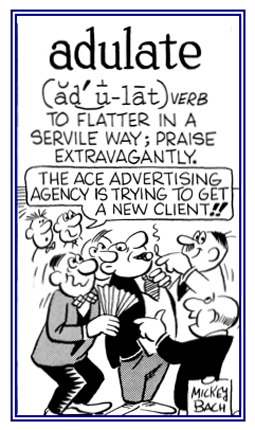
adulate (verb), adulates; adulated; adulating
To show excess devotion to someone or to express obsequious admiration by making a big fuss about the person: Sam was overdoing it when he adulated on and on about his supervisor during the business meeting.
© ALL rights are reserved.
Go to this Word A Day Revisited Index
Go to this Word A Day Revisited Index
so you can see more of Mickey Bach's cartoons.
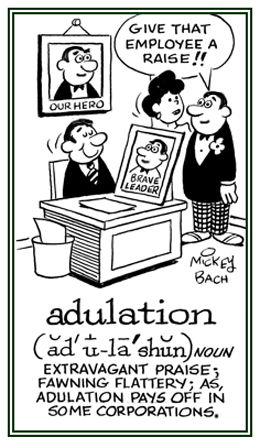
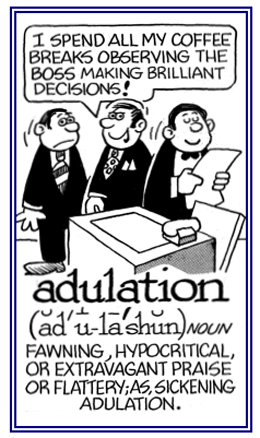
1. Excessive flattery, praise, or admiration beyond the normal manner, especially when done in a servile way: In hopes of getting a substantial raise, Manfred sent his boss a fawning e-mail filled with adulations and an invitation to go for a coffee break together.
2. Abject adoration or great admiration and praise: The critic expressed her adulation and enthusiasm in the local newspaper regarding the dramatic production at the local theater the weekend before.
3. Etymology: from Latin adulationem and adulatio, "a fawning; great flattery", a noun of action from aduliari, "to gratify the vanity of"; from ad-, "to" + ulos, "tail".
© ALL rights are reserved.
© ALL rights are reserved.

© ALL rights are reserved.
Go to this Word A Day Revisited Index
2. Abject adoration or great admiration and praise: The critic expressed her adulation and enthusiasm in the local newspaper regarding the dramatic production at the local theater the weekend before.
3. Etymology: from Latin adulationem and adulatio, "a fawning; great flattery", a noun of action from aduliari, "to gratify the vanity of"; from ad-, "to" + ulos, "tail".
If you were to imagine a dog wagging its tail to get a treat or to show a lot of friendly behavior, you're thinking is correct. Adulation is considered to be one of the more doglike characteristics of human behavior.
Go to this Word A Day Revisited Index
so you can see more of Mickey Bach's cartoons.
A person who uses flattery and clichés or superficial compliments in order to please another person or a group of people: After an adulator introduced a politician with many complimentary words of praise, the candidate stood up and told the audience that after hearing so many wonderful things about his person, he could hardly wait to hear himself start his speech!
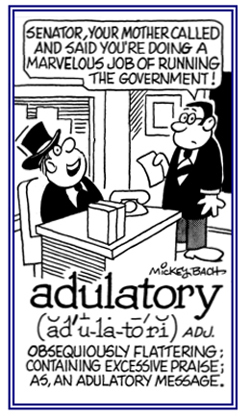
adulatory (adjective), more adulatory, most adulatory
Descriptive of a tendency to insincerely praise someone with flattery and being excessively willing to do almost anything to please that person: Often when foreign officials meet, there is a tendency to exchange adulatory comments that are full of platitudes or overused words and feigned or false praise.
© ALL rights are reserved.
Go to this Word A Day Revisited Index
Go to this Word A Day Revisited Index
so you can see more of Mickey Bach's cartoons.
1. Someone who commits fornication or extramarital relations between partners who are not married to each other: As soon as Mary found out that her husband was cheating on her, she called him an adulterer, along with many other terms, and threw him out of the house!
2. Etymology: from Old French fornication, from Late Latin fornicationem (fornicatio; from fornicari "to fornicate"; from Latin fornix, "brothel"; originally "arch, vaulted chamber"; from fornus "arched or domed shape".
2. Etymology: from Old French fornication, from Late Latin fornicationem (fornicatio; from fornicari "to fornicate"; from Latin fornix, "brothel"; originally "arch, vaulted chamber"; from fornus "arched or domed shape".
Roman prostitutes commonly solicited customers from under the arches of certain buildings and therefore "fornication" means "intimate relations between an unmarried man and an unmarried woman"; extended in the Bible as "adultery".
The fact of being darkened or overshadowed: The adumbration of Ruth's marriage was caused when her sister stated that she was going to leave the country the following day.
advance (verb), advances; advanced; advancing
1. To move forward in a meaningful way: At the box office at the movies, the people advanced slowly in order to buy their tickets to the show.
2. To present something, such as a proposal: After listening to the others in the meeting, Nancy advanced or suggested interviewing the tenants first before making a final decision.
3. To supply something or part of something, especially money before it is due: Because Stella wanted to buy a very special purse for her outfit, she asked her parents to advance her allowance one month so she could buy it!
4. To rise, or to make or help someone rise, in rank: Floyd had a chance to advance to a better-paid position in his firm, so he filled out the application and gave it to his boss for consideration.
5. To make something happen earlier than originally expected: The Robinsons wanted to advance their dinner party at their home because of the upcoming renovations of their house.
6. Etymology: from Latin abante, "before" which was based on ab-, "from" and ante, "before".
2. To present something, such as a proposal: After listening to the others in the meeting, Nancy advanced or suggested interviewing the tenants first before making a final decision.
3. To supply something or part of something, especially money before it is due: Because Stella wanted to buy a very special purse for her outfit, she asked her parents to advance her allowance one month so she could buy it!
4. To rise, or to make or help someone rise, in rank: Floyd had a chance to advance to a better-paid position in his firm, so he filled out the application and gave it to his boss for consideration.
5. To make something happen earlier than originally expected: The Robinsons wanted to advance their dinner party at their home because of the upcoming renovations of their house.
6. Etymology: from Latin abante, "before" which was based on ab-, "from" and ante, "before".
1 A superior or favorable position in relation to someone or something: Henry was hoping to gain an advantage in his negotiations with the company.
2. A circumstance or factor that places a person in a favorable position in relation to another individual or to other people: Janet had an advantage over the other applicants in that she could speak 5 different languages fluently, and so she got the job right off!
3. Etymology: from Old French avant, "before"; from Latin abante, "before".
2. A circumstance or factor that places a person in a favorable position in relation to another individual or to other people: Janet had an advantage over the other applicants in that she could speak 5 different languages fluently, and so she got the job right off!
3. Etymology: from Old French avant, "before"; from Latin abante, "before".

