
mne-, mnem-, mnemon-, mnes-, -mnesia, -mnesiac, -mnesic, -mnestic
(Greek: memory, to remember; recollection of something or someone; awareness, consciousness of the present and the past)
1. Failure of the memory to call up the images of sounds: The doctor diagnosed a severe case of acousmatamnesia for Kerri and he had no suggestion as to how he could help her.
2. The inability to recall and to identify certain sounds: Eugene could see Sara struggle with her acousmatamnesia as she tried to remember how to pronounce the sounds of the alphabet.
2. The inability to recall and to identify certain sounds: Eugene could see Sara struggle with her acousmatamnesia as she tried to remember how to pronounce the sounds of the alphabet.
amnemonic (adjective); more amnemonic, most amnemonic
Characterizing a loss of memory; amnesic: Judy's grandmother was told by her doctor that she was mnemonic because she suffered from faulty recollections of the past and couldn't remember important facts about herself.
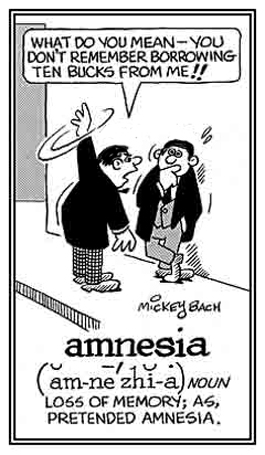
A partial or a total loss of or an inability to remember: Tom's mother's amnesia was shown by her incapability to recall past experiences or being unable to remember who he was.
© ALL rights are reserved.

© ALL rights are reserved.
Go to this Word A Day Revisited Index
Amnesias may exist for some people because of shocks, psychological disturbances, brain injuries, certain kinds of illnesses, or just old age.
Go to this Word A Day Revisited Index
for a list of additional Mickey Bach illustrations.
Someone who is afflicted with a partial or a total loss of memory: Amnesiacs and their conditions are usually results of shocks, psychological disturbances, brain injuries, illnesses, etc.
amnesic (adjective) (not comparable)
A reference to a person who has a loss of memory or a fragmentary loss of memory: Jo's father was an amnesic patient in the retirement home and was quite unmindful when going outside for a walk in winter by totally forgetting to put on any type of winter clothing.
1. The panic a person has of not being able to remember things, which is commonly related to the development of Alzheimer’s disease: Becky's mother developed an amnesiophobia after a head injury caused by the car accident and wanted to write down everything so she wouldn't forget important dates, places, names of friends, etc.
2. There are essentially two basic types of forgetfulness that people are afraid of:
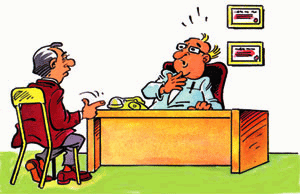
No, doctor, I don't ever remember having amnesia.
2. There are essentially two basic types of forgetfulness that people are afraid of:
- The inability to form new recollections in which the individual either does not consolidate what is perceived into permanent retention storage or cannot retrieve recent memories.
- The loss of remembering certain events that occurred before this mental disturbance started.
amnestic (adjective); more amnestic, most amnestic
1. A reference to something that causes a loss of memory: Some diseases, poisonous agents, etc. are amnestic reasons for not remembering what has happened in the past.
2. Of or relating to the current or previous medical history of a patient: Goren's amnestic conditions have been recorded in her medical doctor's files.
2. Of or relating to the current or previous medical history of a patient: Goren's amnestic conditions have been recorded in her medical doctor's files.
1. A decision by officials that certain people will not be punished or that a specific group will be permitted to go free: The government granted amnesty for all of the political prisoners.
2. A general overlooking or pardon of past offenses by a ruling authority: The local library declared that there would be an amnesty from fines for all DVDs and books that are returned by a specified date.

© ALL rights are reserved.
Go to this Word A Day Revisited Index
2. A general overlooking or pardon of past offenses by a ruling authority: The local library declared that there would be an amnesty from fines for all DVDs and books that are returned by a specified date.
Go to this Word A Day Revisited Index
so you can see more of Mickey Bach's cartoons.
The recollections of things that have happened in the past; reminiscences; remembering: Adam was visiting his grandmother and she was telling him about the anamneses that took place when she was younger.
anamnestic (adjective); more anamnestic, most anamnestic
1. Descriptive of summoning back or the retrieval of a person's memories: The original, philosophical meaning of anamnestic things or times involved the taking of recollections from an individual's past existences and using them in his or her current life with rational thoughts and true knowledge.
2. Relating to the proposed equivalent of devices that exist for remembering something: This term can also apply to a patient's medical history when a doctor takes notes on someone's anamnestic conditions during his or her first visit.
3. Etymology: Anamnestic is a Greek word that refers to "a calling to mind," from the roots ana-, "back," and mimneskesthai, "to recall" or "to cause to remember."
2. Relating to the proposed equivalent of devices that exist for remembering something: This term can also apply to a patient's medical history when a doctor takes notes on someone's anamnestic conditions during his or her first visit.
3. Etymology: Anamnestic is a Greek word that refers to "a calling to mind," from the roots ana-, "back," and mimneskesthai, "to recall" or "to cause to remember."
antimnemonic (adjective); more antimnemonic, most antimnemonic
A reference to something that is intentionally hard to remember: Antimnemonic features of a password make it complicated and should nevertheless be memorised by the owner rather than just have it written down so no one else can see and use it!
An unsteadiness, incoordination, or disorganization of movements of the body in the absence of paralysis: Symptoms of ataxiamnesia include mental confusion, vision impairment, stupor, coma, hypothermia, hypertension and daytime drowsiness.
ataxiamnestic (adjective); more ataxiamnestic, most ataxiamnestic
A reference to mental confusion, poor vision, a coma, hypertension and daytime sleepiness: Greg's grandfather was certainly ataxiamnestic because he was often very drowsy and very tired during the normal hours of sunlight between dawn and dusk.
A clinical history which is provided by the patient; especially, a psychiatric history: When Sam's father went to Dr. Smithson, he was asked to provide an autoanamnesis so that he, Dr. Smithson, could prepare himself for the visits that would follow in order to help him in a successful way.
The spontaneous revival of memories of an earlier condition of one's life without any marked associative circumstance: When the two older ladies went to the seaside for a short vacation, one of the ladies, Mrs. Johnson, experienced an automnesia when she suddenly remembered her son as a toddler playing with small figures beside their house.
