
mne-, mnem-, mnemon-, mnes-, -mnesia, -mnesiac, -mnesic, -mnestic
(Greek: memory, to remember; recollection of something or someone; awareness, consciousness of the present and the past)
A good memory for events of the recent past: Ted certainly possessed neomnesia when he studied for the test only the day before and got 100% on it!
The possession of a superb memory for events of the distant past: Maggie's grandmother was not demented at all and could remember all the little things she did as a child, so she certainly enjoyed paleomnesia in her old age!
A memory for past events or experiences: Most people are able to use their palinmnesia for remembering important facts, names, places, and occurrences from former times in their lives.
The belief that all mental impressions will remain for a long time in the memory of a person: Janet's doctor said that she would reap the benefits of having panmnesia her whole life as long as she stayed healthy, and she would be able to tell her grandchildren about all of her adventures as a child!
1. Remembrance of everything a person has ever learned: Even though George's mother was 95 years old, she still had an excellent pantomnesia about her children from the time when they were born until they were adults.
2. Etymology: from Greek panto-, "always" + mnesia, "memory".
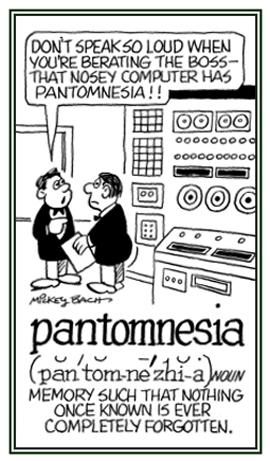
© ALL rights are reserved.
Go to this Word A Day Revisited Index
2. Etymology: from Greek panto-, "always" + mnesia, "memory".
Go to this Word A Day Revisited Index
so you can see more of Mickey Bach's cartoons.
1. A distortion of memory in which facts and imaginations are confused: Jane's dream was so real that she thought that she was in Canada visiting her daughter, but after waking up the next morning, she realized that she was still in Germany, and this bafflement must have been a case of paramnesia!
2. Disordered or perverted memory, especially of the meaning of words: Maybe Aunt Mary was getting so old that she was suffering from paramnesia and just couldn't understand what Sally was telling her, although she was using just simple terms to explain herself.
3. False recollections, as of events that have never occurred: Doug was positive that he left his keys in the bowl beside the front door but, even though he searched everywhere, he didn't find them there but in the kitchen drawer, and his wife was sure that he experienced a bout of paramnesia!
2. Disordered or perverted memory, especially of the meaning of words: Maybe Aunt Mary was getting so old that she was suffering from paramnesia and just couldn't understand what Sally was telling her, although she was using just simple terms to explain herself.
3. False recollections, as of events that have never occurred: Doug was positive that he left his keys in the bowl beside the front door but, even though he searched everywhere, he didn't find them there but in the kitchen drawer, and his wife was sure that he experienced a bout of paramnesia!
Impairment of memory that is characteristic of old age: Since Albert was already 99 years old, it was no wonder that he was afflicted with presbymnemia and couldn't remember certain dates and places where he had been when he was younger.
The paradoxical sensation of recollecting a scene which is only now occurring for the first time; déjà vu; already seen: While riding in the car, Thomas was sure he had observed the same river, the same houses, and the same people walking along the streets before although he was traveling in a perfectly new area where he had never been before and was certain that he was experiencing a case of promnesia!
Science fiction is usually where examples of promnesia are found
One of the best examples of promnesia is found in novelist Morgan Robertson's novel, Futility, printed in 1898.
Published fourteen years before the ship named the Titanic sank in history's most famous marine disaster, the novel told of a great "unsinkable" luxury liner named the Titan which sank on its maiden voyage after hitting an iceberg, with the loss of almost all of its passengers because there weren't enough lifeboats aboard.
There were at least ten other promnesias in the novel which were applicable to the real tragedy which took place with the Titanic; and remember, the novel was published fourteen years before the actual disaster!
A recollection of events that have never taken place or of things that have never existed; a false memory: Dr. Smith's psychiatric patient, who was having a case of pseudomnesia, was sure he had been in Australia on vacation with his wife and had such vivid memories of being there, although, in reality, he had never been to that continent at all!
The loss or the lack of the ability to understand the form and nature of objects that are touched; astereognosis: Since Judy had tactile amnesia she was unable to determine the shape of physical items, gadgets, or articles when feeling them with her fingers.
Poor recollections about events of a distant past: Linda's great-grandmother was so very old and so many years had past that she was experiencing telamnesia and couldn't remember occurrences that had happened a long time ago.
In psychiatry, the acquisition of consciousness of matters in the recall or remembrances of another person: Strangely enough, the creature from outer space had the power of knowing the past experiences of some selected beings on Earth by possessing telemnemonike!
