
dis-, di-, dif-
(Latin: separation, apart, asunder; removal, away, from; negation, deprivation, undoing, reversal, utterly, completely; in different directions)
The meaning of dis- varies with different words; dif-, assimilated form of dis- before f; di-, form of dis- before b, d, g, l, m, n, r, and v.
disconnect
disconsolate (adjective), more disconsolate, most disconsolate
Pertaining to being utterly dejected, cheerless, forlorn, or gloomy: Survivors of the tornadoes were even more disconsolate when they saw the destruction that resulted.
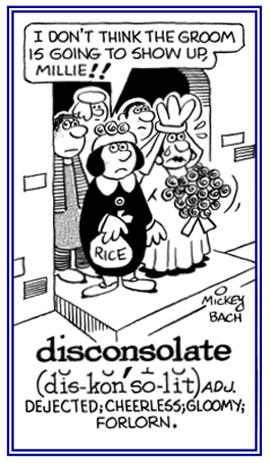
© ALL rights are reserved.
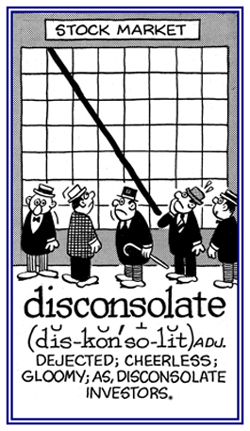
© ALL rights are reserved.
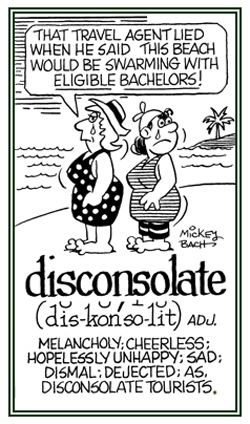
© ALL rights are reserved.
Go to this Word A Day Revisited Index
Go to this Word A Day Revisited Index
so you can see more of Mickey Bach's cartoons.
discontent
discontentedly
discontentedness
discontinue
discontinuous
discontinuously
A disease of a disk, especially of an invertebral disk: Gary had pains in his back and his doctor described it as being a case of discopathy, an illness of a fibrocartilaginous disk situated between the vertebrae of his backbone.
1. Strife, tension, or without agreement among people, or groups.
2. Harsh or confusing because of a bad intermingling of sounds.
2. Harsh or confusing because of a bad intermingling of sounds.
1. The lack of agreement or harmony by people or groups of people.
2. In music, a combination of inharmonious sounds or tones.
2. In music, a combination of inharmonious sounds or tones.
discordant (adjective), more discordant, most discordant
1. Conflicting or disagreeable and not getting along with each other: "The discordant views of Fred Brown, and his son Luis, resulted in many arguments between them."
2. Harsh or unpleasant sounds: "The students were playing discordant music at the beginning of the semester and then, later in the school year, they were much more harmonious."
2. Harsh or unpleasant sounds: "The students were playing discordant music at the beginning of the semester and then, later in the school year, they were much more harmonious."
discordantly
discordantness
discount (verb), discounts; discounted; discounting
1. To deduct or subtract from a cost or the price of something.
2. To purchase or to sell (a bill, note, or other commercial paper) at a reduction equal to the amount of interest that will accumulate before it matures.
3. To lend money on (a commercial paper not immediately payable) after deducting the interest.
4. To sell or offer something for sale at a reduced price.
5. To reduce in quantity or value.
6. To underestimate the significance or effectiveness of something or someone; to minimize: "Her husband took care not to discount his wife's accomplishments."
7. To regard with doubt or disbelief.
2. To purchase or to sell (a bill, note, or other commercial paper) at a reduction equal to the amount of interest that will accumulate before it matures.
3. To lend money on (a commercial paper not immediately payable) after deducting the interest.
4. To sell or offer something for sale at a reduced price.
5. To reduce in quantity or value.
6. To underestimate the significance or effectiveness of something or someone; to minimize: "Her husband took care not to discount his wife's accomplishments."
7. To regard with doubt or disbelief.

