
para-, par-
(Greek: by the side of, beside, past, beyond; contrary, wrong, irregular, abnormal)
parapsychosis
paraselene
1. A bright moonlike spot on a lunar halo; a mock moon. Also called moondog.
2. A mock moon; an image of the moon which sometimes appears at the point of intersection of two lunar halos.
2. A mock moon; an image of the moon which sometimes appears at the point of intersection of two lunar halos.
parasitaster
A mean or sorry parasite.
1. An organism that lives on another body or in another species, known as the host, of which it obtains nutriments: Mistletoe is a parasite that lives on trees and is used in some cultures as a holiday decoration in homes.
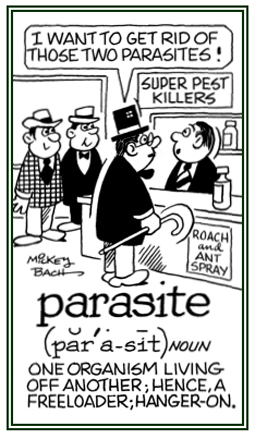
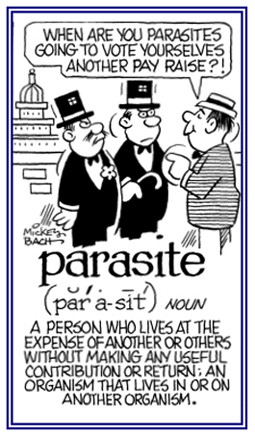
2. A person who receives support, advantage, or the like, from another or others without returning anything useful; such as, anyone who lives on the hospitality of others: Some citizens are of the opinion that people who are receiving financial support from the government for doing nothing in return are really useless parasites and should be forced to work.
3. In ancient Greece, a person who received free meals in return for amusing or making flattering remarks, etc.: Some royal courts in ancient Greece employed parasites to entertain them with music or to provide humorous conversations.
4. From Latin parasitus, from Greek parasitos "someone who eats at the table of another"; "feeding beside" from para- "beside" + sitos "food".
© ALL rights are reserved.
© ALL rights are reserved.
Go to this Word A Day Revisited Index
2. A person who receives support, advantage, or the like, from another or others without returning anything useful; such as, anyone who lives on the hospitality of others: Some citizens are of the opinion that people who are receiving financial support from the government for doing nothing in return are really useless parasites and should be forced to work.
3. In ancient Greece, a person who received free meals in return for amusing or making flattering remarks, etc.: Some royal courts in ancient Greece employed parasites to entertain them with music or to provide humorous conversations.
4. From Latin parasitus, from Greek parasitos "someone who eats at the table of another"; "feeding beside" from para- "beside" + sitos "food".
Go to this Word A Day Revisited Index
so you can see more of Mickey Bach's cartoons.
The presence of parasites (especially malarial parasites) in the blood: Jill was diagnosed with parasitemia of malaria which didn't_cause any fever, but nevertheless she had to stay in hospital until she was healthy again.
parasitic (adjective),more parasitic, most parasitic
1. Of, relating to, or characteristic of a parasite: In medical school, Sam took a course in parasitic diseases.
Parasitic illnesses or disorders can be caused by or result from the effects of parasites.
2. Relating to or having the practice of a parasite: Parasitic plants and animals live on or inside bigger plants or animals and thrive on them.
parasitical (adjective), more parasitical, most parasitical
1. Of the nature of a parasite; fawning for food or favors; sycophantic: Lynn_s neighbors seemed to be quite parasitical because they often asked for help or some food they had forgotten to buy, but they always said "no" when Lynn wanted some help from them.
2. Of or pertaining to parasites; living on, or deriving nourishment from, some other living animal or plant: Mary was diagnosed with parasitical worms which she evidently aquired while she was on a camping trip in Italy.
2. Of or pertaining to parasites; living on, or deriving nourishment from, some other living animal or plant: Mary was diagnosed with parasitical worms which she evidently aquired while she was on a camping trip in Italy.
parasiticidal (adjective) (not comparable)
Pertaining to an agent that is capable of expelling or destroying parasites; such as, parasitic worms: After Sally was diagnosed with a case of tape worms, she got a prescription for a parasiticidal medication which she could get at the pharmacy.
An agent or preparation that destroys or kills, parasites: Mrs. Kilfoil bought some parasiticide that her doctor prescribed, to cure her of a case of a parasitic skin infection.
An organism that serves as the host of a parasite: In his biology class at school, Tom learned that a parasite could live off a parasitifer for a long time and finally kill it if it is not cured before that.
1. Symbiosis in which one population (or individual) adversely affects the other, but cannot live without it: Parasitism is the interaction between two organisms whereby one of them, the parasite, benefits at the cost of the host.
2. Infection or infestation with parasites: Jane wondered why her favorite plant was dying and then she saw that it had a bad case of parasitism.
3. Etymology: "a hanger-on, a toady, a person who lives on others", from Middle French (about 1400 to 1600) parasite; from Latin parasitus, from Greek parasitos, "person who eats at the table of another"; from para-, "beside" + sitos, "food".
2. Infection or infestation with parasites: Jane wondered why her favorite plant was dying and then she saw that it had a bad case of parasitism.
3. Etymology: "a hanger-on, a toady, a person who lives on others", from Middle French (about 1400 to 1600) parasite; from Latin parasitus, from Greek parasitos, "person who eats at the table of another"; from para-, "beside" + sitos, "food".
The scientific meaning of "animal" or "plant that lives on others" is first recorded in 1646.
Infection or infestation with a parasite or parasites: Greg found a book on parasitization which he could use in a report on parasites in his biology class.
parasitize (verb), parasitizes; parasitized; parasitizing
To live on or in a host: Such organisms as tapeworms, roundworms, and protozoans parasitize such as, a parasite their hosts (animals or plants) in order to live. .
parasitogenic

