sitio-, siti-, sito-, sit-, -sitia +

(Greek: food; eating; appetite)

hemiparasite (s) (noun), hemiparasites (pl)
A plant, that obtains some nourishment from its host but also photosynthesizes; semiparasite: The mistletoe can be considered to be a hemiparasite.

A hemiparasite is an organism that can live either independently or as a parasite.

holoparasite (s) (noun), holoparasites (pl)
A nonphotosynthetic parasite that must obtain carbohydrates found in the host plant phloem (food-conducting tissue of a plant): A holoparasite is a parasitic flowering plant that lacks chlorophyll (nonphotosynthetic) and must rely totally on the contents of the xylem (woody part of plants; supporting and water-conducting tissue) and the phloem of the host plant.
hyperparasite (s) (noun), hyperparasites (pl)
An organism that is parasitic on or in another parasite: The chalcid wasp is a hyperparasite that feeds on the cocoons of a a braconid wasp which is also a parasite.

A hyperparasite is a secondary parasite capable of development within a previously existing parasite.

A hyperparasite is one that preys on another parasite.

macroparasite (s) (noun), macroparasites (pl)
A parasite that is big enough to be visible to the "naked" eye: Two examples of macroparasites are the louse and the intestinal worm,
microparasite (s) (noun), microparasites (pl)
An extremely tiny microorganism: A microparasite lives as a parasite on other organisms and which is too small to be seen with the "naked" eye.
necroparasite (s) (noun), necroparasites (pl)
A parasite that grows on dead organic organisms, either plant or animal: A necroparasite decomposes nonliving organic matter to obtain nutrients that are then absorbed through cell membranes.
nosoparasite (s) (noun), nosoparasites (pl)
A pathogenic parasite that attacks only already diseased tissues: A nosoparasite is an organism associated with a particular disease and able to modify its coarse, but not serving ing as the actual causal agent.

Or to put it another way: a microorganism found in conjunction with a disease process that, while capable of modifying the course of the disease, is not its cause.

omphalosite (s) (noun), omphalosites (pl)
One of a pair of conjoined twins of unequal size that is smaller and parasitic and that receives its blood supply by way of the larger twin: In comparison to an autosite, the omphalosite is smaller and thrives on its larger member in order to develop and continue to live.
parasite (s) (noun), parasites (pl)
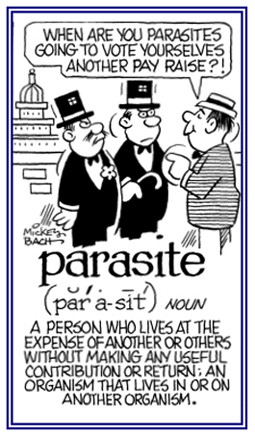
1. An organism that lives on another body or in another species, known as the host, of which it obtains nutriments: Mistletoe is a parasite that lives on trees and is used in some cultures as a holiday decoration in homes.
2. A person who receives support, advantage, or the like, from another or others without returning anything useful; such as, anyone who lives on the hospitality of others: Some citizens are of the opinion that people who are receiving financial support from the government for doing nothing in return are really useless parasites and should be forced to work.
3. In ancient Greece, a person who received free meals in return for amusing or making flattering remarks, etc.: Some royal courts in ancient Greece employed parasites to entertain them with music or to provide humorous conversations.
4. From Latin parasitus, from Greek parasitos "someone who eats at the table of another"; "feeding beside" from para- "beside" + sitos "food".
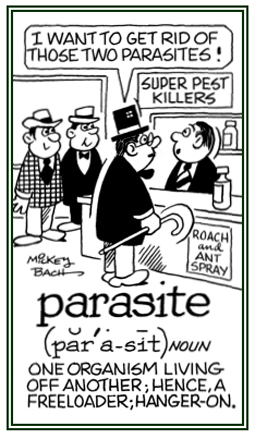
Freeloaders or hangers-on living off another.
© ALL rights are reserved.

Those who live at the expense of others without making any useful contributions.
© ALL rights are reserved.

Go to this Word A Day Revisited Index
so you can see more of Mickey Bach's cartoons.

parasitemia, parasitaemia (s) (noun); parasitemia; parasitaemias (pl) (
The presence of parasites (especially malarial parasites) in the blood: Jill was diagnosed with parasitemia of malaria which didn't_cause any fever, but nevertheless she had to stay in hospital until she was healthy again.
parasitic (adjective),more parasitic, most parasitic
1. Of, relating to, or characteristic of a parasite: In medical school, Sam took a course in parasitic diseases.

Parasitic illnesses or disorders can be caused by or result from the effects of parasites.
2. Relating to or having the practice of a parasite: Parasitic plants and animals live on or inside bigger plants or animals and thrive on them.

parasitical (adjective), more parasitical, most parasitical
1. Of the nature of a parasite; fawning for food or favors; sycophantic: Lynn_s neighbors seemed to be quite parasitical because they often asked for help or some food they had forgotten to buy, but they always said "no" when Lynn wanted some help from them.
2. Of or pertaining to parasites; living on, or deriving nourishment from, some other living animal or plant: Mary was diagnosed with parasitical worms which she evidently aquired while she was on a camping trip in Italy.
parasiticidal (adjective) (not comparable)
Pertaining to an agent that is capable of expelling or destroying parasites; such as, parasitic worms: After Sally was diagnosed with a case of tape worms, she got a prescription for a parasiticidal medication which she could get at the pharmacy.
parasiticide (s) (noun), parasiticides (pl)
An agent or preparation that destroys or kills, parasites: Mrs. Kilfoil bought some parasiticide that her doctor prescribed, to cure her of a case of a parasitic skin infection.
parasitifer (s) (noun), parasitifers (pl)
An organism that serves as the host of a parasite: In his biology class at school, Tom learned that a parasite could live off a parasitifer for a long time and finally kill it if it is not cured before that.

Cross references of word families that are related directly, or indirectly, to: "food, nutrition, nourishment": alimento-; broma-; carno-; cibo-; esculent-; tropho-; Eating Crawling Snacks; Eating: Carnivorous-Plant "Pets"; Eating: Folivory or Leaf Eaters; Eating: Omnivorous.