
itiner-, it-, -it
(Latin: to go, to walk away; to travel, to journey, a journey)
2. Etymology: from Latin aditus, "access"; from the past participle of ad1re, "to approach"; from ad-, "to, toward" + ire, "to go".
2. The object, state, goal, or result aspired or sought after: To be a professional baseball player has been Jim's life-time ambition.
3. A need or urge for an activity: Jerry and Jane have no ambition to go dancing this evening; so, they are staying home.
Word History
Even in ancient Rome candidates for public office went around soliciting votes. This activity was indicated by the word ambitio, "a going about, going around".
Ambitio was derived from ambire, "to go about", which in turn was formed from amb-, "about", and ire, "to go". Since this activity indicated a desire for honor or power, the word ambitio came to mean the desire for official honors.
This word was borrowed in French and English as ambition, and its meaning broadened to denote the earnest desire for achievement.
2. A reference to an aim or objective that someone is trying to attain or to accomplish: The teacher, Mr. Evans, told his classes that ambitious students make the best grades

The scheme, or master plan, of the kingdom of Saudi Arabia to build five new cities gives the term ambitious a new meaning.
2. In a manner showing the desire for personal advancement and may suggest equally a praiseworthy desire.
2. A circular journey or one which begins and ends at the same place; around: the Lawson's began their trip in Covina, and after a couple of months completed the circuit back at home in Covina.
3. A roundabout journey or course: Because of the construction site and roads being closed, Jeff had to take a long circuit to his place of work.
4. A periodical journey from place to place to perform certain duties: Circuits can be exemplified by judges who hold court, ministers who preach, or salespeople covering a route.
A circuit can be the route followed, places visited, or districts covered by people who make journeys to perform their duties.
5. The line going around or bounding any area or object; the distance around an area or object: Sam read in the newspaper that the circuit of the lake was about 10 miles.
6. The space within a bounding line or district: The circuit of the valley was a beautiful drive.
7. In the electrical field, the complete path of an electric current: The circuit includes the generating apparatus, intervening resistors, or capacitors.
8. In telecommunications, a means of transmitting communication signals or messages: Such a circuit usually consists of two channels for interactive communication.
9. A number of theaters, nightclubs, etc., controlled by the same owner or manager: Circuits can also be visited in turn by the same entertainers or acting companies.
10. Etymology: from about 1382, Old French circuit, from Latin circuitus, "a going around", from the stem of circuire, circumire, "to go around", from circum, "around" + -ire, "to go".
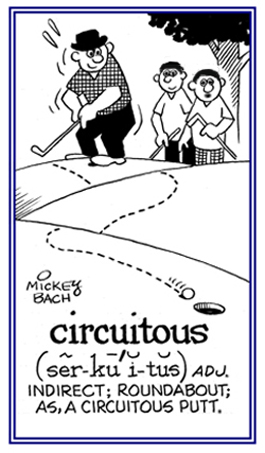
2. Regarding a deviation from a straight course or a direct procedure: Betty's father took a circuitous drive to avoid the rush-hour traffic.

Go to this Word A Day Revisited Index
so you can see more of Mickey Bach's cartoons.
2. Descriptive of responding indirectly or not to the point.
"It may be a rare occurrence, but sometimes snow, rain, and sleet will all come down concomitantly."
2. Etymology: "a title of nobility"; 1258, from Old French conte, from Latin comitem, comes, "companion, attendant"; literally, "someone who goes with"; the Roman term for a provincial governor, from com-, "with" + ire, "to go".
2. A woman who holds the rank of count or earl.
