
hiat-; -hisc-

(Latin: to stand open, to split; opening, aperture, gap; to yawn)

dehisce (verb), dehisces; dehisced, dehiscing
1. To open in definite places: Some plants dehisce or discharge seeds, pollen, or other contents, as the bursting of ripe capsules.
2. To rupture or to break open, as a surgical wound: A surgical wound may partially or completely dehisce after surgery, depending upon whether some or all of the layers of tissue come open.
3. Etymology: from Latin dehiscere, "to split open", and from hiscere, "to gape, to yawn"; from Latin hiare, "to yawn".
dehiscence (s) (noun), dehiscences (pl)
1. The spontaneous or natural bursting open at the maturity of a plant structure: Dehiscencecan be exemplified by a fruit, anther, or sporangium, that releases its contents.
2. A rupture, bursting open, or splitting open, as of a surgical wound, or of an organ or structure to discharge its contents: A dehiscence is a complication of surgery which takes place in a secondary to poor wound healing.

Risk factors of dehiscences include diabetes, advanced age, obesity, and trauma during the post-surgical period.

3. Etymology: from Latin dehiscere, "to split open"; from hiscere, "to gape, to yawn", and from Latin hiare, "to yawn".

The word dehiscence is one of the most vexing words in the surgeon's vocabulary. When a post-operation patient has a dehiscence, one or more of the tissue layers of the incision have come apart. In a worst scenario, underlying organs; such as, the gut, lung, etc. bulge out of the wound.

—Compiled from information seen in
Wordsmith, Anu Garg; [email protected];
AWAD (A Word a Day) Mail Issue 221; August 6, 2006.
dehiscent (adjective), more dehiscent, most dehiscent
1. Pertaining to something that breaks open when mature in order to release its contents: Many plants have dehiscent seed pods that open to release their seeds when they reach final development.
2. A reference to the splitting open of a partially healed surgery: There are times when a surgical incision, which has been closed with sutures or clips, becomes a dehiscent wound when it breaks open before it heals.
hiant (adjective), more hiant, most hiant
1. Referring to something that is gaping or open: Joe went to the medical clinic so a doctor could treat his laceration or hiant wound which was bleeding and needed immediate emergency treatment.
2. Etymology: from Latin hians and hiare, "to gape or to open wide">
hiatal (adjective), more hiatal, most hiatal
Relating to a large opening, aperture, or perforation: A hiatal hernia is an anatomical abnormality in which part of the stomach protrudes through a diaphragm (large muscle between the lungs and the stomach that helps people to breathe) and up into the chest.
hiation (s) (noun), hiations (pl)
An opening or gap in an organ of the body: One example of a hiation is the opening in the diaphragm (muscular separation of the stomach and the tube that moves food from the mouth to the stomach) and the thoracic cavities (area between the neck and the diaphragm).
hiatopexia (s) (noun), hiatopexias (pl)
The protrusion of a stomach part through the diaphragm into the chest area: Normally a hiatopexia remain undetected and causes no problems
hiatopexy (s) (noun), hiatopexies (pl)
A surgical procedure to repair a space, gap, or widened opening; usually employing sutures: The procedure of a hiatopexy Involves the correction of the hiatal hernia.
hiatus (s) (noun), hiatuses (pl)
1. A gap or a large opening or an interruption in space, time, or continuity: The concert series has to take a hiatus because the concert hall burnt down the previous week.
2. A slight pause occurring when two adjacent vowels in consecutive syllables are pronounced, as in "duality": In Voni's English class she learned that the terms "naive" and "cooperate" were two good examples of hiatuses.
3. In anatomy, a separation, aperture, fissure, or short passage in an organ or a body part: The spinal cord passes through the hiatus, a large opening called the foramen magnum, which is located at the base of the cranium.
4. In printing, a space where something is missing; especially, in manuscripts: The scholars detected a hiatus, or a lost passage in the medieval writings which they were trying to transcribe.
5. Etymology: from Latin hiatus, "opening, rupture, gap", from hiare, "to gape, to stand open"; "a break or opening in a material object".
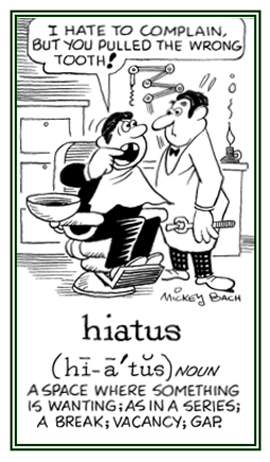
A space where something is missing.
© ALL rights are reserved.

Go to this Word A Day Revisited Index
so you can see more of Mickey Bach's cartoons.

indehiscence (s) (noun) (no pl)
The condition of remaining closed when matured: The indehiscence of the heads of cereal was important for the farmer because it wouldn't shed the grain when gathering it.
indehiscent (adjective) (not comparable)
Not splitting open at maturity: Some plants are indehiscent in that the fruits do not open spontaneously at maturity to release seeds and are hard, dry, and hold onto the seeds.

Some types of vegetation are indehiscent because they lack a distinct opening mechanism, like spores that shed by irregular rupture or breakdown of the capsule walls.

iris dehiscence (s) (noun), iris dehiscences (pl)
A defect of the eye characterized by multiple holes in the iris: Iris dehiscenceobstructs the integrity of the colored part of the eye that can cause an irregularly shaped pupil or dispersed or sprinkled light that enters the eye.
root dehiscence (s) (noun), root dehiscences (pl)
A loss of the buccal or lingual bone overlaying the root portion of a tooth: Root dehiscence is a dental condition which leaves the area of the lost bony covering with by soft tissue only.

Pointing to a page about standing open, gap, opening, yawning Another gaping, yawning unit.


A cross reference of other word family units that are related directly, indirectly, or partially with: "opening, hole, cavity, tract, tube": alveolo-; antro-; anu-; celo-; coelio-; concho-; fenestra-; hernio-; meato-; ora-; parieto-; poro-; pyl-, pyle-; pylor-; sphinctero-; splanchn-; stomato-; syringo-; uretero-; urethro-; vagino-; ventricul-.