
circum-
(Latin: around, about, surrounding, closed curve, circling, circular on all sides; literally, "in a circle")
1. A diacritical mark (^) placed above a vowel in some languages to indicate a special phonetic quality: In some languages, a circumflex is above an alphabetical symbol in order to indicate a specific pronunciation, usually different from that of the unaccented letter. Circumflexes may be written over vowels as in French or over consonants as in Esperanto.
2. Curving around: Blood vessels are one kind of a circumflex in the body.
3. Etymology: from Latin circumflexus, past participle of circumflectere, "to bend around" + flectere, "to bend".
2. Curving around: Blood vessels are one kind of a circumflex in the body.
3. Etymology: from Latin circumflexus, past participle of circumflectere, "to bend around" + flectere, "to bend".
A mark or symbol that is used over a letter to show that it is pronounced in a certain way: For example, the circumflex accent of "o" as in "order" is (?r'duhr) or "circumflex" is (sûr' kuhm fl?ks').
1. The act of bending, or causing something to assume a curved form: A case of circumflexion can perhaps be exemplified by the stems and leaves of a plant that are drooping because they are too dry, and needs to be watered!
2. A winding about; a turning; a circuity; a fold: Jack viewed a drawing of a circumflexion of the intestines of a person in his book on anatomy.
2. A winding about; a turning; a circuity; a fold: Jack viewed a drawing of a circumflexion of the intestines of a person in his book on anatomy.
circumflexus (adjective), more circumflexus, most circumflexus
A reference to the form of the arc of a circle; bow-shaped: Circumflexus passages, arrangements, or formations of certain structures, such as blood vessels and nerves, are those that curve or bend around another part.
A flowing around on all sides; encompassing: During blizzards and storms, the little island underwent a period of circumfluence and the people huddled together at the highest point available!
circumfluent, circumfluous (adjective), more circumfluent, most circumfluent; mood circumfluous, most circumfluous
Pertaining to flowing all around or surrounding a place or something: After the very hot summer, the people in town enjoyed the cool circumfluent breezes moving throughout the area.
circumfulgent (adjective), more circumfulgent, most circumfulgent
Shining around or about.
circumfuse (verb), circumfuses; circumfused; circumfusing
1. To pour around; to diffuse.
2. To surround as with a fluid.
3. To spread something around something else.
2. To surround as with a fluid.
3. To spread something around something else.
1. The act of pouring or spreading around.
2. The state of being poured around.
2. The state of being poured around.
circumgemmal (adjective), more circumgemmal, most circumgemmal
A description of a form of nerve ending in which a bud like terminal is surrounded by nerve fibrils.
circumgyrate (verb), circumgyrates; circumgyrated; circumgyrating
1. To roll or to turn around.
2. To cause to perform a rotary or circular motion.
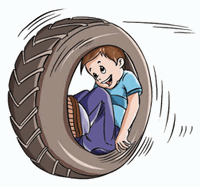
2. To cause to perform a rotary or circular motion.
A boy is having fun as he circumgyrates in a car tire.
1. The act of turning, rolling, or whirling around.
2. A revolution or circular movement.
3. The turning of a limb of the body in its socket.
2. A revolution or circular movement.
3. The turning of a limb of the body in its socket.
circuminsular (adjective), more circuminsular, most circuminsular
Relating to the encircling or situated at the periphery of the cerebral insula.
circumintestinal (adjective), more circumintestinal, most circumintestinal
Relating to the area that is situated at or occurring around the intestine.
circumjacent (adjective), more circumjacent, most circumjacent
1. Referring to surrounding, bordering on every side, or around: Hayden and Jennifer were visiting Paris and the more circumjacent areas in order to learn more about France.
2. Etymology: from Latin circumjacens, circumjacent-; from circumjacere, "to lie around"; from circum-, "round, around" + jacere, "to lie".
2. Etymology: from Latin circumjacens, circumjacent-; from circumjacere, "to lie around"; from circum-, "round, around" + jacere, "to lie".

