
ora-, or-, orat-; os- +
(Latin: oris, mouth, face; opening, entrance; talk, speak, say)
1. A speech, lecture, or other instance of formal or ceremonial public speaking: At the funeral, the pastor held an oration emphasizing the outstanding phases of Mr. Dodson's life.
2. A speech that is considered pompous, boring, or inappropriately long: The oration that Mr. Smith gave was so dull and uninspiring that some in the audience fell asleep or left early.
3. An academic speech that is designed to show the speaker's rhetorical skills, especially a speech given as an exercise in public speaking; Jack took part in a public speaking contest where there were many who gave orations dealing with politics.
2. A speech that is considered pompous, boring, or inappropriately long: The oration that Mr. Smith gave was so dull and uninspiring that some in the audience fell asleep or left early.
3. An academic speech that is designed to show the speaker's rhetorical skills, especially a speech given as an exercise in public speaking; Jack took part in a public speaking contest where there were many who gave orations dealing with politics.
1. A person who delivers a speech or oration: Tom was especially good at giving speeches in front of an audience, so he became a professional orator.
2. Someone who gives speeches; An orator is mainly a person skilled in giving formal, ceremonial, or persuasive public addresses.
2. Someone who gives speeches; An orator is mainly a person skilled in giving formal, ceremonial, or persuasive public addresses.
oratorical (adjective) (not comprable)
Like, or characteristic of, oratory or an orator.; rhetorical; eloquent: James was noted for his oratorical fluency and expressiveness and was chosen to give the leading speech at the graduation ceremony.
A small chapel, especially for private worship: Sally was glad to have found an oratorium because she needed some peace for thinking and praying for the return of her missing daughter.
1. The art of speaking in public with style, cogency, and grace: In her English class, Alice could specialize in the competence of presenting an oratory, and at the end of the semester, give a speech to the parents of the students.
2. Eloquence in public speaking, especially of the kind that shows the speaker's rhetorical skills: In the debate club, Roger showed much expertise in the oratory he was presenting , and could easily sway his audience in the topic at hand.
2. Eloquence in public speaking, especially of the kind that shows the speaker's rhetorical skills: In the debate club, Roger showed much expertise in the oratory he was presenting , and could easily sway his audience in the topic at hand.
A female public speaker:Mrs. Black was an oratrixe and was widely known for her great eloquence in speaking.
An aperture, or hole, opening into a bodily cavity: An orifice is an opening, especially the mouth, anus, vagina, or other entrance way into a cavity or passage in the body.
An archaic term for "a prayer": In one of her grandfather's very old books, Mary came across the term orison which referred to the way people used to pray to God.
Mouth, or oral opening: When Peggy got the prescription from her doctor, she read the wird os which she found out referred to the cervix uteri.
Os is a medical term used in prescriptions.
osculant (adjective), more osculant, most osculant
1. Meeting, kissing, and clinging to another person.
2. A reference to a close embrace or long kiss.
3. Adhering closely; embracing; applied to certain creeping animals; such as, caterpillars.
4. Intermediate in character, or on the border, between two genera, groups, families, etc, of animals or plants, and partaking somewhat of the characters of each, thus forming a connecting link.
2. A reference to a close embrace or long kiss.
3. Adhering closely; embracing; applied to certain creeping animals; such as, caterpillars.
4. Intermediate in character, or on the border, between two genera, groups, families, etc, of animals or plants, and partaking somewhat of the characters of each, thus forming a connecting link.
A dread of kissing or being kissed: After learning about different diseases that can be passed on from one person to another, Grace developed osculaphobia because she was terribly afraid of catching an illness when caressing someone with her lips.
oscular (adjective), more oscular, most oscular
Relating to the mouth or activities of the mouth: such as, the lips of two people touching each others lips together: There was an oscular stimulation as Jack and Jill embraced and kissed each other.
osculate (verb), osculates; osculated; osculating
1. To touch with the lips by pressing them against another person's lips or to kiss another part of the body as an expression of love, greeting, etc.: The newly married couple osculated each other when they were pronounced "husband and wife".
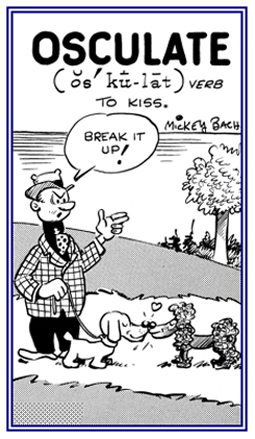
© ALL rights are reserved.
Go to this Word A Day Revisited Index
Little Patrick's grandmother always osculates him on the forehead when she comes to visit his family.
2. Etymology, from Latin osculari, from osculum, "kiss"; literally, "little mouth" diminutive of os, "mouth".Go to this Word A Day Revisited Index
so you can see more of Mickey Bach's cartoons.
1. The act of touching each others lips together: Little Susan wondered when she would experience her first osculation with a boy!
2. In mathematics, a contact, as between two curves or surfaces, at three or more common points: In his math class, Mr. Smart explained that an osculation can occur when curves or surfaces touch at which point they have a common tangent.
2. In mathematics, a contact, as between two curves or surfaces, at three or more common points: In his math class, Mr. Smart explained that an osculation can occur when curves or surfaces touch at which point they have a common tangent.
A person who kisses very often: Congressman Peterson is a politician who is known as an inveterate osculator of babies on their cheeks.
Cross references of word families related directly, or indirectly, to: "talk, speak, speech; words, language; tongue, etc.":
cit-;
clam-;
dic-;
fa-;
-farious;
glosso-;
glotto-;
lalo-;
linguo-;
locu-;
logo-;
loqu-;
mythico-;
-ology;
-phasia;
-phemia;
phon-;
phras-;
Quotes: Language,Part 1;
Quotes: Language, Part 2;
Quotes: Language, Part 3;
serm-;
tongue;
voc-.
A cross reference of other word family units that are related directly, indirectly, or partially with: "opening, hole, cavity, tract, tube": alveolo-; antro-; anu-; celo-; coelio-; concho-; fenestra-; hernio-; hiat-; meato-; parieto-; poro-; pyl-, pyle-; pylor-; sphinctero-; splanchn-; stomato-; syringo-; uretero-; urethro-; vagino-; ventricul-.

