
-ity
(Latin: suffix used to form abstract nouns expressing act, state, quality, property, or condition corresponding to an adjective)
1. Shortness, especially as applied to time.
2. Being short in speech or writing; contraction into few words, conciseness, terseness.
2. Being short in speech or writing; contraction into few words, conciseness, terseness.
If it takes a lot of words to say what you have in mind, then give it more thought.
If you would focus your words, whether spoken or written, be brief! It is with words as with sunbeams that the more they are condensed, the deeper they penetrate into the realm of people’s thinking.
1. A disastrous event resulting in great loss and misfortune: The recent flooding was a great calamity.
2. A great misfortune or disaster: There were calamities for all of the people who were involved in the series of auto accidents that took place in the thick fog.
3. A grievous affliction; adversity; misery: People are seeing many more calamities resulting from the wars in Iraq, Syria, and other countries from which refugees are fleeing to European countries.
4. An event that brings terrible loss, lasting distress, or severe affliction: The fire in the hotel resulted in calamities that caused losses of life and many severe injuries.
"Calamity is what a pessimist sees in every opportunity, while the optimist sees an opportunity in every calamity."
caloricity
1. Amount of room or space inside; largest amount that can be held by a container: A gallon can has a capacity of four quarts.
2. The ability to receive, hold, or absorb the maximum amount that can be contained or produced: The capacity of the theater was 1500 seats and it was usually filled to capacity.
3. The capability to learn or to do; power or fitness: Sabina has a great capacity for learning.
4. The ability to withstand some force or to perform some function: Metal is known for its capacity to retain heat.
5. Maximum output: During the war, steel factories worked at full capacity.
6. A position or relation; legal power or qualification: A person may act in the capacity of a guardian, trustee, voter, friend, etc.
7. Etymology: from Latin capacitatem, capacitas, "breadth, spacious"; from capax, "able to hold much"; from capere "to take".
cardiomotility
A condition in which a person is involved in the sensual appetites and passions of the body: The carnality shown in the films Alfred watched was not tolerated by his parents at all.
The opposite of carnality is spirituality.
carnosity
An excrescence [any abnormal growth from the surface of a body part] resembling flesh; a fleshy growth.
causticity
The quality of acting like fire on animal matter, or the quality of combining with the principles of organized substances, and destroying their texture. This quality belongs to concentrated acids, pure alkalis, and some metallic salts.
cautel, cautility
1. A crafty device, artifice, stratagem; a trick, sleight, deceit.
2. Cunning, craftiness, wiliness, trickery.
3. A precaution; in Law, etc.; an exception, restriction, or reservation made for precaution's sake.
4. A caution or direction for the proper administration of the sacraments; especially in cautels of the Mass.
5. In its verb form: To devise cunningly or craftily.
A swiftness of action or movement at great speed: Celerity is primarily distinguished from velocity because it refers to the movements or actions of living beings.
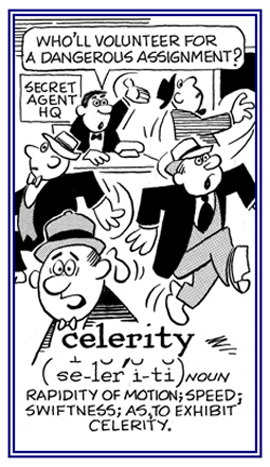
© ALL rights are reserved.
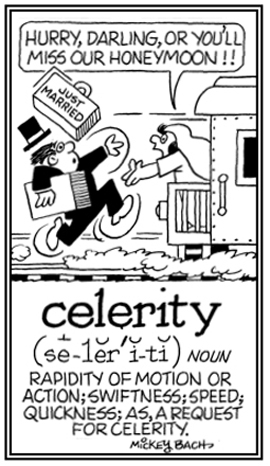
© ALL rights are reserved.
Go to this Word A Day Revisited Index
Gossip often travels with celerity, as well as children who are trying to get to a big plate of cookies.
Go to this Word A Day Revisited Index
so you can see more of Mickey Bach's cartoons.
centricity
cheirality, chirality
1. The chemical version of left-handed and right-handed.
2. While some molecules have the same atoms tied up in the same way, they are not physically the same because of their orientation.
3. The property possessed by an object; that is, a molecule, if it differs from its mirror image.
2. While some molecules have the same atoms tied up in the same way, they are not physically the same because of their orientation.
3. The property possessed by an object; that is, a molecule, if it differs from its mirror image.
Such a chemical is called a chiral compound, and the two (or more) forms are called enantiomers (or optical isomers) of each other. Nearly all of the molecules that make up living systems are chiral.
The state of being chronic: Chronicity can reoccur in patients if the symptoms have not fully been resolved with proper treatment.
cibosity
A store of food.

