
agora-, -gor- +
(Greek: assembly, market place; open space, public speaking; originally, "to unite")
2. A mental disorder characterized by an irrational anxiety of leaving the familiar setting of one's home or venturing into the open: Agoraphobia is so pervasive that a large number of external life situations are entered into reluctantly, or are avoided, because they are often associated with hysterical attacks.
A common characteristic of agoraphobia is a history of apprehensive attacks in which the person experiences symptoms of extreme excitement, distortion of perceptions, and an overwhelming sense of imminent catastrophe, loss of control, or dread of public humiliation.
Agoraphobia can cause an individual to begin experiencing anxiety in anticipation of dreadful reactions.
3. Etymology: derived from the Greek agora which means an "assembly" or "market place"; not "open spaces", as is commonly stated by some writers. Again, agoraphobia refers to the fears of streets and crowded places, not to "open spaces".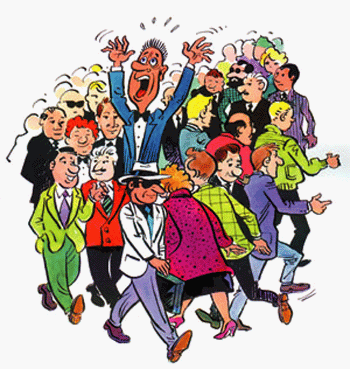
 The agoraphobia page of extended information.
2. The symbolic expression of a deeper meaning through a story or scene acted out by a human, an animal, or mythical characters: George Orwell's novel Animal Farm is an allegory in which animals behave and talk like humans..
3. A symbolic representation of something: "An allegory" by Sandro Botticelli created in 1488 is an example of a painted allegory.
The blindfolded figure holding scales is an allegory of justice.
4. A story in which people, things, and happenings have a hidden or symbolic meaning: Allegories are used for teaching or explaining ideas, moral principles, etc.
After the extinction of the teratorns, the Haast's Eagle was the largest bird of prey in the world.
Teratorns were very large birds of prey that lived in North and South America from the Miocene to the Pleistocene periods. They were close relatives of modern condors.
2. Sometimes it was erroneously applied to the mechanism used: A phantasmagoria can be the device which produces such optical illusions, like a stereopticon or a magic lantern.
3. A shifting series or succession of phantasms or imaginary figures: A phantasmagoria can be seen in a dream or fevered condition, as called up by the imagination, or as created by a literary description.
4. Etymology: name of a "magic lantern" exhibition brought to London in 1802 by Philipstal, the name an alteration of a French version of phantasmagorie, said to have been coined in 1801 by French dramatist Louis-Sébastien Mercier, from Greek phantasma, "image" + second element probably a French form of Greek agora, "assembly". This may have been chosen more for the dramatic sound than any literal Greek sense.
The inventor of the word apparently wanted a fancy and startling term, and may have fixed on -agoria without any reference to a Greek lexicon.
2. Fantastic imagery as represented in art: Jill went to an art museum where paintings of phantasmagories were on display by many well-known painters.