
jocu-, jocul-; jocund-
(Latin: joke, joking, jesting, humorous; cheerful and full of good humor)
1. A precious or semiprecious stone incorporated into a piece of jewelry.
2. It is generally assumed that this Anglo-Norman juel is derived from jeu, "game" which came from Latin jocus (source of English "jocular, joke," etc.).
3. An item, worn as an ornament, made of a gemstone placed in a setting of gold, silver, or other metal; such as, a ring, necklace, or bracelet.
4. Etymology: from about 1290, "an article of value used for adornment", from Anglo-French juel, Old French juel, jouel, "ornament, jewel"; perhaps from Middle Latin jocale, from Latin jocus, "joy"; in Vulgar Latin, "that which causes joy".
2. It is generally assumed that this Anglo-Norman juel is derived from jeu, "game" which came from Latin jocus (source of English "jocular, joke," etc.).
3. An item, worn as an ornament, made of a gemstone placed in a setting of gold, silver, or other metal; such as, a ring, necklace, or bracelet.
4. Etymology: from about 1290, "an article of value used for adornment", from Anglo-French juel, Old French juel, jouel, "ornament, jewel"; perhaps from Middle Latin jocale, from Latin jocus, "joy"; in Vulgar Latin, "that which causes joy".
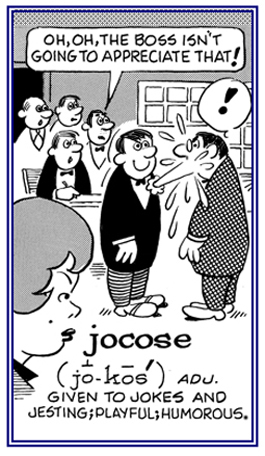
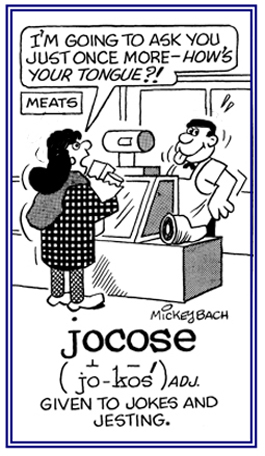
jocose (adjective), more jocose, most jocose
1. Characterized by jokes and good humor: Peter often covered his embarrassment by indulging in jocose comments.
2. With a playful joking disposition: Sam’s jocose personality was always welcome at the local golf club.
3. Humorous, playfully humorous in style: The famous comedy about two newly married couples often employed jocose ribaldry to supplement the silly plot.
4. Etymology: from Latin iocosus, "full of jesting, joking"; from iocus, "pastime, sport; a jest, a joke". It implies ponderous humor.
© ALL rights are reserved.
© ALL rights are reserved.
Go to this Word A Day Revisited Index
2. With a playful joking disposition: Sam’s jocose personality was always welcome at the local golf club.
3. Humorous, playfully humorous in style: The famous comedy about two newly married couples often employed jocose ribaldry to supplement the silly plot.
4. Etymology: from Latin iocosus, "full of jesting, joking"; from iocus, "pastime, sport; a jest, a joke". It implies ponderous humor.
Go to this Word A Day Revisited Index
so you can see more Mickey Bach illustrations.
jocoserious (adjective), more jocoserious, most jocoserious
Mixing humor or something funny with serious matters.
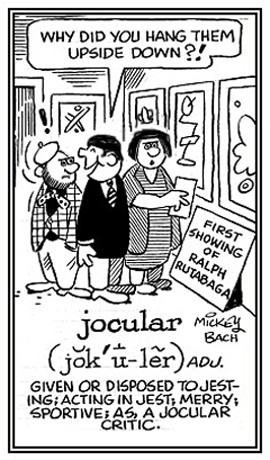
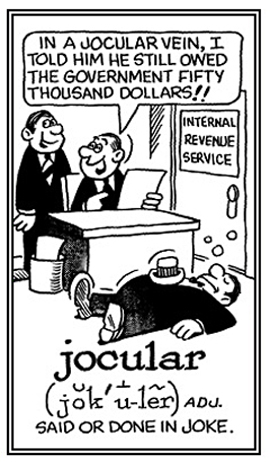
jocular (adjective), more jocular, most jocular
1. Descriptive of a playful joking disposition: Norman's jocular sense of humor was appreciated by his colleagues when dealing with stressful situations.
2. Humorous, intended to be funny: Although sometimes out of sync with the occasion, Peter never forgot his jocular sense of humor.
3. Characterized by joking: Jeb's mother told him to contain his jocular sense of humor during the church ceremony.
4. Containing jokes; sportive; not serious: Despite his serious face, Glenn often told jocular jokes that were not appropriate on some occasions.

© ALL rights are reserved.
© ALL rights are reserved.
© ALL rights are reserved.
Go to this Word A Day Revisited Index
2. Humorous, intended to be funny: Although sometimes out of sync with the occasion, Peter never forgot his jocular sense of humor.
3. Characterized by joking: Jeb's mother told him to contain his jocular sense of humor during the church ceremony.
4. Containing jokes; sportive; not serious: Despite his serious face, Glenn often told jocular jokes that were not appropriate on some occasions.
Go to this Word A Day Revisited Index
so you can see more Mickey Bach illustrations.
1. Someone who is fond of joking; a humorous person.
2. Jokes and good humor.
2. Jokes and good humor.
jocularly (adverb), more jocularly, most jocularly
A description of something or someone who is amusing or intended to cause laughter: Jessi was a man who could make the most serious people smile when he jocularly talked with people.
The quality or nature of a joke.
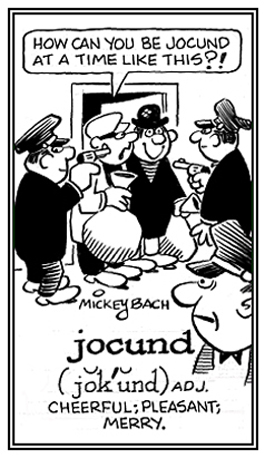
jocund (adjective), more jocund, most jocund
1. Cheerful and full of good humor: Harry's aunt had a jocund personality that endeared her to her friends and colleagues.
2. Sprightly and lighthearted in disposition, character, or quality: In contrast to her overly serious husband, Mildred’s jocund sense of humor was always welcome and appreciated by her friends.
3. Full of gladness and gaiety; mirthful: The gathering at the social event was a jocund event and everyone enjoyed themselves.
4. Etymology: from Latin jocundus, "pleasant, agreeable, delightful"; however, there appears to be an influence from Latin jocus, "jest, joke".
© ALL rights are reserved.
Go to this Word A Day Revisited Index
2. Sprightly and lighthearted in disposition, character, or quality: In contrast to her overly serious husband, Mildred’s jocund sense of humor was always welcome and appreciated by her friends.
3. Full of gladness and gaiety; mirthful: The gathering at the social event was a jocund event and everyone enjoyed themselves.
4. Etymology: from Latin jocundus, "pleasant, agreeable, delightful"; however, there appears to be an influence from Latin jocus, "jest, joke".
Go to this Word A Day Revisited Index
so you can see more Mickey Bach illustrations.
1. The state or an instance of being funny; gaiety.
2. A joking remark or act.
3. Etymology: from Old French jocond, from Latin jocundus, "variant" (influenced by jocus, "joke") of jucundus, "pleasant"; originally "helpful", contraction of juvicundus, from juvare, "to please, to benefit, to help".
2. A joking remark or act.
3. Etymology: from Old French jocond, from Latin jocundus, "variant" (influenced by jocus, "joke") of jucundus, "pleasant"; originally "helpful", contraction of juvicundus, from juvare, "to please, to benefit, to help".
jocundly (adverb), more jocundly, most jocundly
Conveying a situation that is gaily and lighthearted in disposition, character, or quality.
A situation where someone or people are being cheerful or lively and sportive.
1. Something said or done to provoke laughter or to cause amusement; such as, a witticism, a short and amusing anecdote, or a prankish act.
2. A story, anecdote, or wordplay that is intended to amuse.
3. Anything that is said or done to make people laugh.
4. Something that is amusing or ridiculous; especially, because of being ludicrously inadequate or a sham.
5. A thing, situation, or person laughed at rather than taken seriously; a farce.
6. Someone or something that is laughably inadequate or absurd: The restaurant environment was nice, but the service was a joke.
7. Something that does not present the expected challenge and which is simply too easy: Ted said that the whole class thought that the test the teacher gave us was a joke.
8. Etymology: from Latin jocus, "jest, fun, humor".
2. A story, anecdote, or wordplay that is intended to amuse.
3. Anything that is said or done to make people laugh.
4. Something that is amusing or ridiculous; especially, because of being ludicrously inadequate or a sham.
5. A thing, situation, or person laughed at rather than taken seriously; a farce.
6. Someone or something that is laughably inadequate or absurd: The restaurant environment was nice, but the service was a joke.
7. Something that does not present the expected challenge and which is simply too easy: Ted said that the whole class thought that the test the teacher gave us was a joke.
8. Etymology: from Latin jocus, "jest, fun, humor".
juggle (verb), juggles; juggled; juggling
1. The act of keeping (several objects, as balls, plates, tenpins, or knives, etc.) in continuous motion in the air simultaneously by tossing and catching them.
2. To hold, catch, carry, or balance precariously; almost drop and then catch hold again: The baseball player juggled the ball, but he finally completed catching it.
3. To alter or manipulate in order to deceive, as by subterfuge or trickery: The politician juggled the facts in his efforts to avoid blame for his misconduct.
4. Making efforts to manage or alternate the requirements of (two or more tasks, responsibilities, activities, etc.) so as to handle each one sufficiently.
5. Etymology: from Latin joculari, "to joke, jest" and Latin jocus, "jest".
2. To hold, catch, carry, or balance precariously; almost drop and then catch hold again: The baseball player juggled the ball, but he finally completed catching it.
3. To alter or manipulate in order to deceive, as by subterfuge or trickery: The politician juggled the facts in his efforts to avoid blame for his misconduct.
4. Making efforts to manage or alternate the requirements of (two or more tasks, responsibilities, activities, etc.) so as to handle each one sufficiently.
5. Etymology: from Latin joculari, "to joke, jest" and Latin jocus, "jest".
1. A person who performs juggling feats; such as, with balls, knives, etc.
2. Someone who deceives by trickery; a trickster.
3. Anyone who tries to manage or alternate the requirements of (two or more tasks, responsibilities, activities, etc.) so as to handle each adequately: Shirley was a mother who had to juggle the obligations of her job and the school for her children.
4. Etymology: from about 1100, iugulere, "jester, buffoon"; also "wizard, sorcerer" from Old English geogelere, "magician, conjurer", also from Anglo-French, from Old French jogleor, from Latin joculatorem, joculator, "joker" from joculari, "to joke."
2. Someone who deceives by trickery; a trickster.
3. Anyone who tries to manage or alternate the requirements of (two or more tasks, responsibilities, activities, etc.) so as to handle each adequately: Shirley was a mother who had to juggle the obligations of her job and the school for her children.
4. Etymology: from about 1100, iugulere, "jester, buffoon"; also "wizard, sorcerer" from Old English geogelere, "magician, conjurer", also from Anglo-French, from Old French jogleor, from Latin joculatorem, joculator, "joker" from joculari, "to joke."
Someone who sets up a situation to produce a humorous physical outcome at the expense of others.
<img src="/img/left_arrow_sm.gif" alt="" /> <img src="/img/right_arrow_sm.gif" alt="" />
Showing 1 page of 15 main-word entries or main-word-entry groups.