
Quotes: Epitaphs
(statement that lies above about the one who lies below)
2. A short speech or piece of writing celebrating the life of a recently deceased person: "The politician was asked to read the epitaph that the newspaper editor had written honoring the local city mayor who had died last week."
"An elegy is also known as a commemoration or a memoir for someone who has passed on."
"Sometimes an epitaph is a monumental lie."
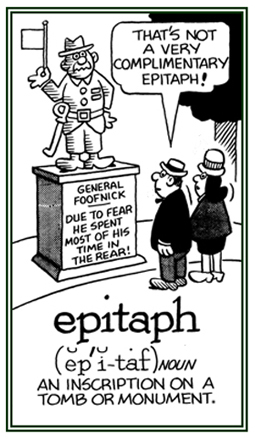
Go to this Word A Day Revisited Index
so you can see more of Mickey Bach's cartoons.
In the mythological age of the Roman gods, the world was divided into regions, each ruled by a god. The Infernal Regions, Hades, Death, and Cemeteries fell to the governance of Pluto, son of Cronus and Rhea.
As a reward for this rather solemn obligation, he was given the guardianship of riches, of all the precious metals, and stones that are buried deep in the earth.
The appearance of Pluto on earth was never a happy event, because his mission was always to take back to his kingdom the spirits of the dead. Riding up from the bowels of the earth in a chariot drawn by four coal-black steeds, he inspired fear in the hearts of humans.
Pluto's kingdom was almost impossible to reach without his permission, since it was located deep in the underworld guarded by huge Cerberus, the three-headed dog.
Near Pluto's throne were placed the seats of his three judges, Aeacus, Minos, and Rhadamanthus, who questioned the newly-arrived souls. These hearings were enacted before Themis, the blindfolded, impartial goddess, whose sword of justice hung above the new arrvials.
If the souls were proven to be good, they were led away to the Elysian Fields; if not, they were forever committed to the infernal regions of Tartarus. While the souls were being judged, Pluto, it is said, amused himself by writing their epitaphs.
Epitaphs
In life, we weep at the thought of death.
Perhaps in death we weep at the thought of life.
Si moumentum requiris, circumspice.
If you seek his monument, look around you.
To
The memory of
Micah Hall, Gentleman,
Attorney at Law,
Who died on the 14th of May, 1804,
Aged 79 years.
Quid eran nescitis: What I was you know not;
Quid sum, nescitis: What I am you know not;
Ubi abii, nescitis: Whither I am gone you know not;
Valete. Farewell.
After Benjamin Franklin’s death, an epitaph that he wrote when he was twenty-three years old was found among his papers. Although it was not chiseled on his tomb stone, it is quoted here:
The body of B. Franklin
Printer
Like the cover of an old book its contents torn out,
And stripped of its lettering and gilding,
lies here, food for worms,
But the work shall not be wholly lost;
for it will, as he believed, appear once
more in a new and more perfect edition,
corrected and amended by the Author.
My sledge and hammer lie declined,
My bellows-pipes have lost their wind,
My fire's extinct, my forge decay'd,
My vice is in the dust now laid;
My coal is spent, my iron's gone,
My nails are drove, my work is done,
My fire-dried corpse here lies at rest,
My soul, smoke-like, soars to be blest.
 Other Quotes,
Quotation Units.
Other Quotes,
Quotation Units.
Cross references of word groups that are related, directly or indirectly, to: "bury, burial, cemetery, grave; sleeping place":
coimetro-;
funer-;
sepulc-;
sheol;
tapho-.