
veter-
(Latin vetus: old, aged, old age; many years, a long time; elder, elderly; senior)
inveteracy
1. The quality or state of being inveterate or deeply ingrained: "She never could understand the inveteracy of people's prejudices."
2. The firm establishment by long continuance; firmness or deep-rooted obstinacy of any quality or state acquired by time; such as, the inveteracy of custom, habit, or disease; usually in a bad sense; such as, the inveteracy of errors.
3. Malignity; spitefulness; virulency.
2. The firm establishment by long continuance; firmness or deep-rooted obstinacy of any quality or state acquired by time; such as, the inveteracy of custom, habit, or disease; usually in a bad sense; such as, the inveteracy of errors.
3. Malignity; spitefulness; virulency.
inveterate (adjective), more inveterate, most inveterate
1. Referring to that which has existed or continued for a long time; of old standing; aged: Ever since he was 10, Jerry had an inveterate habit of chewing gum when he got nervous.
2. A reference to a disease of long standing; hence, deep-seated and resisting treatment: David had to accept the fact that his inveterate illness was chronic and probably never to be cured.
3. Relating to being full of obstinate prejudice or hatred; embittered, malignant; virulent: The elderly Mrs. Hutchison had an inveterate attitude towards people who smoked or drank liquor and didn't allow them into her house.
4. Pertaining to someone who is confirmed in some evil habit or who is a hardened offender: Doug had an inveterate weakness for gambling which turned out to be quite an obsession and he lost all of his money that way.
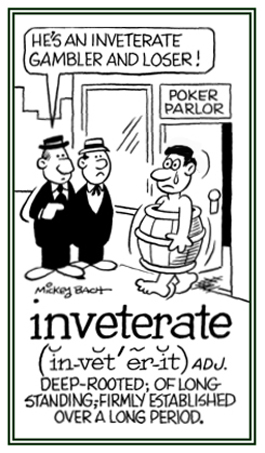
© ALL rights are reserved.
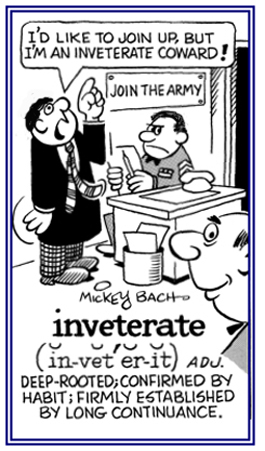
© ALL rights are reserved.
Go to this Word A Day Revisited Index
2. A reference to a disease of long standing; hence, deep-seated and resisting treatment: David had to accept the fact that his inveterate illness was chronic and probably never to be cured.
3. Relating to being full of obstinate prejudice or hatred; embittered, malignant; virulent: The elderly Mrs. Hutchison had an inveterate attitude towards people who smoked or drank liquor and didn't allow them into her house.
4. Pertaining to someone who is confirmed in some evil habit or who is a hardened offender: Doug had an inveterate weakness for gambling which turned out to be quite an obsession and he lost all of his money that way.
Go to this Word A Day Revisited Index
so you can see more of Mickey Bach's cartoons.
inveterately
1. In a habitual and long-standing manner.
2. Firmly established by long persistence, obstinacy.
2. Firmly established by long persistence, obstinacy.
inveterateness
Obstinacy confirmed by time; inveteracy.
inveteration
The act of hardening or confirming by long continuance.
veteran
1. One who has had long experience in military service; an old soldier; any ex-serviceman (primarily North American).
2. The meaning of any former member of the armed forces, ex-serviceman (not necessarily old) is first recorded in 1798, in American English, but is alluded to earlier in reference to the same condition in the Roman army
3. One who has seen long service in any office or position; an experienced or aged person.
2. The meaning of any former member of the armed forces, ex-serviceman (not necessarily old) is first recorded in 1798, in American English, but is alluded to earlier in reference to the same condition in the Roman army
3. One who has seen long service in any office or position; an experienced or aged person.
veterancy
The state or condition of being a veteran.
veteraness
A female veteran.
veteranize
To re-enlist for service as a soldier.
veterascent
Growing old.
veterate
1. Of long standing; inveterate.
2. Having the authority of age or antiquity.
2. Having the authority of age or antiquity.
veterinarian
1. Someone who is skilled in, or professionally occupied with, the medical and surgical treatment of cattle and domestic animals; a veterinary surgeon.
2. A reference to a doctor who treats animals.
3. Etymology: from 1646, formed in English (perhaps by influence of French veterinaire) from Latin veterinarius, "of or having to do with beasts of burden"; also, "cattle doctor", from veterinum, "beast of burden", maybe from vetus,"old"; possibly from the notion of being "experienced", or being "one year old"; hence, strong enough to pull burdens.
2. A reference to a doctor who treats animals.
3. Etymology: from 1646, formed in English (perhaps by influence of French veterinaire) from Latin veterinarius, "of or having to do with beasts of burden"; also, "cattle doctor", from veterinum, "beast of burden", maybe from vetus,"old"; possibly from the notion of being "experienced", or being "one year old"; hence, strong enough to pull burdens.
Another theory connects it to Latin, vehere "to draw, to pull", based on the notion of "used as a draft animal".
A sign seen in a veterinarian’s office:
The doctor is in. Sit! Stay!
veterinary
1. Of or pertaining to, connected or concerned with, the medical or surgical treatment of cattle and domestic animals.
2. Etymology: from Latin veterinarius, "pertaining to beasts of burden or draft animals"; as in plowing or pulling; especially, veterina, "a draft animal", from vetus, "old" (veter-, stem of vetus, "old"); originally "one year old".
2. Etymology: from Latin veterinarius, "pertaining to beasts of burden or draft animals"; as in plowing or pulling; especially, veterina, "a draft animal", from vetus, "old" (veter-, stem of vetus, "old"); originally "one year old".
Veterina bestia probably means "an animal one year old"; hence, strong enough to draw burdens (1729-1797).
veteriniatrics, veteriniatric
1. The branch of medicine which usually deals with the medical treatment of domestic animals.
2. A reference to any aspect of the study or medical treatment of diseases in animals.
2. A reference to any aspect of the study or medical treatment of diseases in animals.
<img src="/img/left_arrow_sm.gif" alt="" /> <img src="/img/right_arrow_sm.gif" alt="" />
Showing 1 page of 14 main-word entries or main-word-entry groups.