
auspic-, auspec-
(Latin: to look, to observe in order to make a prediction; to see omens; from auspex [genitive form auspicis] avi-, stem of avis, "bird" plus -spex, "observer", from specere)
2. Etymology: from Latin avis, "bird" + specere, "to look, to see."
2. To give a favorable turn when starting something; to inaugurate in a sense derived from the historical practice of observing birds in flight, before undertaking an important decision or action: The leaders of Rome usually auspicated their public activities before proceeding with them.
2. A sign indicative of future prospects; a favorable sign or propitious circumstance; an omen: The auspices for the new venture by the company appeared to be favorable.
3. Etymology: from Latin auspicium, "divination by observing the flight of birds"; from auspex, auspicis, literally, "bird seer"; from avis, "bird", and the stem of specere, spicere, "to see, to look at, to watch".
Observations of and predictions that in the past were based on the actions or behaviors of birds.
The high priest in earlier Roman times used to study the auspices by observing the flight of birds, just as Romulus did when founding Rome. Later the high priest did it by examining the entrails of sacrificed animals.
2. Attended by favorable circumstances; propitious: Since the company was making so much money, it seemed to be an auspicious time for Mike to ask for a raise in salary, especially since he was one of the most successful salesmen.
3. Refering to something that promises success; propitious; opportune; favorable: It was an auspicious occasion when Mark's and Mary's twins were born in two separate years. The first one was born one minute before midnight in 2013 and the other one was born one minute after midnight in 2014.
4. Concerning something favored by good fortune and prosperity: Because of her beautiful and unique art work, Madeline experienced more auspicious sales than she had ever experienced before.
5. Descriptive of a good omen or prophetic sign indicating, or suggesting, that future success is possible: It was an auspicious time for Randy's uncle to start his new business because there was a significant demand for the products he was producing.
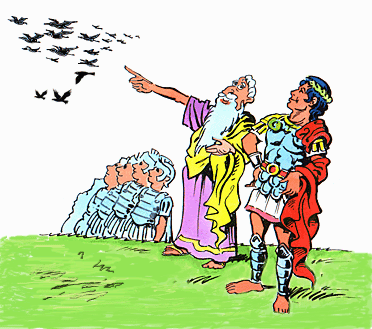
Favorable omens came to be known as auspicious while unfavorable signs were considered inauspicious.
In Roman times, an "augur" was a person who foretold the future by observing the birds flying in the sky. "Auspicium" became a divination (fortune telling) which involved watching the birds as they were soaring in the air and came from "auspex", someone who interprets signs from the movements of birds.A Latin derivative was the verb "inaugurare", to foretell the future from the flight of birds, which was applied to the installation of someone in office after the appropriate omens, or predictions, had been determined.
By the time "inaugurare" reached English, as "inaugurate", the association with the divination of birds had been forgotten.
An ancient Roman priest, or "auspex", was appointed to foretell or to divine the future outcome of an important event by observing how the birds were passing around, listening to their songs, observing the food they ate and sometimes by examining their internal organs.
Later the Roman "auspex" was replaced with the term "augur" as the interpreter-observer of bird signs; his name being derived from the Latin avis, "bird", and garrire, "to talk" or "to explain".
The augur's interpretation, or "augurism", became the English word "augury", an omen (prophecy, prediction), and the Latin "inaugurare", to install an official after consulting the birds, became the word we use to install politicians in office with the hope that their inaugurations will prove to be auspicious instead of consisting of political plots, schemes, and intrigues.
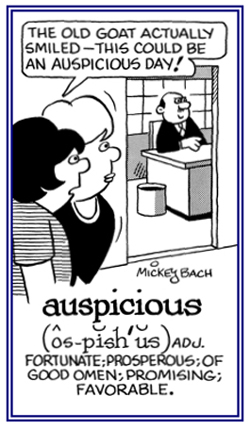
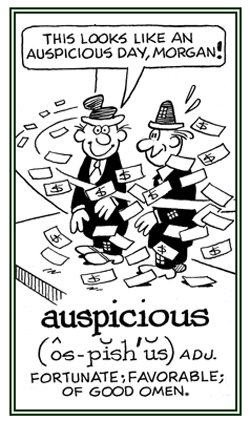
Go to this Word A Day Revisited Index
so you can see more of Mickey Bach's cartoons.
In school, Ralph found out that in Roman times auspicy was practiced among people to find out how certain political situations were to be decided upon. Romulus and Remus, for example, decided to end their discussion about where to build the city of Rome by checking out how many vultures they saw while sitting on the ground.
Cross references of word families that are related directly, or indirectly, to: "divination, diviner; seer, soothsayer, prophecy, prophesy, prophet": augur-; fa-, fate; Fates in action; futur-; -mancy; omen; -phemia; sorc-, sorcery; vati-.
A cross reference of other word family units that are related directly, or indirectly, to: "chance, luck, fate": aleato-; cad-; fortu-; -mancy; serendipity; sorc-; temer-; tycho-.
