
augur-
(Latin: diviner, soothsayer; a member of the college of priests in Rome, who foretold the future; in ancient Rome, a priest who foretold events by interpreting omens)
Related to augerer, "to increase".
2. A priest who was a member of the College of Augurs that numbered twelve, six patricians, and six plebeians.
Before the "lex Domitia de sacerdotiis" was passed by Gnaeus Domitius Ahenobarbus in 104 B.C., new augurs were chosen by those who were already in the college; however, after the law came into effect, augurs were to be publicly elected.
At one time, it is said that augurs did not personally predict the future, nor did they make personal interpretations of the objects or signs to determine whether or not a proposed undertaking had the approval of the gods, but there was a guide book which was to be followed exactly to find out if a meeting, a proposed new law, a war, or any other State or government business should take place.
3. Etymology: be aware of a possible "folk-etymological" derivation error!John Ayto writes, "In Roman times, an augur was someone who foretold the future by observing the flight of birds (or by examining their entrails). His method of divination was reflected in his title, for the Latin word augur, earlier auger, seems to have meant literally 'one who performs with birds,' from avis 'bird' (as in English aviary) and aviation and gerere 'do, perform' (as in English gestation, gesture, gerund, digest, and suggest).
Another etymologist, Dr. Ernest Klein, challenges part of the above source of information by stating: The usual derivation from avi-ger (avis, "bird", and gerere, "to bear, conduct") is folk etymology.
Regardless of any disagreement about the etymology of augur, dictionaries generally seem to be "on the same page" in that they essentially agree that it refers to Roman augurs who predicted the future by interpreting the flights of birds and by other natural occurrences; such as, examining their entrails, etc.
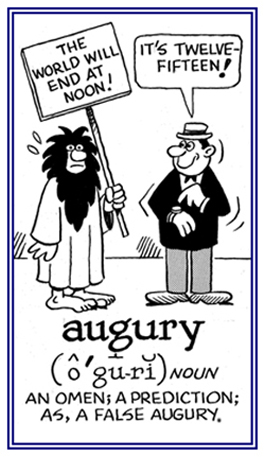
2. To indicate a sign or an omen: The successful dress rehearsal augured well for a good drama.

Go to this Word A Day Revisited Index
so you can see more of Mickey Bach's cartoons.
Cross references of word families that are related directly, or indirectly, to: "divination, diviner; seer, soothsayer, prophecy, prophesy, prophet": auspic-; fa-, fate; Fates in action; futur-; -mancy; omen; -phemia; sorc-, sorcery; vati-.
