A primo ad ultimum. (Latin motto)
Translation: "From first to last."
Translation: "To the final end."
Said to be the motto of the Canadian Space Agency.
antepenultimate, antepaenultimate
(adjective) (not comparable)
Two before the last: The
antepenultimate comes immediately before the
penultimate in a series; for example, a book that has 20 chapters, chapter 18 is the
antepenultimate chapter in the book.
Other adjectives indicating such sections in words: ultimate (last), penultimate (one from the last), preantepenultimate (third from the last), propreantepenultimate (fourth from the last).
bioultrasonics
1. The use of ultrasonics for biological applications; such as, ultrasonic medical tomography, ultrasonic microscopy, and physical therapy.
2. The study of the interaction of sound at frequencies above about 20 000 hertz with living systems.
cryoultramicrotomy
(s) (noun) (no pl)
The method of using a special instrument in ultramicrotomy for cutting frozen samples of biological substances:
Cryoultramicrotomy is the technique of using a cryostat, or freezing microtome, in which the temperature is regulated to -2° Celsius to cut ultrathin frozen sections for microscopic (usually, electron microscopic) examination.
exultingly
(adverb), more exultingly, most exultingly
Reveling triumphantly or exceedingly: It was exultingly easy to celebrate the fact that Gordon got a significant raise in pay.
ne plus ultra
Not more beyond.
The limit, perfection, highest point, or peak of achievement or excellence; the pinnacle, the ultimate. The most profound degree of a quality or condition.
Although the literal sense of the phrase makes it possible to be used as a term expressing prohibition, in the sense of "no further may you go", its primary use indicates the supremacy of a product, a literary work, a system, etc.
Ne ultra.
Nothing beyond.
Motto of Davidson College, Davidson, North Carolina, USA.
Non plus ultra.
Until here and not any further.
Based on a German source, Hercules is said to have settled in Cadiz, Spain, where he erected columns as a monument with the inscription: "These are the limit stones of Hercules" with the idea that this was the edge of the world.
Many Germans believe the phrase refers to something that is "the best", "the utmost", or "nothing better".
penult, penultima
(s) (noun); penults, penultimas
(pl)
1. The second to the last item in a series of things; especially, the next to the last syllable of a word: In the word penultima, the penult is ti as shown in, pe•nul•ti•ma.
2. Etymology: a shortened term for penultima, from Latin paenultima, feminine of paenultimus, "next to last" from paene, "almost" + ultimus, "last".
penultimate
(pi NUL tuh mit, pin UL tuh mit) (adjective) (not comparable)
1. A reference to the second or next to the last in a series or a sequence: A
penultimate segment in the word
definition is
ni as in def•i•
ni•tion or it could refer to the next to last chapter in a book or that there is only one more show in a TV series.
2. Etymology: from Latin
paene, "almost" and
ultimus, "last".
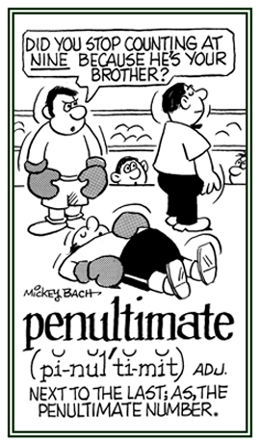 © ALL rights are reserved.
Go to this Word A Day Revisited Index
so you can see more of Mickey Bach's cartoons.
Plus ultra.
More beyond.
Motto of Shepherd College, Shepherdstown, West Virginia, USA.
Plus! Ultra!
More! Further!
Motto of German Emperor Charles V (1519-1556). It is also written as, Plus ultra and it is translated as, "Thus far and further".
pneumonoultramicroscopicsilicovolcanoconiosis, pneumonoultramicroscopicsilicovolcanokoniosis
This is one of the longest words in the English language and is divided into the following segments: pneu, mono, ultra, micro, scopic, silico, volcano, coni, osis; and together they mean, "miner's lung disease", or "a disease of the lungs caused by the inhalation of very fine silicate, or quartz dust, and occurring especially in the lungs of miners".
propreantepenultimate
(adjective) (not comparable)
Pertaining to a rare term meaning the fourth syllable from the last one in a word that is written or spoken: If you have a book that has fifteen chapters then chapter twelve is the preantepenultimate part.
Related "above, over, beyond the normal, excessive" word units:
epi-;
hyper-;
super-, supra-.
Inter-related cross references, directly or indirectly, involving word units meaning "more, plentiful, fullness, excessive, over flowing":
copi-;
exuber-;
hyper-;
multi-;
opulen-;
ple-;
pleio-;
plethor-;
poly-;
super-;
total-;
undu-.

