
anti-, ant-
(Greek: against, opposed to, preventive; used as a prefix)
Don't confuse this anti- ("against, preventive") with the anti- which means "before".
anecdote, antidote
anecdote (AN ik doht") (noun)
An interesting incident or brief history; a short narrative; sometimes, a humorous account: Scott, have you noticed that many public speakers begin their talks with a humorous anecdote?
Jane told an anecdote about her early childhood.
antidote (AN ti doht") (noun)
1. A remedy to counteract poison; an antitoxin: Doctors rushed an antidote to the boy who was bitten by a snake.
2. Anything that works against an unwanted condition; a remedy or a cure: A hobby is considered a good antidote for boredom and for keeping our minds active.
2. Anything that works against an unwanted condition; a remedy or a cure: A hobby is considered a good antidote for boredom and for keeping our minds active.
Is there an antidote for strychnine poisoning?
Be sure to spell and pronounce anecdote properly. Don't confuse it with antidote; for example, James told an anecdote about his Canadian travels.
Does the doctor have an antidote for the food poisoning our friend got when he ate at the restaurant?
An agent that can counteract acidity: Dr. Black suggested that Bill use antacids to neutralise the acidity in his stomach.
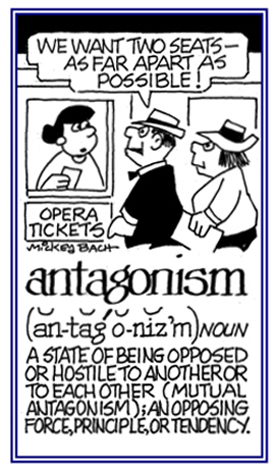
1. Hostility or hatred that causes opposition and ill will: The two neighbors were expressing antagonisms and demonstrating unfriendly behavior towards each other.
2. In physiology, the interaction between two or more chemical substances in the body that diminishes the effect each of them has individually: Antagonism can be seen in lab rats when the chemical dopamine slows down their movements, as it impedes the usual functions of their physical activities.
© ALL rights are reserved.
Go to this Word A Day Revisited Index
2. In physiology, the interaction between two or more chemical substances in the body that diminishes the effect each of them has individually: Antagonism can be seen in lab rats when the chemical dopamine slows down their movements, as it impedes the usual functions of their physical activities.
Go to this Word A Day Revisited Index
so you can see more of Mickey Bach's cartoons.
antagonistic symbiosis, antipathetic symbiosis
A type of symbiosis that is beneficial to one symbiont and detrimental to another one; for example, "parasitism".
antagonize (verb), antagonizes; antagonized; antagonizing
To arouse dislike in someone: Sam's remarks antagonized Mildred when he criticized her for not presenting a complete report on a specific date.
Antarctic, antarctic
1. The region around the South Pole; such as, Antarctica and the surrounding waters.
2. As antarctic, found in, coming from, or associated with this region.
2. As antarctic, found in, coming from, or associated with this region.
Most compound entries using this term may be spelled either Antarctic or antarctic.
antebrachial, antebrachium, antibrachial
The part of the arm or fore-limb from the wrist to the elbow; the forearm.
antiabortion, anti-abortion (adjective); more antiabortion, more anti-abortion; most antiabortion, most anti-abortion
Pertaining to opposition of the discontinuance of a pregnancy or to a fetal development: The antiabortion doctor refused to remove the fetus before it was able to survive, especially since he was not convinced that it was necessary for the mother's well- being.
A person who is opposed to medical terminations of pregnancies and expulsions of embryos or of fetuses: Antiabortionists are against surgical or medicinal procedures that terminate a pregnancy by removing the fetus (unborn baby) which is a non-contraceptive form of birth control.
A substance that destroys the action of an agglutinin: Amy read in her biology book that an antiagglutinin can be a specific antibody that inhibits the activity of an agglutinin.
antiaircraft
antiandrogen
Any substance capable of preventing full expression of the biological effects of androgenic hormones on responsive tissues, either by producing antagonistic effects on the target tissue, as estrogens do, or by merely inhibiting androgenic effects, such as by competing for binding sites at the cell surface.
antiantibody
antiantidote
Against a substance that neutralizes poisons or their effects.
antiantitoxin
