
labor-, laborat-
(Latin: work, toil)
arte et labore
By skill and toil (work).
belabor
1. To repeat or to discuss something unnecessarily or at too great a length.
2. To discuss something repeatedly; to harp on and on without stopping.
3. To subject someone to a sustained verbal or literary attack.
2. To discuss something repeatedly; to harp on and on without stopping.
3. To subject someone to a sustained verbal or literary attack.
belabored
Something which is explained more than necessary.
belaboring
1. Assailing verbally.
2. Discussing repeatedly or at length; harping on and on and on: "She kept belaboring the point and just wouldn't shut up!"
2. Discussing repeatedly or at length; harping on and on and on: "She kept belaboring the point and just wouldn't shut up!"
belabors
1. Someone who explains, worries about, or works at (something) repeatedly or more than is necessary: "The guy kept belaboring the point long after we had agreed on how to settle the issue."
2. Anyone who assails persistently, as with scorn or ridicule: "The book belabors the excess of immigrants who are working in agricultural areas of the country."
2. Anyone who assails persistently, as with scorn or ridicule: "The book belabors the excess of immigrants who are working in agricultural areas of the country."
Child labor in Guatemala
Children are forced to work very early in their lives
- Guatemalan children shine shoes and make bricks, many starting as early as five or six years of age.
- They cut cane and mop floors; and at some factories exporting to the United States, they sew and sort and chop, often in conditions so onerous that they violate even Guatemala's very loose labor laws.
- Guatemala's young workers, most of them poor indigenous people, say they often feel that nobody cares about them, not their parents who send them off to the work force, not their stern bosses who treat them like adults, and not even the dysfunctional government in Guatemala City.
- Guatemalan work-places resemble grade schools, with adult supervisors standing over little laborers like the strictest of teachers.
- According to an independent study of the issue, an estimated one million Guatemalan children under the age of 18 are working.
One child worker's testimony
The child workers are people like Maria, 16, who lamented her four years in the labor force, but at the same time insisted that she not be fully identified so as not to endanger a job that is helping to support her parents and four brothers and sisters.
- "My father hits me and tells me I can't study," she said, tears running down her cheeks. "He stays home and drinks and I have to go to the factory."
- On Sundays, her only day off, she goes to special classes for young laborers offered by the Center for Study and Support for Local Development.
- Despite having worked at a factory since she was twelve and at home for years before that, Maria has now completed the equivalent of third grade.
- "I can be so tired, so exhausted, but I feel so good when I come home and read," she said, her tears stopping and her face lighting up.
- "It can be any book. I just like to see the words."
clinical laboratory
A laboratory for the measurement and examination of materials derived from the human body; for example, fluids, tissues, cells, etc.; for the purpose of providing information on diagnosis, prognosis, prevention, or treatment of diseases.
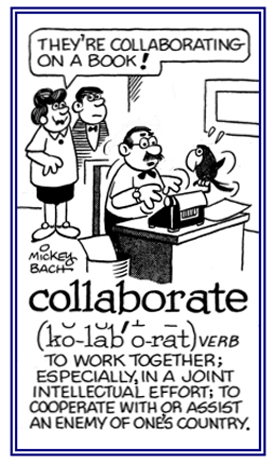
collaborate (verb), collaborates; collaborated; collaborating
1. To cooperate with another person, or group, in order to achieve something: Patricia and her family members strived to collaborate with each other to decide on where they would spend their next vacation.
2. To work together, especially in a joint intellectual effort: The two writers decided to collaborate on a novel which was finally completed and published.
3. To cooperate jointly on an activity; primarily, to produce a mutual project: The people working on the special dictionary certainly have been able to collaborate nicely in order to achieve its completion!

© ALL rights are reserved.
Go to this Word A Day Revisited Index
2. To work together, especially in a joint intellectual effort: The two writers decided to collaborate on a novel which was finally completed and published.
3. To cooperate jointly on an activity; primarily, to produce a mutual project: The people working on the special dictionary certainly have been able to collaborate nicely in order to achieve its completion!
Go to this Word A Day Revisited Index
so you can see more of Mickey Bach's cartoons.
The act of working together with one or more people in order to create something.
collaborationism
The act of cooperating traitorously with an enemy who is occupying one's country.
A person who works with another person, or group of people, in order to achieve or to accomplish something.
collaborative
Characterized or accomplished by collaboration; such as, collaborative methods; a collaborative report.
collaboratively
A reference to people accomplishing something by working together on a common enterprise or project.
1. Those who co-operate together for a special purpose: Jack was a collaborator with Sam to produce books for high school students.
2. An associate who works with others toward a common goal.
2. An associate who works with others toward a common goal.
Deo fisus labora.
Work while trusting in God.
Motto of William Jewell College, Liberty, Missouri, USA.
