
curr-, cur-, cor-, cour-
(Latin: to run, running)
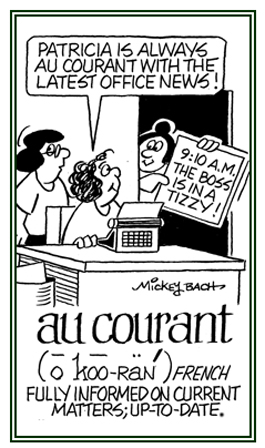
au courant (oh" koo RAN) (adjective), more au courant, most au courant
1. Pertaining to someone who is informed about current affairs and so he or she is well-informed : The anthropologist always tried to be an au courant scholar about what was going on in Africa with the various native groups.
2. Descriptive of a person concerned about having a fully familiar and knowledgeable environment: James was a business executive who was au courant about what his staff was doing to keep his company profitable.
3. Etymology: Based on Latin currere, "to run"; then from French au courant; au, "in the" + courant, "current"; literally, "in the current"; that is, "knowledgeable or up-to-date".
© ALL rights are reserved.
Go to this Word A Day Revisited Index
2. Descriptive of a person concerned about having a fully familiar and knowledgeable environment: James was a business executive who was au courant about what his staff was doing to keep his company profitable.
3. Etymology: Based on Latin currere, "to run"; then from French au courant; au, "in the" + courant, "current"; literally, "in the current"; that is, "knowledgeable or up-to-date".
Go to this Word A Day Revisited Index
so you can see more of Mickey Bach's cartoons.
coarse (adjective), coarser, coarsest
1. Of low, common, or inferior quality: Delia's wool dress was coarse compared to her sister's silk dress.
2. Lacking refinement in manners or behavior: The dancing after the soccer team's victory was coarse, to say the least.
3. Vulgar or indecent; such as, coarse language: During the TV interview, the star player used coarse language toward the reporters, and they were offended.
4. Consisting of large particles; not fine in texture; including sand: Sara and Eugenia were disappointed when they discovered that the beach consisted of coarse gravel instead of sand.
5. Rough, especially to the touch: The cloth napkins handed out to the guests were not soft but rather coarse; particularly when anyone wiped his or her mouth.
6. Etymology: from cors, "ordinary", probably an adjective use of the noun cours, originally referring to "rough cloth for ordinary wear".
2. Lacking refinement in manners or behavior: The dancing after the soccer team's victory was coarse, to say the least.
3. Vulgar or indecent; such as, coarse language: During the TV interview, the star player used coarse language toward the reporters, and they were offended.
4. Consisting of large particles; not fine in texture; including sand: Sara and Eugenia were disappointed when they discovered that the beach consisted of coarse gravel instead of sand.
5. Rough, especially to the touch: The cloth napkins handed out to the guests were not soft but rather coarse; particularly when anyone wiped his or her mouth.
6. Etymology: from cors, "ordinary", probably an adjective use of the noun cours, originally referring to "rough cloth for ordinary wear".
Coarse is believed to have come from "course", which came from Latin cursus, "a running race" or "course", from curs- past participle stem of currere, "to run".
It developed a sense of "rude" in about 1510 and included the meaning of "obscene" in about 1711.
Apparently "a misspelling" of concourse because it cannot be found in a dictionary; however, some automobile companies are using the term for specific car models.
You are advised to use concourse if you are referring to an assemblage; a gathering, a large open space for accommodating crowds; as in, a railroad station, a park, or an airport; an act or an instance of running or coming together; a confluence; such as, a concourse of events, etc.
1. A large open space for the gathering or passage of crowds, as in an airport or railroad station: At three o'clock in the morning, the concourse at the bus station was empty of any passengers.
2. A broad thoroughfare: The concourse between the university buildings was packed with students who were going to their first period classes.
3. A great crowd; a throng: In the city square, there was a concourse of screaming people with torches who were demonstrating against governmental restrictions.
4. The act of coming, moving, or flowing together; such as, streams: At the concourse of the two mighty rivers there was an island consisting of volcanic rock.
2. A broad thoroughfare: The concourse between the university buildings was packed with students who were going to their first period classes.
3. A great crowd; a throng: In the city square, there was a concourse of screaming people with torches who were demonstrating against governmental restrictions.
4. The act of coming, moving, or flowing together; such as, streams: At the concourse of the two mighty rivers there was an island consisting of volcanic rock.
concur (verb), concurs; concurred; concurring
1. To agree or to have the same opinion: The testimony of the witness concurred with the victim’s story.
2. To cooperate: Tom and Jason usually concurred on how to do their homework.
3. To happen at the same time: The arrival of the police and the ambulance concurred at Rene's next door neighbor at 2 A.M.
2. To cooperate: Tom and Jason usually concurred on how to do their homework.
3. To happen at the same time: The arrival of the police and the ambulance concurred at Rene's next door neighbor at 2 A.M.
1. An agreement with an opinion, a belief, or a statement: There was a concurrence with the plaintiff and the accused during the court trial.
2. Cooperation relating to agents, circumstances, or events: The judge and attorneys were pleased that there was a concurrence among the members of the jury in coming to a final verdict.
3. Situations in which two or more things happen at about the same time: During the monsoon season in Arizona, the concurrence of rain and sunshine is common.
2. Cooperation relating to agents, circumstances, or events: The judge and attorneys were pleased that there was a concurrence among the members of the jury in coming to a final verdict.
3. Situations in which two or more things happen at about the same time: During the monsoon season in Arizona, the concurrence of rain and sunshine is common.
concurrent (adjective), more concurrent, most concurrent
1. Descriptive of two actions or situations that happen at the same time: Mike and Joan had
concurrent accidents in different parts of the city.
2. Pertaining to an action that takes place together with another person: Raising a flag up a pole correctly is a concurrent act for military personnel and Boy Scouts.
3. A reference to two things converging: Where the two streams become concurrent, a lake is formed.
2. Pertaining to an action that takes place together with another person: Raising a flag up a pole correctly is a concurrent act for military personnel and Boy Scouts.
3. A reference to two things converging: Where the two streams become concurrent, a lake is formed.
concurrently (adverb) (not comparable)
Relating to two actions or situations occurring simultaneously or at the same time: The reports of the killings in the city were broadcast concurrently on several TV stations.
1. A fenced in area in which livestock or horses are kept: : The cowboys drove their cattle into
the corral and closed its gate.
2. A temporary defensive enclosure formed by covered wagons arranged in a circle: In the early west, when the travelers saw Indians coming, they circled the wagons and created a corral.
3. Etymology: from Latin currere, "to run"; and from Spanish corro, "ring", from correr, "to run"; a pen for horses.
2. A temporary defensive enclosure formed by covered wagons arranged in a circle: In the early west, when the travelers saw Indians coming, they circled the wagons and created a corral.
3. Etymology: from Latin currere, "to run"; and from Spanish corro, "ring", from correr, "to run"; a pen for horses.
corral (verb), corrals; corralled; corralling
To herd animals into and to keep them in a special enclosure: The determined cowboys were finally able to corral all of the wild mustangs.
A long hallway with rooms opening into it: The high school students hurried to class down the crowded corridors before the tardy bell rang.
A pirate, particularly from the coast of North Africa from the 16th to the 19th centuries: The U.S. Navy fought to break the power of the corsairs from the Barbary Coast.
A messenger or delivery person who is entrusted to transport important documents or items: When Maribel and Mike went to New York, they saw couriers on bicycles darting back and forth through traffic.
1. A class in a sequence of classes, particularly at the college level: Jim was told that he must study hard to pass his courses.
2. A continuous movement forward in space or time: In the course of a year, Tamara will have spent a lot of money for her university classes.
3. The direction or path taken by moving water, or runners in a race, or the specific playing area for a sport; such as, golf: Cheering spectators packed the edges of the course followed by the runners in the marathon.
4. A particular dish or portion of food served as a separate part of a meal: The banquet will be a formal dinner of five courses.
2. A continuous movement forward in space or time: In the course of a year, Tamara will have spent a lot of money for her university classes.
3. The direction or path taken by moving water, or runners in a race, or the specific playing area for a sport; such as, golf: Cheering spectators packed the edges of the course followed by the runners in the marathon.
4. A particular dish or portion of food served as a separate part of a meal: The banquet will be a formal dinner of five courses.
1. A dog trained to hunt by sight rather than by scent: The fox appeared to be a red flash as the coursers chased it across the meadow.
2. An exceptionally fast horse: The courser, Old Pale, won every race he ever entered.
2. An exceptionally fast horse: The courser, Old Pale, won every race he ever entered.
