circumvent
(verb), circumvents; circumvented; circumventing
1. To find a way of avoiding restrictions imposed by a rule or law without actually breaking it: In order to avoid all the red tape involved in becoming a permanent immigrant as a single person, Grace simply married her boyfriend and therefore
circumvented the usual process of being able to stay in Canada for a long time.
2. To anticipate and to counter someone’s plans: During the spelling bee in class, Doug
circumvented it, or avoided it, by having to go to the bathroom just when it was his turn.
3. To encompass; literally, to enclose: In the movie, the Indians
circumvented, or surrounded, the camp the settlers had set up.
4. To get around a restriction or obstacle: The road was blocked by a fallen tree after the storm, but James knew a way to
circumvent it by taking another route.
—
Word Info image © ALL rights reserved.
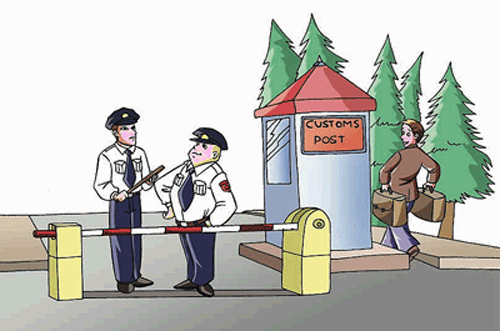
A man is circumventing the custom guards by sneaking around the entrance gate.
 © ALL rights are reserved.
 © ALL rights are reserved.
Go to this Word A Day Revisited Index
so you can see more of Mickey Bach's cartoons.
circumvention
(s) (noun), circumventions
(pl)
The action of overreaching, outwitting, or getting the better of anyone by craft or artifice: Tom knew, by the use of
circumvention, how to avoid or evade his duty of washing up the dishes after dinner by saying that he suddenly felt ill and had a headache.
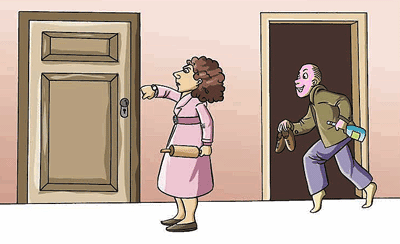
A husband makes the supreme effort to avoid facing his wife after too much drinking and getting home long after he said he would.
circumventive
(adjective), more circumventive, most circumventive
A reference to evading or avoiding some law or restriction.
circumvolute
(verb), circumvolutes; circumvoluted; circumvoluting
1. To twist or to fold around.
2. To roll about.
circumvolutio
1. A structure or tissue twisted or folded into a tortuous shape.
2. A convolution, or gyrus (a convolution on the surface of a cerebral hemisphere caused by the infolding of the cerebral cortex).
circumvolution
(s) (noun), circumvolutions
(pl)
1. A turning or winding movement around a central axis.
2. An act of turning, coiling, or folding around a center, a core, or an axis.
3. A single turn, coil, or fold.
circumvolve
(verb), circumvolve; circumvolved; circumvolving
1. To roll or wind together; to coil; to twist.
2. To roll around; to cause to revolve; to put into a circular motion.
3. To revolve or cause to revolve.
craniotabes, circumscribed craniomalacia
A disease marked by the presence of areas of thinning and softening in the bones of the skull and widening of the sutures and fontanelles (soft membranous gaps between the incompletely formed cranial bones of a fetus or an infant). Usually of syphilitic (syphilis) or rachitic (rickets or bending of the bones) origin.
extenuating circumstances, extrordinary circumstances, mitigating circumstances
To render a crime less aggravated, heinous, or reprehensible than it would otherwise be, or to tend to palliate or to lessen its guilt.
Such circumstances may ordinarily be shown in order to reduce a punishment or damages. In contract law, unusual or extraordinary events that prevent performance within a specified time; for example, a delay resulting from a strike by workers or suppliers.
nanocircuit
(s) (noun), nanocircuits
(pl)
A computer circuit built and assembled on a single carbon nanotube: The
nanocircuit is one-fifth the width of a human hair and can only be viewed under an electron microscope.
The nanocircuit is not designed to be used in a computer chip; instead, it is proof that allows a research team to test the switching speed of its design.
While using a nanocircuit, researchers have claimed that they could achieve a speed of 50 megahertz, hundreds of times slower than the gigahertz speeds of silicon processors seen in most personal computers; however, the researchers say the circuit is 100,000 times faster than any previously recorded for a device made with a carbon nanotube, and with continued refinement they hope to push speeds beyond those possible today.
osteoporosis circumscripta crani
Localized osteoporosis of the skull associated with Paget's disease (a disease of bone occurring in the middle aged and elderly; excessive bone destruction sometimes leading to bone pain and fractures and skeletal deformities).
perilenticular, circumlental
Surrounding the lens of the eye.
Si monumentum requiris, circumspice. (Latin proverb)
Translation: "If you seek a monument, look around you."
An inscription on Sir Christopher Wren's tomb in St. Paul's Cathedral, London, England. Wren was the architect of the cathedral that was constructed in 1675-1720.
Si quaeris peninsulam amoenam circumspice. (Latin motto)
Translation: "If you seek a pleasant [lovely] peninsula, look about you."
Motto of the State of Michigan, USA.
Related "around, round, surrounding" units:
ambi-;
ampho-;
circ-;
cyclo-, -cycle;
gyro-;
peri-.

