In zoology, concerning the superfamily Aeluroidea of the order Carnivora: Aeluroid members are included in the family of cats, Felidae, and related families.
aeluromancy
(s) (noun) (no pl)
Divination or prophecy by watching the behavior or appearance of cats: In a book on prophecies and predictions, Tina read about aeluromancy being the foretelling of a cat's manner of jumping!
aeluromania, ailuromania, eluromania
(s) (noun); aeluromanias; ailuromanias; eluromanias
(pl)
An absurd desire to have many cats:
Aeluromania describes the ridiculous longing that some people have for cats, even some people have dozens of cats in an apartment or house!
An intense enthusiasm or abnormal love of having many cats around, sometimes even when conditions are not suitable for their existence.

aelurophile
(s) (noun), aelurophiles
(pl)
A person who has a special love of, or a fondness for, cats: Lynn's sister must be an aelurophile because she absolutely adores her little purring fuzzball.
aelurophilic, ailurophilic
(adjective); more aelurophilic, most aelurophilic; more ailurophilic, most ailurophilic
A reference to anyone who has a special fondness for cats: Mildred loved cats, but not dogs, and could be described as an aelurophilic girl.
aelurophobe, ailurophobe, elurophobe
(s) (noun); aelurophobes; ailurophobes; elurophobes
(pl)
Someone who has a terrible fear of cats: Linda’s friend, who is an
aelurophobe, loves dogs, but dreads coming in contact with Linda’s tabby because he was scratched very badly by a feline once as a child.

aelurophobia, ailurophobia, elurophobia
(s) (noun); aelurophobias; ailurophobias; elurophobias
(pl)
An excessive or abnormal terror or panic of being close to any felines: Usually anyone who has
aelurophobia dreads the thought of being clawed by them.
Some people react with shortness of breath, rapid heartbeat, or feelings of extreme anxiety just at the sight of a cat, while for others aelurophobia is induced only if the creature comes very close or touches them.
In its most abnormal condition, a person who has an ailurophobia may stay home in order to avoid encountering a cat in the street or, in extreme cases, of even seeing one when he or she is in a vehicle.
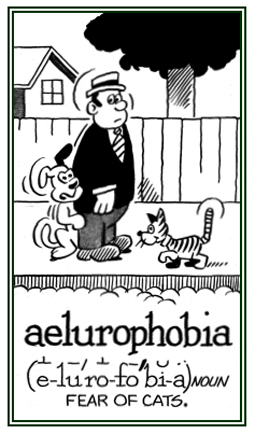 © ALL rights are reserved.
Go to this Word A Day Revisited Index
so you can see more of Mickey Bach's cartoons.
aelurophobic, ailurophobic, elurophobic
(adjective); more aelurophobic, most aelurophobic; more ailurophobic, most eilurophobic; more elurophobic, most elurophobic
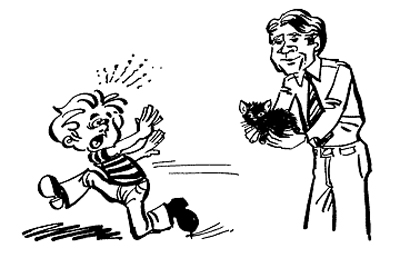
Descriptive of someone who has a morbid, or deathly, horror or detestation of cats: Greg never went to visit his aunt because he was
aelurophobic and was unable to tolerate any contact with his aunt’s felines even though they were very friendly and well-
behaved.
aeluropodous, ailuropodus
(adjective); more aeluropodous, most aeluropodous; more ailuropodus, most ailuropodus
In zoology, descriptive of an animal having feet with retractile claws: Whoever has a cat or likes cats knows that they are aeluropodous creatures because their talons can be withdrawn into their paws!
The Cat Gecko of the genus Aeluroscalabotes:
Aeluroscalabotes felinus is a species of gecko found in the countries of Indonesia, Malaysia, Singapore, and Thailand.
Aeluroscalabotes felinus is also the only species in the genus found within the taxonomic subfamily Aeluroscalabotinae. It is commonly called the "Cat Gecko" because of its habit of curling up with its tail around itself when it sleeps, very much like a cat.
Aelurostrongylus
(s) (noun) (no pl)
A common genus of lungworm in cats: Land snails and slugs serve as intermediate hosts of the members of the genus
Aelurostrongylus, and snail-eating animals can serve as transport hosts.
Aelurostrongylus abstrusus is the lungworm within this genus that causes verminous bronchitis or pneumonia in cats.
This "cat lungworm" is found in branches of the pulmonary artery where eggs are laid and hatch. The larvae break into the alveoli and ascend the air ducts to the mouth where they pass out with sputum or are swallowed and passed with the feces.
The larvae develop in the infective state in various terrestrial mollusks. Excessively infected cats display coughing, diarrhea, and emaciation.
In zoology, a group of the taxonomic order Carnivora that includes the cats: Ailuroidea also include the civets and hyenas.
ailuromancy
(s) (noun) (no pl)
Divination as determined by the way a cat jumps or moves:
Ailuromancy can be a bad omen in the U.S. and Germany when a black cat crosses in front of someone, but it is considered fortunate in Britain. Owning a black cat is also considered to be a good divination.
It is a widespread belief that killing or mistreating a cat will bring ill fortune, probably from ancient religious beliefs that cats were sacred animals.
ailurophilia, aelurophilia
(s) (noun) (no pl)
A love of cats: Ailurophilia can also be described as the fondness for cats or felines in general, as by cat devotees or enthusiasts.
ailurophilous
(adjective), more ailurophilous, most ailurophilous
Descriptive of a special love or fondness for cats: Virginia's sister had an ailurophilous affection towards felines and had at least one in her home to keep her company.
Cross references of word families that are related directly, or indirectly, to: "cat":
cat;
feli-, felin-;
galeo-;
gato-.

