
capri-, capr-
(Latin: goat, resembling a goat)
2. An automobile with a folding top: Tim wanted to save his money to buy a cabriolet with a convertible coupe!
3. Etymology: French from cabriole, "leap of a goat, caper"; from cabrioler, caprioler, "to leap like a goat, to caper"; from Italian capriolare, from Latin capreolus, diminutive formed from caper, "he goat", whence capra, "she-goat".
2. Etymology: from Latin, diminutive of caper, "goat".
2. Of or pertaining to a special acid or its derivatives: Capric acid comes from animal fats and oils which are used in the manufacture of perfumes and fruit flavors.
The capric acid also occurs in small quantities in butter, coconut oil, etc.; which is united with glycerin.
Capric acids are colorless oils or white crystalline solids of an unpleasant odor similar to goats or sweat.
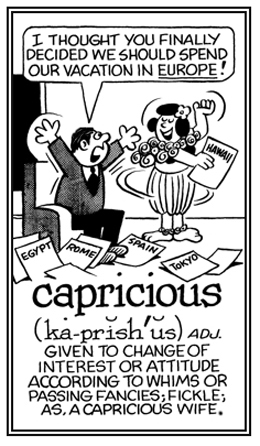
2. Characterized by or subject to impulsive and unpredictable behavior: Although people may enjoy a little unpredictability in life now and then, the term capricious is not ordinarily used in a positive sense, for example a capricious wife can make a nervous wreck of her spouse.
caput, "head" + riccio, "curled" or "frizzled".
The root of capricious is the noun caprice, which means "a whim' or "sudden change of mind" and caprice ultimately came from the Italian word capriccio, which also has the meaning of whim and at this point hedgehogs enter into the research of the etymology.
Hedgehogs are known for their spiky, spiny coats and the Italian capriccio is a combination of capo, "head" and riccio, "hedgehog", and its original meaning was "hedgehog head", a description of someone so frightened or astonished that the hair on his or her head "stood on end".
The transformation of the meaning of capriccio from "fright" to "whim" or "sudden impulse" seems to have involved another group of animals; namely, goats.
While the Italian word capra, "goat", is not directly related to capriccio, the similarity of the words and the skittish, flighty behavior of goats apparently gradually pushed capriccio away from "fright" and towards "whim". By the time "caprice" entered English in 1667, it meant simply "whim, erratic", or "notion".
Go to this Word A Day Revisited Index
so you can see more of Mickey Bach's cartoons.
Constance capriciously purchased and exchanged five dresses in one week at the local department store.
Joan's capriciousness was revealed when she invested her entire savings in stocks that lost a significant amount in value, thus decreasing the amount of money that she had in her bank account.
Capricorn is classified as an earth sign, and its ruling planet is Saturn.
2. In astronomy, a faint zodiacal constellation in the equatorial region of the southern hemisphere: In school Christaine learned that Capricorn was situated between Aquarius and Sagittarius.
Caprification is the artificial transfer of pollen from the anther to the stigma of figs by means of the sting of insects, such as by chalcid wasps.
2. Etymology: from Latin caprificatio, "ripening of figs" (by the stinging of gall-insects); from caprificatus, past participle of caprificare, "to ripen figs", from caprificus, "wild fig"; literally, "goat fig", from caper, "goat" and ficus, "fig".
2. Etymology: from New Latin caprifoliaceae, from caprifolium type genus, from Medieval Latin: "honeysuckle", from Latin caper, "goat" + folium, "leaf".
2. Etymology: from Latin caprigenus; caper, "goat" + gegnere "to produce".
Capriloquism is also known as "bronchoegophony", "egobronchophony", "tragophonia", and "tragophony".
2. Etymology: from Latin caper, "goat", + loquor, "to speak".
On the little farm, Jack and Jill wanted to have some caprine animals so they could drink their milk!
