
sorc-, sors-, sort-
(Latin: lot, fortune, fate)
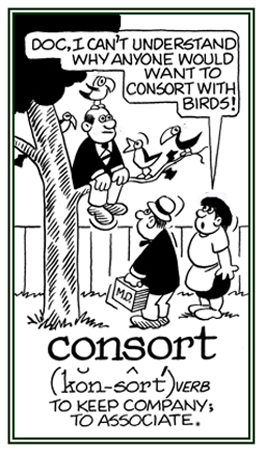
Rudy has indicated that he wants to consort with other writers.
2. A ship accompanying another in travel: As the oil ship was traveling through the dangerous piracy area, there was a consort which was prepared to protect the bigger one.
The queen and her consort decided to attend a concert in a foreign country to which they would travel by ship accompanied by a consort which carried all of their luggage.
Go to this Word A Day Revisited Index
so you can see more of Mickey Bach's cartoons.
2. An association or a combination, as of businesses, financial institutions, or investors, for the purpose of engaging in a joint venture.
3. A cooperative arrangement among groups or institutions.
4. The right of a husband or wife to the company, affection, and help of, and sexual relations with, his or her spouse.


Go to this Word A Day Revisited Index
so you can see more of Mickey Bach's cartoons.
2. An object used to make a determination or choice at random: "casting lots."
3. The use of objects in making a determination or choice at random: "chosen by lot."
4. Something that befalls one because of or as if because of determination by lot.
5. Etymology: from Old English hlot, "object (anything from dice to straw, but often a chip of wood with a name inscribed on it) used to determine someone's share"; also, "what falls to a person by lot".
An object was placed with others in a receptacle, which was shaken, the winner being the one that fell out first; hence, to cast lots. In some cases the lots were drawn by hand.
The sense of "plot of land" is first recorded in 1633 (distribution of the best property in new settlements often determined by casting lot), that of "group, collection" is 1725, from the notion of auction lots.
The generalized sense of "many" is first attested in 1812. To cast (one's) lot with another is to agree to share the winnings of something.
The people in the village thought the old man who lived alone in the forest was a sorcerer and that he was able to conjure up evil spirits to torment them if they mistreated him; so, they treated him with respect.
2. Etymology: from the Latin sortiarius, usually someone who "casts lots" which are used to determine the fate or destiny of certain people.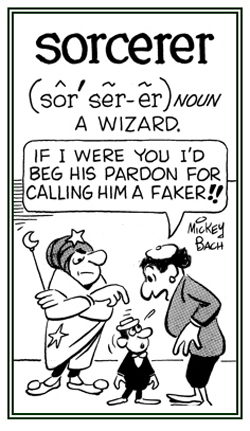
Go to this Word A Day Revisited Index
so you can see more of Mickey Bach's cartoons.
Go to this Word A Day Revisited Index
so you can see more of Mickey Bach's cartoons.
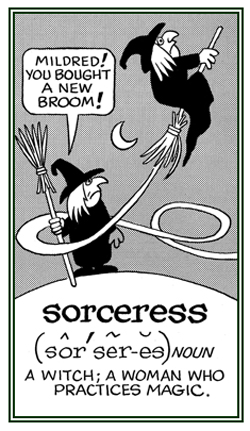
2. Etymology: from Old French sortir, "allot, sort, assort", from Latin sortiri, "draw lots, divide, choose", from sors which is a shortened form of "assort".
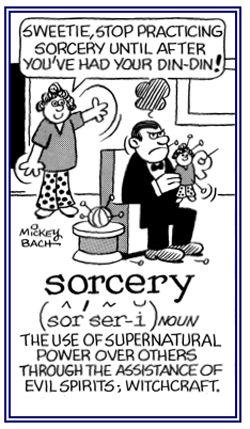
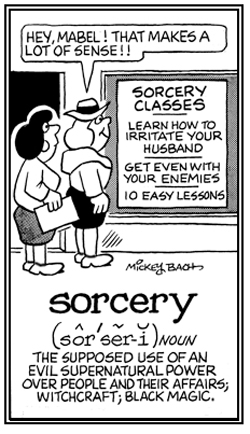
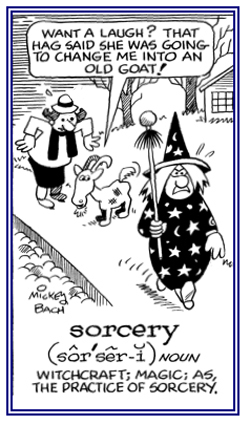
2. Etymology: from Old French sorcerie, from sorcier, "sorcerer", from Vulgar Latin sortiarius; literally, "someone who influences fate or fortune", from Latin sors, "lot, fate, fortune".
Sort (noun) from Old French sorte "class, kind", from Latin sortem, "lot, fate, share, portion, rank, category". The sense that evolved in Vulgar Latin is from "what is allotted to one by fate," to "fortune, condition", to "rank, class, order".
Go to this Word A Day Revisited Index
so you can see more of Mickey Bach's cartoons.
2. Etymology: from Latin sortilegus, “prophetic, soothsayer”; from sors, “lot, fortune” plus legere, “to read”.

Go to this Word A Day Revisited Index
so you can see more of Mickey Bach's cartoons.
Cross references of word families that are related directly, or indirectly, to: "divination, diviner; seer, soothsayer, prophecy, prophesy, prophet": augur-; auspic-; fa-, fate; Fates in action; futur-; -mancy; omen; -phemia; vati-.
A cross reference of other word family units that are related directly, or indirectly, to: "chance, luck, fate": aleato-; auspic-; cad-; fortu-; -mancy; serendipity; temer-; tycho-.