
cad-, cas-, cid-
(Latin: to fall, befall)
A three-car accident tied up the highway traffic for five hours.
2. In law, a situation resulting in injury that is in no way the fault of the injured person for which compensation or indemnity is legally sought: The lawyer explained that the accident involving her client was not his fault and he should not be charged by the police.3. Any event that happens unexpectedly, without a deliberate plan or reason: Tamika met her best friend purely by accident when she was shopping at the Farmers' Market.
4. By chance; fortune; luck: Sam arrived just in time for a meeting by accident because he didn't know when it was supposed to start.
5. A fortuitous circumstance, quality, or characteristic: It was a fortuitous accident that the house that Jake bought was on the north side of the street so his children could go to the school just across the park.
6. Etymology: "an occurrence, an incident, or an event"; from Old French accident (12th century), from Latin accidentem, accidens, accidere, "to happen, to fall out, to fall upon"; from ad-, "to" + cadere, "to fall".
2. Regarding something that happens by chance; unplanned, unintentional, unpremeditated, uncalculated; unexpected, fortuitous; random: The meeting of Dale and Mike on the street was purely accidental.
This word is often mispronounced and misspelled The word has five syllables ac-ci-den-tal-ly.
The use of accidently is considered a gross error and displays a lack of knowledge of what is supposed to be the correct spelling and pronunciation.
2. A dead human body that may be used by physicians and other scientists to study anatomy, identify disease sites, determine causes of death, and provide tissue to repair a defect in another living human being: There were several new cadavers donated to the university medical school for the anatomy classes.
3. Etymology: borrowed from Latin cadaver from cadere, "to fall, to fall dead, to sink down, to die"; literally, "a fall".
Students in medical schools study and dissect cadavers as part of their education. Others who study cadavers include archaeologists and artists.
It is said that the great Renaissance artist Michelangelo (1475-1564) studied cadavers by candlelight in a dark morgue (while enduring the smell of rotting flesh) in order to better understand the structures of bones, sinews, and muscles.
The fruits of his efforts are evident in his painting "The Creation of Adam" on the ceiling of the Sistine Chapel in Rome and in his marble sculpture "David" in the Galleria dell' Accademia in Florence.
Courts of law sometimes use the term cadaver to refer to a dead body, as do recovery teams searching for bodies after a natural disaster; such as, an earthquake or a flood. A dead body is usually a corpse in a mystery story. The term cadaver also has a more deathly ring when it is used by medical professionals.
2. The hardening of the muscular tissues of the body, from one to seven hours after death as a result of the coagulation of the myosinogen and paramyosinogen: The cadaveric rigidity disappears after one to five or six days, or when decomposition begins.
Sometimes the rigor mortis, or cadaveric rigidity in the corpse, makes it difficult to fit the body into the coffin for burial.
3. The postmortem stiffening of the voluntary and involuntary muscles of the body present a board-like situation for the entire body: The development of cadaveric rigidity may be poor or incomplete in elderly, very young, or severely debilitated individuals.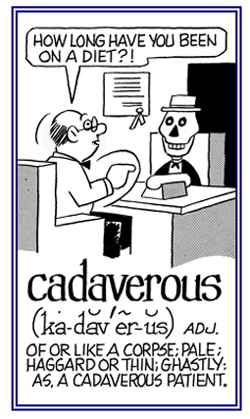
Go to this Word A Day Revisited Index
so you can see more of Mickey Bach's cartoons.
Sometimes it is possible for some people to recognize which foreign language is being spoken just by listening to the cadence of the words.
2. A regular beat or rhythmic movement when dancing or marching: There was a steady cadence of the drums near the end of the concert.