a-, an-
These prefixes are normally used with elements of Greek origin, a- is used before consonants and an- is used before vowels.
It affects the meanings of hundreds of words.
There are too many words that use these prefix elements to list all of them on this site; however, there are significant examples listed in this and the other units where they exist.
ataxic aphasia, motor aphasia
(s) (noun); ataxic aphasias, motor aphasias
(pl)
A type of partial or total loss of language skills as a result of brain damage: Patrick had ataxic aphasia and could not speak well enough to be understood and even his writing was so unrecognizable that no one could determine what he was trying to communicate.
ataxiophemia, ataxophemia
(s) (noun); ataxiophemias, ataxophemias
(pl)
A medical condition that results in the lack of proper coordination of the speech muscles: After Trisha's uncle had a stroke, it appeared that he developed ataxiophemia and was unable to use his speech muscles that produce the ability to speak clearly.
ataxiophobia
(s) (noun), ataxiophobias
(pl)
1. An excessive fear of clutter, disarray, disarrangement, or of being in an disheveled situation: Some people who are afflicted with ataxiophobia have obsessive-compulsive ailments that are persistent, intense, senseless, and worrisome, in fact they tend to be so excessive at keeping things neat and tidy that they make it nearly impossible to exist with others who are of a less-than-orderly nature.
2. An abnormal fear of falling or tripping: Ataxia is a lack of co-ordination in the muscles which is a symptom of damage to part of the central nervous system, and so people who have ataxiophobia may be that way because of their experiences in swaying or even falling down, especially if they close their eyes even for a second.
ataxophobia
(s) (noun), ataxophobias
(pl)
A mental dread of disorder or chaos: Every time Mrs. Smith went to visit her husband's Aunt Gracia, Gracia's ataxophobia appeared to increase because she was constantly rearranging things on her shelves or dusting things to such a degree, that it was impossible to carry on much of a conversation with her.
atectonic
(adjective), more atectonic, most atectonic
A reference to a geological condition in which the crust of the earth is not deformed or shifted to create mountains: Dr. McMahon's research of the earth tremors in the area indicated that there was tectonic evidence that such quakes were not the beginning of any internal structures of mountains.
atelesis
(s) (noun), ateleses
(pl)
Absence of integration or successful completion of an objective or a purpose: Dr. Swift, the psychiatrist, diagnosed Tina as having
atelesis or a disintegration and a dissociation of different psychic functions because of her schizophrenic disjunction (separation of something normally joined together) between her inner and outer worlds.
Atelesis has been used by psychiatrists to refer to three major disjunctions that are well known in schizophrenic psychopathology:
- Disjunction of a person's inner world and environment (autism or phantasies, delusions, hallucinations, etc.).
- Disjunction of one's ego and the contents of consciousness (splitting or incomplete ego development).
- Disjunction of someone's experience contents and the elementary forms of mental perception (destruction of conscious and willful focusing on one object or one component at a time).
—A compilation based on information located in
Psychiatric Dictionary, Seventh Edition,
by Robert Jean Campbell, M.D.;
Oxford University Press; New York; 1996; page 96.
atelia
(s) (noun), atelias
(pl)
An imperfect or incomplete development of the body or any of its parts: At the time of the child’s birth, the doctors advised Mr. and Mrs. Johnson that their daughter was born with atelia and that she would grow up with an incomplete development of her body, as in a condition of infantilism in which an older child or adult keeps infantile or childish characteristics.
ateliosis, ateleiosis
(s) (noun); atelioses, ateleioses
(pl)
1. A form of infantilism (immaturity) that is a result of pituitary insufficiency, in which there is arrested growth (lack of physical development) but no deformities: Because of Joan's ateliosis, she had a very small body and her voice and face resembled those of a child even though she was over 50 years old.
2. Incomplete development which may refer to psychic infantilism or puerilism, and/or to physical dwarfism (microsomia): The unusual acting troupe consisted of people with atelioses; that is, they were dwarfish in stature but they were wonderful actors.
atheism
(s) (noun), atheisms
(pl)
Godlessness, disbelief in, or denial of, the existence of a God or any gods: In contrast to Andrew's upbringing by his uncle, a pastor in the local church, Mary's cousin declared that he was devoted to atheism because he could not believe in God.
atheist
(s) (noun), atheists
(pl)
1. Someone who does not believe in a God or gods or who denies the existence of Divine Beings, or Deities: An
atheist believes there is no God while an agnostic believes human beings can never know whether there is a God or not.
2. A person who denies, or disbelieves, that there is any such thing as a Supreme Being or beings: Joe's friend, even though he is an
atheist, still enjoys having long philosophical discussions with the archbishop of the local church.
3. A disbeliever, an unbeliever, a nonbeliever, a denier of God's existence, a godless person: Laura believes in the existence of God, but her brother is an
atheist and he thinks his sister is silly to believe that there is any such thing as a God.
4. Etymology: from French
athéiste, from ancient Greek
atheos, "godless, denying the gods"; from
a-, "without, no" +
theos, "god".
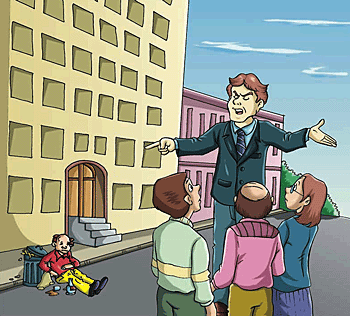
As an atheist, I proclaim that if there were a God, would people like this poor man be allowed to be in such miserable conditions? This is just one example of how so many people in the world are suffering and which proves to me that there is no God.
atheistic
(adjective), more atheistic, most atheistic
1. A description of a person who denies the existence of god: Because of Michael's atheistic beliefs, the young man chose to go for a walk in the forest rather than to go to church.
2. Related to or characterized by a denial that God exists or is real or present in any form: As a psychologist, Susan's atheistic beliefs contrasted with those of her college roommate who was a deeply devoted Christian.
atheistical
(adjective), more atheistical, most atheistical
1. A reference to a belief that no deities or gods exist: Being a professor, Dr. Young's essay regarding the atheistical practices of the ancient tribes was read with great interest by the students in his anthropology classes.
2. Related to the absence of belief in a particular deity, pantheon, or religious doctrine: Lester, the archaeologist, was studying an ancient atheistical culture that apparently had no religious structure.
athermic
(adjective), more athermic, most athermic
1. Pertaining to a lack of a fever or with no rise of temperature: Since Pat's temperature didn't get any higher, Dr. Anderson was relieved to see that she was getting closer to the athermic condition that he was striving to achieve for her.
2. A reference to a nonexistent opening of a passage or entrance to heat or heat-rays: The athermic coating on the space shuttle proved to be successful when it re-entered the earth’s atmosphere.
3. Characterized by the absence of fever: After a worrisome night, baby Jill seemed to be athermic and now had a cool forehead and no fever.
4. Relating to being heatless: It was speculated that many of the planets in the solar system were of an athermic nature; that is, they had no natural heat.
athymia
(s) (noun), athymias
(pl)
1. A name formerly given to absence of feeling or emotion, as seen in depression or the dysthymic disorder: In Rebecca's journals, which were written 100 years ago, she referred to experiencing a state of
athymia which sounded as if she were depressed.
2. Apathy, emotional indifference, or unresponsiveness: Because of Teresa's persisting
athymia, Dr. Brown prescribed a mild antidepressant.
Priscilla's athymia was expressed by the fact that she didn't care if she got any better or not, nor whether she would live or die.
3. A congenital lack at birth of a thymus gland (an organ situated in the center of the upper chest just behind the breastbone that assists the immune system): Dr. Bowers noted that, given the
athymia of her patient, a regimen of medications to counter the inherent immunodeficiency was necessary.
atokous
(adjective), more atokous, most atokous
Descriptive of someone or something that cannot produce offspring:
Atokous animals may become nonproductive because of some form of sterility process, such as dogs, cats, bulls, etc.
There are those who become atokous by having their reproductive organs removed, either by choice or because they have genetically transmissible disabilities, etc.
Other atokous examples include making some plants incapable of bearing fruit or germinating, or the rendering of land that makes it unfruitful because of chemicals, excessive salt, etc.


