
bio-, bi-, -bia, -bial, -bian, -bion, -biont, -bius, -biosis, -bium, -biotic, -biotical
(Greek: life; living, live, alive)
Don’t confuse this element with another bi- which means "two".
The most important things in life are not things.
Specifically, a term for areas of land and water capable of supporting photosynthesis at sufficient rates so as to provide economically useful concentrations of biomass.
Marginal and unproductive regions are generally excluded; such as, deserts, tundra, and the deep oceans.
2. The use or emphasis of biological principles or methods in explaining human social behavior.
2. A scientist who studies living organisms.
3. A scientist devoted to the study of organisms and their relationships to their environments and the underlying mechanisms that govern how those organisms work.
2. The science of physical life; the division of physical science that deals with organized beings or animals and plants, their morphology, physiology, origin, and distribution.
3. The study of living organisms, including their structure, function, evolution, interrelationships, behavior, and distribution.
4. The study of human life and living.
5. The study of the properties and history of living organisms and of their interactions with the non-living world.
Using physics as a model, biologists have attempted to find universal processes and properties of all organisms that can be applied to all forms, despite the apparent diversity of life.
Living organisms are affected by and affect the non-living world strongly. The study of the history of the earth and its atmosphere is inseparable from the study of biology.
Bioluminescence occurs when a pigment, usually "luciferin"; is oxidized without giving off heat.
Although it is believed that bioluminescence is involved in animal communication, its function in many organisms has yet to be understood.
Bioluminescence is a form of "chemiluminescence" and most luminescent animals have an effulgent-producing organ; such as, "photophore".
Such bioluminescence may contain their own specialized luster-producing cells, or have symbiotic luminescent bacteria.
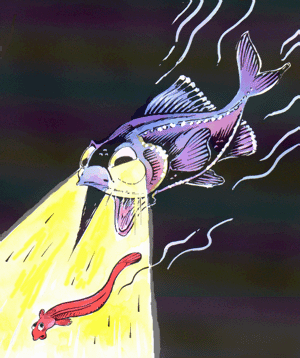
The darkness of the ocean presents a variety of bioluminescent creatures
The most expansive animal habitat on the earth lies between the sea surface and the floor of the deep ocean basins. Within this enormous space live the largest and perhaps most remarkable biological communities of fauna.
Most creatures of this twilight world are able to augment the scant sunlight reaching them with another form of natural illumination known as bioluminescence.
Although bioluminescence is a relatively rare phenomenon in terrestrial ecosystems, the vast majority of the animals that inhabit the upper kilometer of the ocean are capable of producing light with photophores in one way or another.
The illustrated bioluminescent fish for this page is similar to a "flashlight fish" which has headlights made up of sacs of luminescent bacteria under its eyes that light its way around the ocean depths.
Before man caught up with nature, she developed her own uses for bioluminescence; for example, many predators use their natural lighting to catch their meals; as shown in the image.
2. Disintegration of organic matter through the chemical action of living organisms; such as, bacteria.
3. Sewage decomposition by tiny organisms.
2. Related to biolysis or capable of destroying life.
 If you would like to take a series of self-scoring quizzes over some of the words in this bio- unit, then click this Life, Live, Living Quiz link so you can check your knowledge. You may also try several additional quizzes in this listing.
