
-ant, -ants
(Latin: a suffix; a person who, the thing which; people who, things which)
1. A member or adherent of any denomination of the Western Christian church that rejects papal authority and some fundamental Roman Catholic doctrines, and who believes in the justification by faith.
2. Any Western Christian who is not an adherent of a Catholic, Anglican, or Eastern Church.
2. A believer of any of those Christian bodies that separated from the Church of Rome during the Reformation, or of any group descended from them.
2. Any Western Christian who is not an adherent of a Catholic, Anglican, or Eastern Church.
2. A believer of any of those Christian bodies that separated from the Church of Rome during the Reformation, or of any group descended from them.
puerperant
In the act of childbearing.
pugilant (adjective), more pugilant, most pugilant
Characterized by boxing or fighting and used mostly figuratively: Steven seemed to be in a pugilant mood, being belligerent and very aggressive.
quadrant
radicant
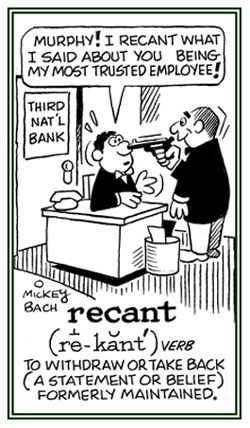
recant (verb), recants; recanted; recanting
1. To formally reject or to disavow a formerly held belief, usually under pressure: The witness was pressured to recant her testimony in court.
2. To deny believing in something or to withdraw something previously said: When confronted with new evidence, the spy recanted her evidence which had sounded so believable before.
3. To make a formal retraction or disavowal of a previously held statement or belief: The senator agreed to recant his allegations about the President and signed a formal statement indicating his new position.
4. Etymology: from about 1535, from Latin recantare, "to recall, to revoke"; from re-, "back" + cantare, "to sing, to chant".

© ALL rights are reserved.
© ALL rights are reserved.
Go to this Word A Day Revisited Index
2. To deny believing in something or to withdraw something previously said: When confronted with new evidence, the spy recanted her evidence which had sounded so believable before.
3. To make a formal retraction or disavowal of a previously held statement or belief: The senator agreed to recant his allegations about the President and signed a formal statement indicating his new position.
4. Etymology: from about 1535, from Latin recantare, "to recall, to revoke"; from re-, "back" + cantare, "to sing, to chant".
A loan-translation of Greek palinoidein, "recant", from palin, "back" + oeidein, "to sing".
Go to this Word A Day Revisited Index
so you can see more of Mickey Bach's cartoons.
recreant
1. Disloyal to a cause or duty; someone who is disloyal or deserts a cause; a coward; a quitter; fainthearted, dastardly, or “yellow”.
2. Originally, "surrendering oneself (to an adversary)."
2. Originally, "surrendering oneself (to an adversary)."
reductant
A reducing agent.
A substance capable of bringing about the reduction of another substance as it is oxidized; used in photography to lessen the density of a negative or print by oxidizing some of the slackened silver.
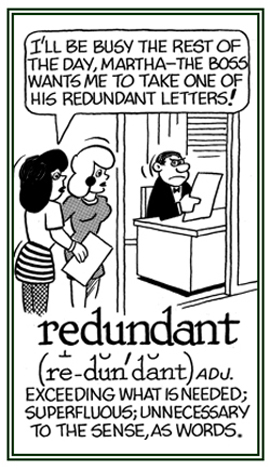
redundant (adjective), more redundant, most redundant
1. Pertaining to the use of more words than are necessary to express an idea: The mayor's speech was considered to be the most redundant one that the citizens had ever heard; including, promises, promises, and more promises.
2. Referring to the repetition of words with the same meanings as others which are used several times in a presentation: In her speech, the politician became even more redundant than usual, saying: "and I repeat" and "I tell you again".
3. Descriptive of something which is beyond what is necessary or natural; superfluous: Serving chocolate ice cream with the chocolate cake, which was covered with chocolate icing, seemed quite redundant.
© ALL rights are reserved.
Go to this Word A Day Revisited Index
2. Referring to the repetition of words with the same meanings as others which are used several times in a presentation: In her speech, the politician became even more redundant than usual, saying: "and I repeat" and "I tell you again".
3. Descriptive of something which is beyond what is necessary or natural; superfluous: Serving chocolate ice cream with the chocolate cake, which was covered with chocolate icing, seemed quite redundant.
Go to this Word A Day Revisited Index
so you can see more of Mickey Bach's cartoons.
refrigerant
1. Cooling or freezing.
2. In medicine, reducing fever.
2. In medicine, reducing fever.
regnant (adjective), more regnant, most regnant
1. A reference to ruling or reigning: King Charles II in England is now a regnant king.
2. Descriptive of having the chief power or authority; dominant: There are a few big countries that would like to have regnant control and sovereignty in the world.
3. Pertaining to common or to widespread occurrences; prevalent; There are many regnant fires destroying large areas of land in Canada.
2. Descriptive of having the chief power or authority; dominant: There are a few big countries that would like to have regnant control and sovereignty in the world.
3. Pertaining to common or to widespread occurrences; prevalent; There are many regnant fires destroying large areas of land in Canada.
relaxant
1. A drug that reduces tension and strain, particularly in muscles.
2. Causing something such as a muscle to become less tense.
2. Causing something such as a muscle to become less tense.
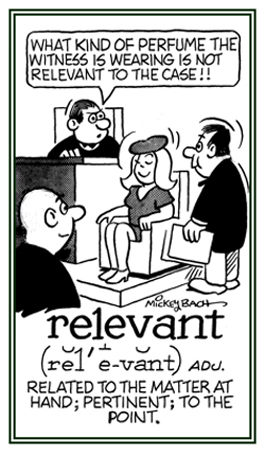
relevant (adjective), more relevant, most relevant
1. A reference to something that has been directly connected with and important to what is being discussed or considered: The relevant suggestions and observations that were written in the book have been an inspiration for many people.
2. Relating to a subject in an appropriate way: Shirley was asked if she had any relevant experience that could be applied to the job that she was applying for.
© ALL rights are reserved.
Go to this Word A Day Revisited Index
2. Relating to a subject in an appropriate way: Shirley was asked if she had any relevant experience that could be applied to the job that she was applying for.
Go to this Word A Day Revisited Index
so you can see more of Mickey Bach's cartoons.
reluctant (adjective), more reluctant, most reluctant
1. Referring to a person who is unwilling to become involved: The boys at school were reluctant to socialize with the new student.
2. Relating to someone who is not very willing to do something and therefore slow to do it: The people waiting for the bus were reluctant to help the drunk get on it when it arrived.
3. Etymology: from Latin reluctari, "to struggle" from re, "against, opposite" + luctari, "to struggle."

© ALL rights are reserved.
Go to this Word A Day Revisited Index
2. Relating to someone who is not very willing to do something and therefore slow to do it: The people waiting for the bus were reluctant to help the drunk get on it when it arrived.
3. Etymology: from Latin reluctari, "to struggle" from re, "against, opposite" + luctari, "to struggle."
Go to this Word A Day Revisited Index
so you can see more of Mickey Bach's cartoons.
1. The power to repel: In the story, the giant possessed enough repellant and force to fend off anything in his way.
2. A chemical substance that fend off animals: Mary had an insect repellant especially to keep off the mosquitoes while camping in the woods.
3. A compound with which fabrics are treated to wards off moisture: The raincoat that Sam bought contained a repellant to withstand any rain or water.
2. A chemical substance that fend off animals: Mary had an insect repellant especially to keep off the mosquitoes while camping in the woods.
3. A compound with which fabrics are treated to wards off moisture: The raincoat that Sam bought contained a repellant to withstand any rain or water.

