
path-, patho-, -path-, -pathia, -pathic, -pathology, -pathetic, -pathize, -pathy
(Greek: feeling, sensation, perception; suffering, disease, or disorder; a system of treating diseases)
In medicine, some of these elements usually mean "someone who suffers from a disease of, or one who treats a disease"; so, they should not be confused with the words that mean "feeling" which are also shown on these pages even though both meanings come from the same Greek element.
Any disease peculiar to males: One example of the ailment andropathia is prostatitis.
One kind of physical disease that is peculiar to men: Andropathy is a disorder of males, especially one involving the genitourinary system.
A disease associated with the exposure to high winds: When out hiking for many weeks, Susan contracted anemopathy because of being consistently subjected to the strong winds, and she found out that she could treat herself by means of inhalation.
An ethically or morally uninhibited person: The old-fashilned term anethopath can apply to a sociopath, or one who has an antisocial personality condition.
In psychiatry, absence of moral inhibitions; without morality: Some people with the disorder of anethopathy are considered to be the so-called habitual criminals.
The conspicuous trait in some people's mental makeup of anethopathies is complete egocentricity, which is also reflected in their narcissistic or inflated belief that they are superior to other people.
A disease affecting both the heart and blood vessels: Mrs. Williams had a serious case of angiocardiopathy and had to stay in hospital for a very long time.
Any disease of the blood vessels including the muscular layer: The doctor diagnosed Meg's illness as being angiomyopathy, which affected not only her veins and arteries, but also their muscular walls.
In pathology, a vascular disorder attributed to an abnormality of the autonomic nervous system fibers that supply the blood vessels: Angioneuropathy is an affliction of the vasomotor system, like angiospasm, angioparalysism, or vasomotor paralysis.
The pathology of, or the changes seen in diseases of the blood vessels: Christoph learned that angiopathology applied to the malfunctioning and abnormalities of a person's blood, and also to the lymphatic vessels in an individual.
One of various diseases of the blood vessels or lymphatics; angiosis: Alzheimer's illness can be caused by cerebral amyloid angiopathy, which impairs or harms the arteries of the brain.
The attachment of human feelings to a thing that is not human: Examples of of anthropopathism are found in inanimate items, animals, or even in natural phenomena!
The attribution of human emotions to non-humans: Anthropopathy can be applied to gods, lower animals, or inanimate objects in nature.
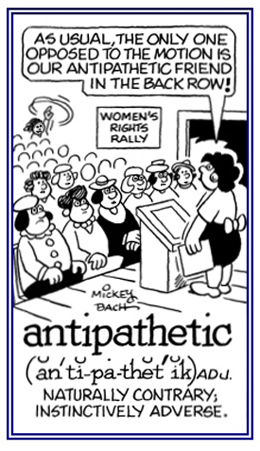
antipathetic (an" ti puh THET ik) (adjective), more antipathetic, most antipathetic
A reference to a strong feeling of dislike, aversion, or repugnance against someone or something: Jane's father could not hide his antipathetic attitudes toward her new boyfriend.
© ALL rights are reserved.
Go to this Word A Day Revisited Index
Go to this Word A Day Revisited Index
so you can see more of Mickey Bach's cartoons.
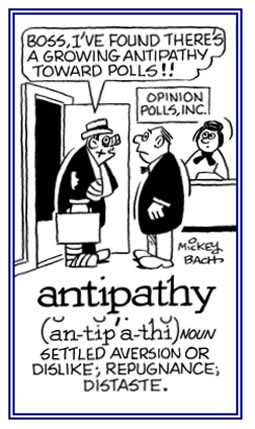
1. A strong hostility, or opposition, toward someone or something: Mike's aunt felt a strong antipathy towards snakes and she could not tolerate even looking at a picture of one.
2. A person, or something, that causes anger, hostility, strong opposition, or disgust: Karl feels a strong sense of antipathy whenever he reads about street violences in the newspapers.
© ALL rights are reserved.

© ALL rights are reserved.
Go to this Word A Day Revisited Index
2. A person, or something, that causes anger, hostility, strong opposition, or disgust: Karl feels a strong sense of antipathy whenever he reads about street violences in the newspapers.
Go to this Word A Day Revisited Index
so you can see more of Mickey Bach's cartoons.
In pathology, a disease affecting the aorta: During the autopsy, Dr. Short found out that the person died of aortophthy which affected the large trunk artery transporting blood from the left ventricle of the heart to other arteries in the human body.


