
phobo-, phob-, -phobia, -phobias, -phobe, -phobiac, -phobist, -phobic, -phobism, -phobous
(Greek: fear, extreme fear of; morbid, excessive, irrational fear, or terror of something or someone; however, sometimes this Greek element also means a strong dislike, dread, or hatred for something or someone)
For more details about the various phobias, visit this Phobias Introduction page to see Phobia Variations Defined and Explained.
There are only two forces that unite men: fear and self-interest.
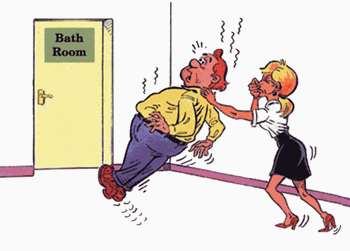
2. A dread of water or of being seen in the nude: Some people who have ablutophobias are overly anxious that their bodies will be criticized or compared with those of others, while some simply have an abnormal fear of being in warm or cold water.
The ablutophobias which Susan's sister suffered from, included being terribly afraid of going near swimming pools.
David's roommate at the university was ablutophobic which made living in the same room with him too difficult, so David made arrangements to move in with a non-ablutophobic student.
The department of psychiatry at t the hospital started a group program for ablutophobic individuals in hopes of generating a better solution for their psychological conditions.
2. Fear of small objects, such as insects, worms, mites, and non-living things like needles and pins: Some people are so afraid of bugs and beetles that they seal off their windows, vacuum and sweep several times a day, and feel anxious outside their "cleansed" homes or apartments.
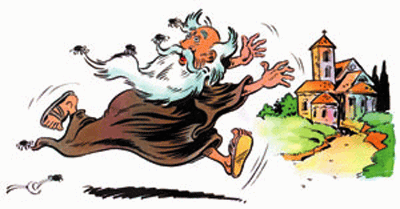
There are over 2,000 different kinds of fleas, of the order Siphonaptera (the kind that live in hair or fur).
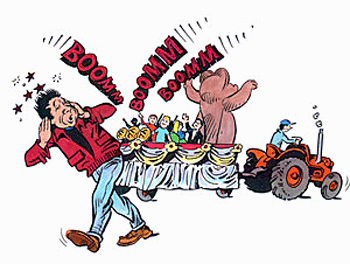
New York mayor started campaign to crack down on noise
- In the year 2002, the mayor of New York, Michael Bloomberg, went after the noise makers.
- He announced a program to tackle the quality-of-life problem most vexing to New York residents: barking dogs, screeching car alarms, music blaring from cars, and drunken bar patrons who share their feelings with everyone on the block at 3 a.m.
- The initiative, known as "Operation Silent Night", was the city's most aggressive attack on noise since 1994.
- The operation was set up to focus on twenty-four neighborhoods that had been identified as among the noisiest, based on calls to the city's quality-of-life hot line.
- Tickets ranging from $5 to $25,000 for businesses with excessive noise complaints were to be issued: arrests, in the most extreme cases, might be made, and cars with blaring alarms were to be towed away.
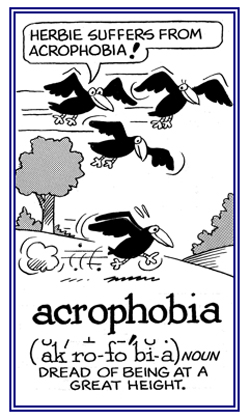
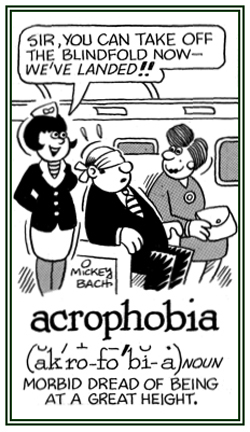
Those who have acrophobia are afraid of being on high floors of buildings or even on the tops of hills or mountains and they often feel overly anxious when they approach the edge of bridges, rooftops, stairwells, and railings.
Sometimes individuals who are afflicted with acrophobia not only have an excessive fear, but they feel an uncontrollable urge to jump off.
There are some people who suffer from acrophobia and also have fantasies and physical sensations of falling even when they are standing on firm ground.
Those who are affected by acrophobia in moving platforms for people, or on escalators, balconies, and stairways, are probably fearful of altitudes just as they are with the terror of flying in aircraft.
Go to this Word A Day Revisited Index
so you can see more of Mickey Bach's cartoons.
An Acrophobic Shared His Experiences
- For one man, life was an unnerving affair.
- The "high anxiety" of a twenty-seven year old civil servant suffered from a condition that restricted both his personal and professional lifestyles.
- His walk-up apartment in the city where he lived was about six feet above ground level which he considered "safe" enough.
- He worked on the fourth floor of a downtown office building where he generally avoided windows.
- If he looked out, it was straight across at the windows of a neighboring building. He didn't dare look down at the hustle and bustle below.
- This phobic always walked the four floors, up and down, because the elevator was a "no-no" for him.
- His acrophobia made him avoid high rises, airplane rides, and car trips through mountainous areas.
- Jaunts to trendy penthouse restaurants were out, as were midway and cable car rides and such "in" sports as mountain climbing, sky-diving, and hang-gliding were obviously out of the question.
- "Height makes me light-headed. I start to tremble and talk reassuringly to myself. If I look down to the ground from a high place, I feel nauseous and want to vomit. I have an overwhelming urge to get out of there, just to get away."
- Although it meant personal sacrifice, this acrophobic learned to live with his phobia. "So far I've been able to get around it. I just don't go to high places. I can find alternate places to go, and other things to do."
Our work is never done. Millions upon millions of secret fears and phobias lurk known and unknown in high and low places of civilization that have yet to be, and must be, leached out of man's progress for his betterment.
