
port-, portat-
(Latin: carry, bring, bear)
Don't confuse this port-, portat with another port- meaning "door, gate, entrance," or "harbor".
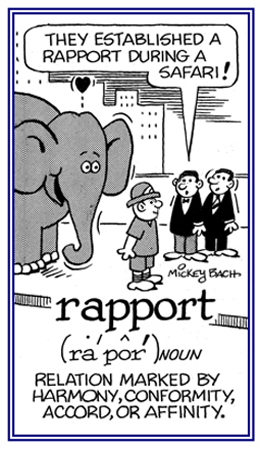
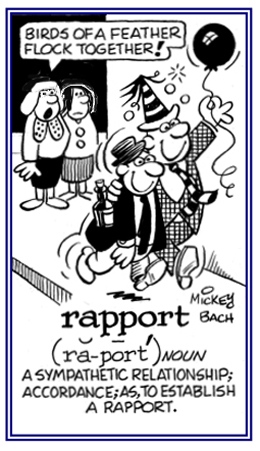
Tim's teacher always established good rapport with her students.
2. Etymology: from Old French rapporter, "to bring back"; from re-, "again" + apporter, "to bring"; from Latin apportare, "to bring"; from ad-, "to" + portare, "to carry".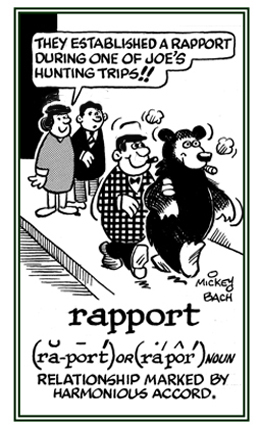

Go to this Word A Day Revisited Index
so you can see more of Mickey Bach's cartoons.
2. A sudden, very loud noise, that may be caused by a gun or an explosion: When walking in the forest, Ezra heard a loud report and was afraid there were hunters in the woods.
3. Etymology: from Latin reportare, "to carry back"; from re-, "back" + portare, "to carry".
2. A person who provides information; especially, someone who is employed to present news or to conduct interviews in order to let others know what has happened: The reporter who appears on one of the major TV networks every evening, Monday-Friday, informs the nation about what is going on nationally and internationally.
2. A diversion; a recreation; or a pleasant pastime: Going hiking whenever possible was Ed's favorite sport.
The Meaning of the Word Sport:
One of the most commonly used English words which we hear and see is sports along with "sports events", "sports programs", "sports activities", "multi sports", and many other applications having to do with sports; however, did you every wonder where the word came from? Well, maybe you don’t care where it came from, but if you are even a little curious, read on:
From about 1400, sport meant a pleasant pastime, amusement, diversion; shortened from an earlier dysporte from about 1303; and borrowed from Anglo-French disport, from Old French desport meaning "a pastime", "recreation", "pleasure", from desporter "to divert", "to amuse" (one- self), "to please", and "to play".
The sense of a game, usually one involving physical exercise, was first recorded in English in 1523. The meaning of "good fellow" (as in “be a good sport”) developed about 1905 from the earlier sense of someone who was concerned with sports, sportsman (1861).
Disport Is the Original Form of the Word Sport
Another word that dictionaries refer to as contributing to the origin of the word sport is "disport" which was borrowed from Old French desporter, literally, "to carry away", as of from Old French desporter, literally, to carry away , as of the attention from serious matters (des- “away”, from Latin dis-, + porter “to carry" or "to bear”, from Latin portare).
So, the result of this discussion about such a well-known word may be summarized by saying, sport is an abbreviation of the original "disport" and the noun originally meant “to carry away”, especially “to carry away from work” and, by extension, “amusement” or “recreation”, which is what people do by amusing themselves when playing a sport; that is, if they are not “professional athletes”. It was not used in its main modern sense as “athletic contests” until the mid 19th century.
Emperor Nero, Chariot Racer
It is a matter of historical record that the emperor of Rome won every event in which he entered during the Olympics held in A.D. 67. In fact, when Emperor Nero on one occasion fell from his chariot during a race, the other contestants politely, and wisely, waited until he had remounted and sped on before they continued the race.
2. To maintain in position so as to keep from falling, sinking, or slipping: As the life guard was saving the woman, he told her that he would support her in the water until she was safe on the beach again.
3. To be able to bear or to withstand: Hanna was emotionally supporting her mother during the crisis after the fire destroyed her house.
4. To provide for, by supplying with money or necessities: When prices increased, Sam found it hard to support his wife and children with his small salary.
5. Etymology: from Latin supportare, "to convey, to carry, to bring up"; from sub, "under" + portare, "to carry".
2. Etymology: from Greek tele, "distance, far" and French portare, "to carry".
Cross references of word families related to "bear, carry, bring": duc-; -fer; ger-; later-, -lation; phoro-.

