
mal-, male-, mali-
(Latin: bad, badly, harsh, wrong; ill; evil; abnormal, defective; used primarily as a prefix)
This combining form has no etymological connection to "male", meaning "man" or "masculine"; despite what some women may think.
Someone who attempts to defame, asperse, or slander other people: The local social columnist for the town newspaper was considered a maligner because he often wrote scathing articles about politicians in the community.
1. Wicked and deep-rooted ill-will; an intense and persistent desire to cause suffering to other people: The malignities between the two families stretched back several generations and no one really knew what the hatred was all about.
2. A disease or an injury that is deadly or destructive: The doctor was sure that the malignity which Joan had was potentially fatal if it was not treated immediately.
3. Qualities; such as, cattiness, spitefulness, or carrying a grudge: The old man, who lived in the run-down house, shouted at everyone who walked by, seemingly unaware of the malignity that he was hollering at them.

© ALL rights are reserved.
Go to this Word A Day Revisited Index
2. A disease or an injury that is deadly or destructive: The doctor was sure that the malignity which Joan had was potentially fatal if it was not treated immediately.
3. Qualities; such as, cattiness, spitefulness, or carrying a grudge: The old man, who lived in the run-down house, shouted at everyone who walked by, seemingly unaware of the malignity that he was hollering at them.
Go to this Word A Day Revisited Index
so you can see more of Mickey Bach's cartoons.
malinger (verb), malingers; malingered; malingering
To feign or to fake an illness; usually, in order to arouse sympathy, to escape work, or to continue to receive compensation: If Susanna tried to malinger when she was going to school, her parents would allow her to stay home; however, she had to stay in bed all day.
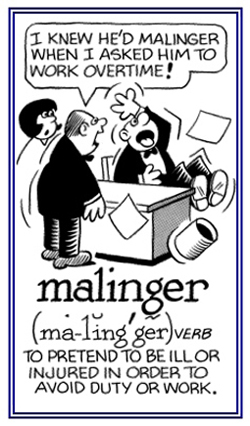
© ALL rights are reserved.
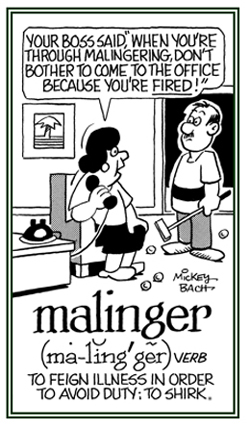
© ALL rights are reserved.
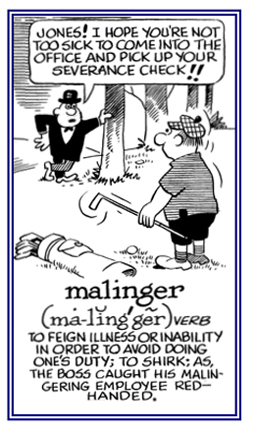
© ALL rights are reserved.
Go to this Word A Day Revisited Index
Go to this Word A Day Revisited Index
so you can see more of Mickey Bach's cartoons.
A person who pretends to be sick in order to avoid some responsibility: Mac's co-worker at his office had a reputation as being a malingerer who often called in sick on Mondays.
malingering (adjective), more malingering, most malingering
Descriptive of someone who is pretending to be ill: The school report card indicated that Timothy was a malingering child, often away from school for seemingly superficial reasons, even though he was always claiming he had been very sick.
A dental condition in which the upper and lower teeth are not properly lined up when biting or chewing: The orthodontist fitted Judy with a brace to help her overcome the malinterdigitation or misalignment of her teeth.
malis avibus (Latin motto)
Translation: "Bad birds."
"With unlucky birds; a reference to bad auspices (prophecies for the future)."
The belief that the world is full of evil or that wickedness is overwhelming the world: There are those who are convinced that the world has too much malism, in too many places, all of which will cause more harm and destruction because of the dominance of wars and terrorist attacks.
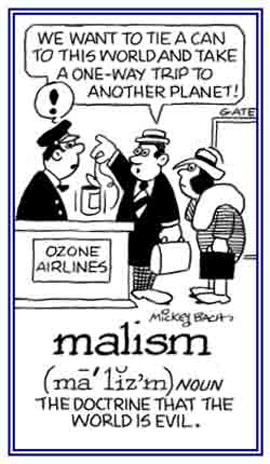
© ALL rights are reserved.
Go to this Word A Day Revisited Index
Go to this Word A Day Revisited Index
so you can see more of Mickey Bach's cartoons.
1. A swearword, an obscenity, or a blasphemous oath: When Spencer got a flat tire while driving in the desert, he uttered several malisons before getting out his cell phone to call for assistance.
2. An appeal to a supernatural being to bring harm to someone or the harm that is thought to result from this: During his walk in the cemetery, Zach was sure he heard whispers of malisons swirling around him and threatening his well-being.
2. An appeal to a supernatural being to bring harm to someone or the harm that is thought to result from this: During his walk in the cemetery, Zach was sure he heard whispers of malisons swirling around him and threatening his well-being.
In a state of depression following a nightmare: Glenda's bad dream was so real that she wandered around the next day in a state of malneiophrenia because she was feeling unsettled and emotionally disturbed.
malnourished (adjective), more malnourished, most malnourished
Relating to suffering from insufficient nutrition or nourishment; undernourished: The television program on poverty showed pictures of malnourished children living in desperate poverty in a large city.
Inadequate nourishment or caloric intake to sustain good health: The state of malnutrition among the animals at the private animal sanctuary was closed because it was so terrible to see and therefore it was no longer available for the public to experience.
Some causes of malnutrition can be a result of not having enough to eat, not eating the right things, or being unable to digest the food that one does eat.
2. Etymology: from Latin mali-, "bad, poor, poorly" + nutritionem from nutire, "a nourishing" + -tion, "act or process of".
Faulty alignment of the teeth: Eugene's neighbor had to wear a retainer to overcome the malocclusions of her teeth so she could chew her food properly.
The antonym for malocclusion is the rarely used term of "benocclusion" or "good alignments of the teeth.
Smelling unpleasant or nasty: The malodor of the polluted beach was so stinking and offensive that it drove visitors away from the resort.
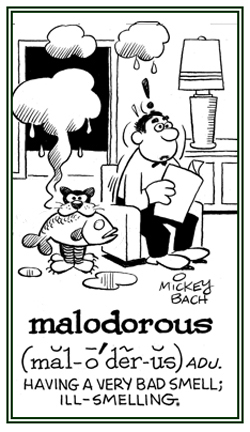
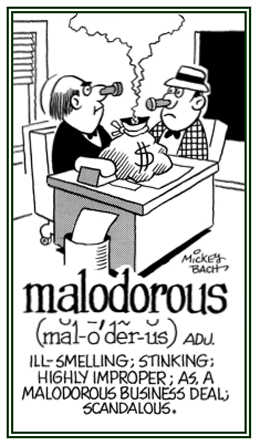
malodorous (adjective), more malodorous, most malodorous
Relating to having a terribly bad stink: The malodorous sewage ditch through the city was so abominable that the health inspectors demanded that it be cleaned up and closed so no one could go near it.
© ALL rights are reserved.
© ALL rights are reserved.
Go to this Word A Day Revisited Index
Go to this Word A Day Revisited Index
so you can see more of Mickey Bach's cartoons.
Inter-related cross references, directly or indirectly, involving word units meaning "bad, wrong": caco-, kako-; dys-; mis-; pessim-; sceler-.

