autoluminescence
(s) (noun), autoluminescences
(pl)
A shine or emission of light that comes from energy within a material; such as, that which is generated by radioactive materials: Many creatures in the deepest parts of the ocean have a form of
autoluminescence, a glow that comes from them to illuminate their surrounding area.
bioluminescence
(s) (noun), bioluminescences
(pl)
The emission of a beaming radiation by some living organisms, or the light so produced: The scientific study of
bioluminescence spans both zoological and botanical specimens, studying the production of a self-generating glowing glimmer.
Bioluminescence occurs when a pigment, usually "luciferin"; is oxidized without giving off heat.
Although it is believed that bioluminescence is involved in animal communication, its function in many organisms has yet to be understood.
Bioluminescence is a form of "chemiluminescence" and most luminescent animals have an effulgent-producing organ; such as, "photophore".
Such bioluminescence may contain their own specialized luster-producing cells, or have symbiotic luminescent bacteria.
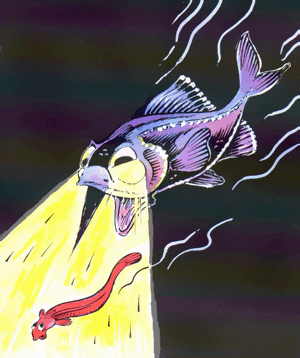
The darkness of the ocean presents a variety of bioluminescent creatures
The most expansive animal habitat on the earth lies between the sea surface and the floor of the deep ocean basins. Within this enormous space live the largest and perhaps most remarkable biological communities of fauna.
Most creatures of this twilight world are able to augment the scant sunlight reaching them with another form of natural illumination known as bioluminescence.
Although bioluminescence is a relatively rare phenomenon in terrestrial ecosystems, the vast majority of the animals that inhabit the upper kilometer of the ocean are capable of producing light with photophores in one way or another.
The illustrated bioluminescent fish for this page is similar to a "flashlight fish" which has headlights made up of sacs of luminescent bacteria under its eyes that light its way around the ocean depths.
Before man caught up with nature, she developed her own uses for bioluminescence; for example, many predators use their natural lighting to catch their meals; as shown in the image.
—"Light in the Ocean's Midwaters" by Bruce H. Robinson;
Scientific American, July, 1995; and "Living Lights"
by Kenneth Jon Rose, Science Digest, January, 1984.
bioluminescent
(adjective), more bioluminescent, most bioluminescent
1. Related to living organisms that emit radiance: Fireflies are bioluminescent creatures.
2. A reference to the production of radiation by living organisms as a result of the oxidation of a light-producing substance (luciferin) by the enzyme luciferase and occurs in many marine organisms and insects; such as, the firefly, etc.: Jonathan reported to his botany class about his strange and disturbing walk through the woods when he saw bioluminescent fungi glimmering in the dark.
cathodoluminescence
(s) (noun) (normally used only in the singular form)
An emission of brightness, resulting from the bombardment of a substance with an electron beam: The procedure of cathodoluminescence is employed in the development of televisions, computers, radars, and oscilloscope displays, etc. and involves the emission of light as a result of an interaction with free electrons.
cathodoluminescence
(adjective), more cathodoluminescence, most cathodoluminescence
A description of the emission of effulgence, including a possible afterglow, by a substance as the result of exposure to electrons from an electrical device: The ore in the mine showed a very
cathodoluminescence radiance after the ore detectors had stormed the surface with electrons.
The principal applications of cathodoluminescence are in television, computer, radar, and oscilloscope displays.
chemiluminescence labeling
(s) (noun), chemiluminescence labelings
(pl)
A method used to label DNA [d(eoxyribo)n(ucleic) a(cid)] or deoxyribo nucleic acid; a substance in living beings which determines their species, and can be used to uniquely identify each person: Two different DNA probes produced light that provided chemiluminescence labeling when they were brought together in the same region of the gene.
chemiluminescence, chemoluminescence
(noun) (normally used only in the singular form)
1. Emission of brightness accompanying a chemical reaction, as in the oxidation of phosphorus: The eerie glimmer of the mushrooms on the forest floor at dusk was caused by chemiluminescence, the chemical action that produces a glowing shine.
2. In physical chemistry, any process in which a chemical reaction produces visible rays without a corresponding increase in temperature: In "bioluminescence", the blinking generated by fireflies, is a form of chemiluminescence.
chemoluminescent, chemiluminescent
(adjective); more chemoluminescent, more chemiluminescent; most chemoluminescent, most chemiluminescent
A reference to, or descriptive terms for, the emission of visible radiation resulting from chemical reactions: Dora watched in fascination as the most chemiluminescent insect she had ever seen walked up the tree trunk. It was like watching a florescent shimmer ascend the tree.
Dominus illuminatio mea. (Latin motto)
Translation: "The Lord is my light."
Motto of Oxford University, Oxford, UK. This motto is also translated as, "The Lord, my illumination."
electroluminescence
(s) (noun) (no plural)
The conversion of electrical energy into light energy which is produced without heat by passing an alternating current through a phosphorescent substance from a high-frequency electric discharge: The designers of Lorna's new kitchen decided to install two ceiling lamps that used the principles of electroluminescence to produce illumination that is cooler than normal lucency.
electroluminescent
(adjective) (not comparable)
A descriptive term for the generation of illumination that is excited by the applications of an electric field to a system, usually in the solid state, which are systems that can be made very thin, resulting in thin-panel area effulgence sources and flat screens to replace cathode-ray tubes for electronic displays and image formations: The guarantee for Norbert's new flat screen TV said it employed the most electroluminescent system for generating brightness known to industry.
electroluminescent display
(s) (noun), electroluminescent displays
(pl)
A display in which various combinations of segments may be activated by applying voltages to produce any desired numerical or other characters: Electroluminescent display devices present data, usually in the form of numbers or letters, when alternating current is applied to their electroluminescent segments.
electroluminescent display screen
(s) (noun), electroluminescent display screens
(pl)
A tool with an extra semiconductor control layer which permits storing of images for controllable periods of at least an hour: The desired image is projected onto the electroluminescent display screen with ultraviolet light, and it is completely erased with infrared radiation.
electroluminescent lamp
(s) (noun), electroluminescent lamps
(pl)
An appliance which provides light for rooms and is designed in the shape of a panel that is decorative as well as functional, providing radiance to various areas: An
electroluminescent lamp is made up primarily of a capacitor having a ceramic dielectric with electroluminescent phosphor.
The amount of illumination of an electroluminescent lamp is determined by the voltage across the layer and by the frequency applied to it.
electroluminescent panel
(s) (noun), electroluminescent panels
(pl)
A light source consisting of a suitable phosphor placed between sheet metal electrodes; one of which is essentially transparent, separated by only a few thousandths of an inch (0.001 cm), with an AC voltage applied between the electrodes: The architect included several electroluminescent panels in the iridescent design of the new home, providing adequate light for the rooms without generating extra heat.

