
dies, di-, die-, -diem, diurn-
(Latin: day)
Don't confuse this dies, "day" (DEE uhs) with the verb dies (DIGHZ) which refers to "dying" or "death".
2. To move, to leave: Having finished dinner, Ted's family adjourned to the living room.
3. To suspend the business of a court, a legislature, or a committee temporarily or indefinitely: The judge adjourned the trial until the following morning.
3. Etymology: originally, "appoint a day for"; then it came to be known "for postponing, deferring, or suspending". It originated from the Old French phrase à jorn nommé, "to an appointed day"; from which the the Old French verb ajourner derived.
The word jour came from late Latin diurnum, a noun that was formed from the adjective diurnus, "daily"; which was based on the noun dies, "day".
2. The end or the conclusion of something: The adjournment of Congress is expected to be delayed until the budget is passed.
2. Before midday; applicable to the hours between midnight and the following noon.
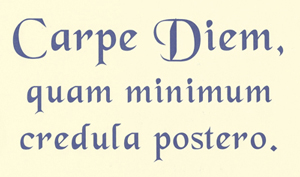
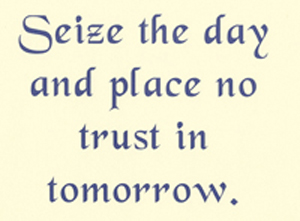
"Enjoy the present moment and don't depend on there being a tomorrow." -Horace
A continuing traditional theme in lyric poetry, dating back at least to Koheleth's "Eat, drink, and be merry" (based on Ecclesiastes 8:15). The phrase carpe diem exemplifies the spirit of hedonism and Epicureanism, i.e., the enjoyment of the moment and recognition of the transient nature of life.
So, carpe diem came from ancient times until the present with the advice often and variously expressed as: "Enjoy yourself while you have the chance"; "Eat, drink, and be merry, for tomorrow we die"; "Make hay while the sun shines"; "Enjoy yourself, it's later than you think."
William Safire had a different attitude regarding carpe diem when he wrote: "Seize the day has come to mean ‘strike while the iron is hot.' No longer is carpe diem the what-the-hell attitude of the dwellers in the present; it has become the battle cry of the gutsy opportunist with an eye on the future."
Many famous poems develop this "live it up now" theme; such as , the following by Robert Herrick (1591-1674):
Old Time is still a-flying,
And this same flower that smiles today
Tomorrow will be dying.
Translation:
2. A book which is set up for keeping a daily record, or having spaces with printed dates for certain daily memoranda and keeping notes about topics: Some diaries also include calendars that contain daily contents about matters of importance to people generally, or to members of a particular profession, occupation, or pursuit.
2. Relating to being depressed and miserable: The nurse noticed how the patient's sickness was making him feel dismal.
3. Descriptive of being very bad, poor, or disaster: The drama that was presented turned out to be a dismal failure. 4. Etymology: from Latin dies mali, "evil days"; via Anglo-Norman dis mal; literally "evil days"; used to indicate two days in each month that, according to ancient superstitions, were supposed to be unfortunate or unlucky days.
The term dismal became known as being a day of "gloom" and "calamity".
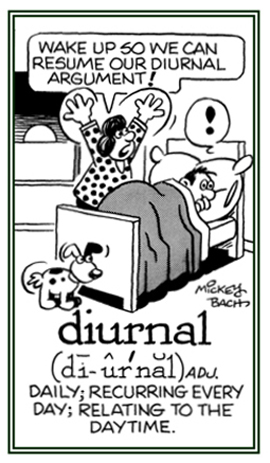
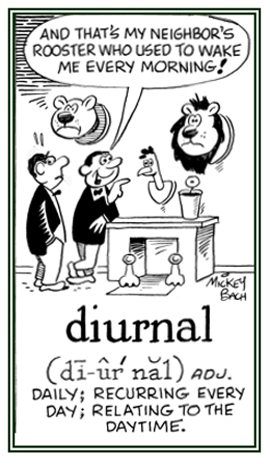
2. Pertaining to something which takes place every day: A good diurnal habit is to brush the teeth in the morning and in the evening on a regular basis.
Diurnal newspapers are delivered to George's mailbox from Monday to Saturday.
3. Descriptive of a book for daily use: On their trip in Africa, Lynn kept a diurnal record in her diary about the sights she and her husband saw and their experiences along the way.
4. Characteristic of a living creature which is active during the day and inactive during the night: Apes are considered to be diurnal animals, since they are busy and lively only from morning until late in the evening.
5. A reference to a flower which opens throughout the daylight and closes at night. There are specific diurnal plants like the morning glory and the crocus.
Go to this Word A Day Revisited Index
so you can see more of Mickey Bach's cartoons.
Humans are primarily diurnal creatures
If people were really at home under the light of the moon and stars, they would go into the darkness happily and the midnight world would be visible just as it is to the vast numbers of nocturnal species on the Earth.
Instead, people are generally diurnal creatures, with eyes adapted to living in the sun's light. This is considered to be a basic evolutionary fact, even though most people don't think of themselves as diurnal beings any more than they think of themselves as primates, or mammals, or Earthlings.
Yet, it's the only way to explain the light pollution that humans have done to the night. Ill-designed lighting has washed out the darkness of night and radically altered the light levels, and light rhythms, to which many forms of life, including mankind, have adapted.
Wherever human light spills into the natural world, some aspect of the lives of other creatures is affected; including migration, reproduction, and feeding.
In most cities, the sky looks as though it has been emptied of stars, leaving behind a vacant haze that mirrors the fear people have of the dark and resembles the urban glow of dystopian science fiction; which includes, societies or states in which the conditions of human life are characterized by misery, poverty, oppression, violence, disease, and pollution.
2. A daily record of commercial transactions, entered as they occur, for the purpose of keeping accounts.
3. A daily newspaper or other publication; hence, by extension, any periodical publication containing news or dealing with matters of current interest in any particular sphere. Now often called specifically a "public journal".
4. Etymology: from about 1355, "a book of church services", from Anglo-French jurnal, "a day"; from Old French journal, originally "daily", from Late Latin diurnalis, "daily"; as in diurnal.
The sense of "a daily record of transactions" was first recorded in 1565; that of "a personal diary" is about 1610, from a sense found in French. "Journalism" in English is from 1833; as well as from French in about 1781.
Another related "day" unit is located at hemer-.
