
voc-, voca-, vocab-, vocat-, -vocation, -vocative, -vocable, vok-, -voke
(Latin: call, talk, speak, say, voice; word)
Abyssus abyssum invocat. (Latin)
Translation: "One misstep leads to another."
Literally, "Hell calls hell." A warning that the first step in the temptation to go astray from what is "right" (or "morally correct") is difficult to prevent; however, we must always be on guard to strive for what is ethical and honorable.
ad hanc vocem; a.h.c. (Latin phrase)
Translation: "At this word."
1. An active verbal support for a cause or political position, etc.: At the political convention, there was a lot of advocacy, or backing up, for the experienced and wise candidate for the office of U.S. President.
2. The act of speaking or writing, in support of something, such as an idea, a cause, or a policy, and giving active support: Jane’s advocacy for the local animal rights group helped convince the public to donate more money for saving the lives of stray animals.
2. The act of speaking or writing, in support of something, such as an idea, a cause, or a policy, and giving active support: Jane’s advocacy for the local animal rights group helped convince the public to donate more money for saving the lives of stray animals.
1. Someone who argues for a cause: Shirley has been a supporter, a defender, and an advocate of civil rights for many years and her husband has also been a tireless advocate of social reform.
2. People who plead in behalf or others or who are intercessors: Tina's parents have been advocates for abused children and spouses in a variety of media and social movements.
3. An individual with legal training who supports or intercedes for other people: The advocate who Jane hired to plead her case in the traffic court was successful and so she didn't have to pay a large fine.
2. People who plead in behalf or others or who are intercessors: Tina's parents have been advocates for abused children and spouses in a variety of media and social movements.
3. An individual with legal training who supports or intercedes for other people: The advocate who Jane hired to plead her case in the traffic court was successful and so she didn't have to pay a large fine.
advocate (AD vuh kayt") (verb), advocates; advocated; advocating
To urge, to suggest, or to exhort in support of someone or something: In court during the weekend, Karl's friend advocated for a former student who had been sleeping in the park.
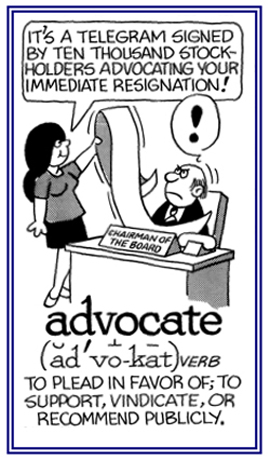
© ALL rights are reserved.
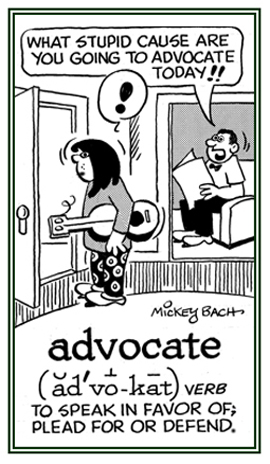
© ALL rights are reserved.
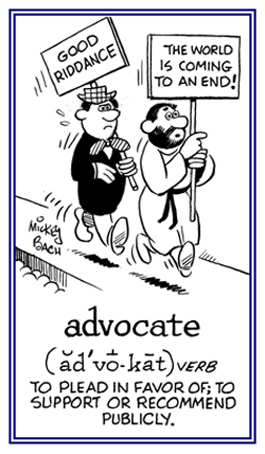
© ALL rights are reserved.
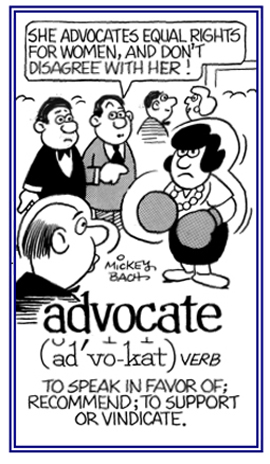
© ALL rights are reserved.
Go to this Word A Day Revisited Index
Go to this Word A Day Revisited Index
so you can see more of Mickey Bach's cartoons.
1. A transaction whereby someone pleads the cause of another person in a court of law: Jane’s advocation in support of her friend who was convicted of trespassing was respected by the judge and the whole jury.
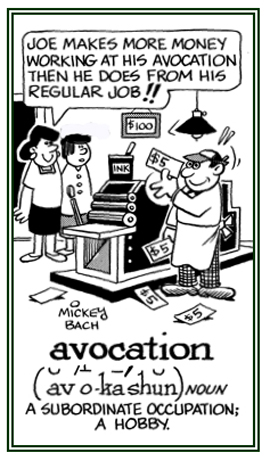
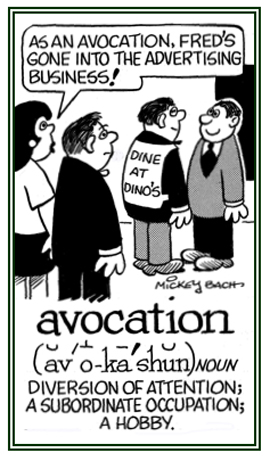
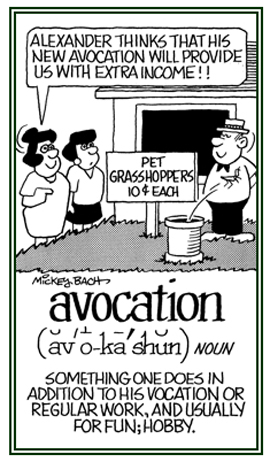
2. What someone does for amusement, or for relaxation, away from his or her regular job; a hobby: A group of teachers whose avocations were the playing of musical instruments decided to form a small orchestra.
2. What someone does for amusement, or for relaxation, away from his or her regular job; a hobby: A group of teachers whose avocations were the playing of musical instruments decided to form a small orchestra.
Advocatus diaboli. (Latin)
Translation: "Devil's advocate."
This term is generally used to describe someone who takes the unpopular or opposite side in an argument either out of contentiousness or out of a zeal for the truth.
1. The right in English ecclesiastical law of a presentation to a vacant benefice, a right exercised by nomination of a clergyman for a church or a church office that provides a living for its holder through an endowment with money attached to it.
2. In English law, an assignment for someone to be in a vacant position temporarily until another person has been chosen to be responsible permanently.
3. Etymology: from Middle English avouson, from Old French avoeson, from Medieval Latin advocatia, from Latin advocatio, "a summoning", from advocare, "to summon".
2. In English law, an assignment for someone to be in a vacant position temporarily until another person has been chosen to be responsible permanently.
3. Etymology: from Middle English avouson, from Old French avoeson, from Medieval Latin advocatia, from Latin advocatio, "a summoning", from advocare, "to summon".
1. A person who is employed to encourage people to break the law so they can be arrested and prosecuted: The government used agents provocateurs to try to undermine the opposition party so they would lose the election.
2. A secret agent implanted in an organization; such as, a trade union or political party, to incite its members to actions or declarations that will result in penalties or punishment for them: In the story that Jim was reading, the secret service decided to ask a young woman to be an agent provocateur in order to provoke a suspected person to perform an illegal deed which would then result in his conviction.
2. A secret agent implanted in an organization; such as, a trade union or political party, to incite its members to actions or declarations that will result in penalties or punishment for them: In the story that Jim was reading, the secret service decided to ask a young woman to be an agent provocateur in order to provoke a suspected person to perform an illegal deed which would then result in his conviction.
The fondness or adoration of a person’s own voice: Marie loved to sing and even recorded her songs to listen to, which showed her strong tendency for autovoxiphillia.
1. A hobby or pastime; not one's normal work: Lynn’s avocation, after teaching in the morning, was working in her garden because she loved the fresh air, seeing the plants grow and enjoying it!
2. The opposite of one's career or occupation: Susan knitted scarves, caps and sweaters as an avocation, which was quite different to her job as a financial advisor, and she gave them to her friends as Christmas presents!
3. Etymology: "a calling away from one's occupation", from Latin avocationem, "a calling away"; and Latin avocare, "to call away"; from ad-, "away" plus vocare, "to call".
© ALL rights are reserved.
© ALL rights are reserved.
© ALL rights are reserved.
Go to this Word A Day Revisited Index
2. The opposite of one's career or occupation: Susan knitted scarves, caps and sweaters as an avocation, which was quite different to her job as a financial advisor, and she gave them to her friends as Christmas presents!
3. Etymology: "a calling away from one's occupation", from Latin avocationem, "a calling away"; and Latin avocare, "to call away"; from ad-, "away" plus vocare, "to call".
Go to this Word A Day Revisited Index
so you can see more of Mickey Bach's cartoons.
avouch (verb), avouches; avouched; avouching
1. To declare the provable truth or validity of; to affirm: Mr. Smith avouched that his son, Tim, could not have committed the crime.
2. To corroborate or to confirm; to verify: Was the police officer able to avouch his accusations about the boy?
3. To accept responsibility for and to acknowledge responsibility for doing something: When Richard and Greg both had exactly the same answers on their tests, Greg avouched that he was the one who copied from Richard.
4. To avow or to confess: Tom avouched or admitted that he had eaten some of the cake and not his brother!
5. Etymology: from Middle French avochier, "call upon as authority"; from Old French and Latin advocare, "to call to" as a witness.
2. To corroborate or to confirm; to verify: Was the police officer able to avouch his accusations about the boy?
3. To accept responsibility for and to acknowledge responsibility for doing something: When Richard and Greg both had exactly the same answers on their tests, Greg avouched that he was the one who copied from Richard.
4. To avow or to confess: Tom avouched or admitted that he had eaten some of the cake and not his brother!
5. Etymology: from Middle French avochier, "call upon as authority"; from Old French and Latin advocare, "to call to" as a witness.
avouchable (adjective), more avouchable, mostavouchable
Conveying that which is capable of being verified: Tom's check for $50 was avouchable because his bank account was covered, so Edward could cash it without any problem.
1. Someone who makes frank acknowledgment or affirmation of something: Jim’s mother gave the bank her personal assurance as an avoucher when he wanted to open up his own banking account.
2. Those who declare or assert something with strong declarations: The members of the peace committee were morally sound and quite eloquent avouchers when it came to stating their convictions at the convention.
2. Those who declare or assert something with strong declarations: The members of the peace committee were morally sound and quite eloquent avouchers when it came to stating their convictions at the convention.
1. Statements asserting the existence or the truth of something: Shirley made a strong avouchment that she had nothing to do with the fight that took place at the party which involved her brother and another guy.
2. Declarations made emphatically; as if no confirming evidence is necessary: The avouchment made by the weather forecaster that it would rain that day was accepted by everyone because that is exactly what was going on!
2. Declarations made emphatically; as if no confirming evidence is necessary: The avouchment made by the weather forecaster that it would rain that day was accepted by everyone because that is exactly what was going on!
Cross references of word families related directly, or indirectly, to: "talk, speak, speech; words, language; tongue, etc.":
cit-;
clam-;
dic-;
fa-;
-farious;
glosso-;
glotto-;
lalo-;
linguo-;
locu-;
logo-;
loqu-;
mythico-;
-ology;
ora-;
-phasia;
-phemia;
phon-;
phras-;
Quotes: Language,Part 1;
Quotes: Language, Part 2;
Quotes: Language, Part 3;
serm-;
tongue.
