
tribo-, trib-
(Greek: friction, rub, rubbing, grind, wear away; spend, waste time; be busy)
The President has expressed many diatribes against various medias; including television, radio, and some newspapers.
2. Etymology: the Greek word diatribe, the ultimate source of the English word, is derived from the verb diatribein, made up of the prefix dia-, "completely", and tribein, "to rub, to wear away, to spend," or "to waste time, to be busy".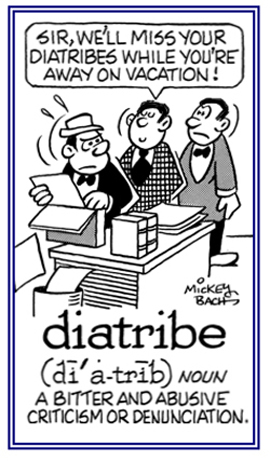
Go to this Word A Day Revisited Index
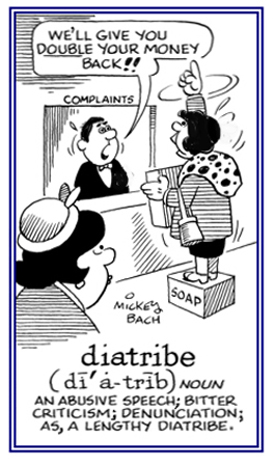
so you can see more of Mickey Bach's cartoons.
2. A type of contact electrification in which certain materials become electrically charged after they come into contact with a different material and are then separated by rubbing.
The polarity and strength of the charges which are produced are determined by the materials, surface roughness, temperature, and other characteristics.
Many tortoises and birds are also hydrotribophiles that exist in barren land having roughly eroded ridges, peaks, and mesas.
This field will become a very important part of production in the years to come, as a new generation of micromachines and nanomachines find their way out of the laboratory and onto the production line.
 More information about nanotribology is available here.
2. Mutual friction of the genitals between women.
Frictional electricity was supposedly known to the ancient Greeks, particularly Thales of Miletus, who observed about 600 B.C. that when amber was rubbed, it would attract small bits of matter. The term "frictional electricity" gave way to "triboelectricity", although since tribo means "to rub", the newer term does little to change the concept.
2. A process of charge separation that involves the rubbing together of dissimilar material surfaces; such as, blowing dust which may charge fences and other metallic objects to such an extent that slight shocks are felt when touched.
The triboelectric series is a classification scheme for the ordering of the tendency for positive charge acquisition in rubbing. The detailed physical mechanism in triboelectrification is a long unsolved problem.
Cross references of word families that are related directly, or indirectly, to: "rub, rubbing; wear away; wipe": bruxo, brux-; frica-, frict-; terg-; -tripsy; trit-.
