
terr-, terra-, -ter
(Latin: earth, dry land, land)
This unit presents many words that are used in references having to do with earth and land; that is, the loose, fragmented material that composes part of the surface of this planet that we live on.
Don't confuse this element with other words that are spelled in a similar way; such as, terrify, terrible.
2. To bring to public notice; to disclose: Janice was able to disinter an ancient document about Julius Caesar that has been missing from public knowledge for centuries.

Go to this Word A Day Revisited Index
so you can see more of Mickey Bach's cartoons.
The word exoterroid is a general term for each moon, asteroid, comet, meteor, and hydrometeor that had its origin on Earth.
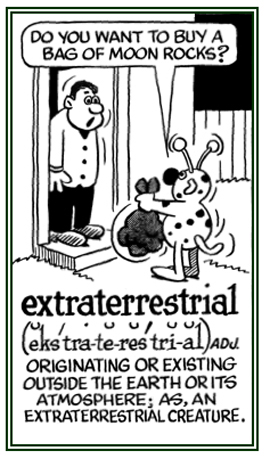
2. Etymology: from Greek and Latin: "form out of the earth".2. A reference to an object originating from sources other than the Earth: One example is the extraterrestrial sun, which is a star providing energy and light to support life on this planet.
Go to this Word A Day Revisited Index
so you can see more of Mickey Bach's cartoons.
2. Of or relating to people who are exempt from the legal jurisdiction of the country in which they reside: An ambassador, or someone from the embassy of one country, has extraterritorial rights that are free of the legal authority of the nation in which he or she lives.
Lots of plants flourish in fluvioterrestrial areas on land, but not in maritime waters.
Whenever you hear the word mediterranean, do you think of that specific place and perhaps of the great cultures that have surrounded it? You should know that the word can also apply to any large body of water that is surrounded completely or almost completely by dry land. This usage goes back to the use in Late Latin of the Latin word mediterraneus, the source of our word, as part of the name Mediterraneum mare for the mostly landlocked Mediterranean Sea.
Keep in mind that Latin mediterraneus, which is derived from medius, "the middle of, the heart of," and terra, "land", in Classical Latin actually meant "remote from the coast, inland".
In Late Latin, in referring to the sea, mediterraneus probably originally meant "in the middle of the earth" rather than "surrounded by land", because to the Mediterranean cultures without knowledge of much of the earth, the Mediterranean Sea was in the center of the world. Our word mediterranean is first recorded in English, in 1594, as the name of the sea.
