
spec-, spic-, spect-, spectat-, spectro- -spectr, -spectful, -spection, -spective
(Latin: to see, seeing; to look at, looking at; sight, to appear, appearing; to behold, to examine, examining)
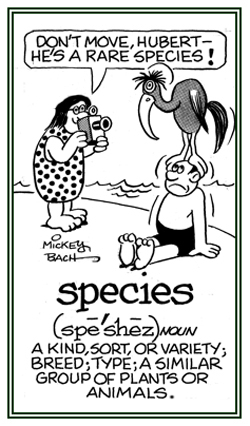
2. The emergence of a new biological group in the course of, and as a consequence of, evolution: "Speciation is the formation of a new species. Geographic isolation can lead to genetic isolation within a few generations, as is thought to have occurred with the grizzly bear (Ursus arctos horribilis) and the polar bear (Ursus maritimus)."
"Over a period of time, the shuffling and reshuffling of the same genes result in individuals with distinct physical characteristics, vastly different from the individuals from whom they became separated; for example, the polar bear developed a unique coloration and diet as distinct from that of its grizzly cousin."
Birds are not a species; however, robins, bluejays, sparrows, etc. are.
Generally speaking, all members of a species look and behave similarly in all important respects and can breed among themselves.
Normally, breeding between members of different species does not occur in nature.
Groups of organisms, minerals, or other entities are recognized as being distinct species from each other.
According to some biologists, there are approximately 8,000 species of ants.
It has been estimated that between five and thirty million different species of organisms live on the Earth.
Such groups as the vertebrates (fishes, amphibians, reptiles, mammals, and birds) and flowering plants have relatively fewer species, numbering only in the hundreds of thousands; while insects account for the greatest number of all of the species which exist.
Go to this Word A Day Revisited Index
so you can see more of Mickey Bach's cartoons.
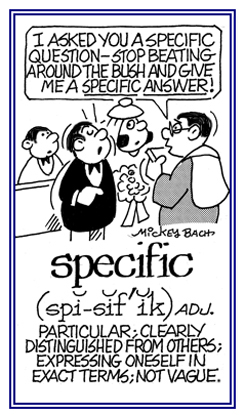
2. Pertaining to particular people or situations: The counselor was presenting an educational plan which was specific for students who were planning to go to a university, or college, after they have graduated from high school.
Go to this Word A Day Revisited Index
so you can see more of Mickey Bach's cartoons.
2. A sample of something that is used for medical-diagnostic analysis: "The doctor asked Karl for a specimen or sample of bodily fluid; specifically, urine which would be used for analysis or diagnosis."
Adam justified his bad behavior with several specious excuses.
2. Etymology: from Latin speciosus, "appearance" and from specere, "to look at."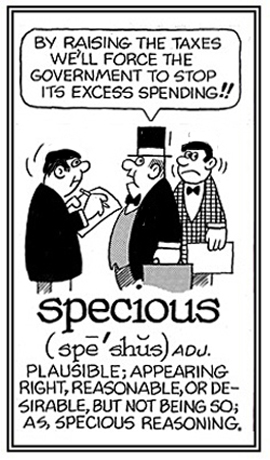
Go to this Word A Day Revisited Index
so you can see more of Mickey Bach's cartoons.
2. A public performance or display; especially, something on a large or lavish scale.
3. A regrettable public display, as of some kind of bad behavior: "The guy drank so much that he made a spectacle of himself."
2. Lenses set in a frame which holds them in front of the eyes and that are used to correct errors of refraction or to protect the eyes.
The parts of the spectacles are the lenses; the bridge between the lenses, resting on the nose; and the rims or frames, encircling the lenses; plus the sides or temples that pass on either side of the head to the ears.
2. A single dramatic production of unusual length or lavishness (expense).
3. Being very impressive or dramatic; such as, a grand and impressive show or performance.
Cross references of word families that are related directly, or indirectly, to: "appear, visible, visual, manifest, show, see, reveal, look": blep-; delo-; demonstra-; opt-; -orama; pare-; phanero-; phant-; pheno-; scopo-; vela-, veal-; video-, visuo-.

