
sed-, sedat-, -sid, -sess
(Latin: sit, sitting)
assess (verb), assesses; assessed; assessing
1. To set an estimated value on property, etc. for taxation; to estimate, to appraise, to value: The local tax office decided to assess the new houses.
2. To estimate or determine the significance, importance, or value of; to evaluate; levy a charge on, tax: The club assessed each member $100 to rebuild the new clubhouse.
3. To judge, evaluate, appraise, look over: The general assessed the military situation and called for reinforcements.
4. To calculate a value based on various factors: Harry said the insurance adjusters already assessed the damage done to his house by the storm.
5. To fix or determine the amount of (damages, a tax, a fine, etc.): The hurricane damage was assessed at billions of dollars.
6. To estimate or to judge the value, character, etc., of; to evaluate: Mark tried to assess what it would cost to improve the condition of his yard after the heavy rain.
2. To estimate or determine the significance, importance, or value of; to evaluate; levy a charge on, tax: The club assessed each member $100 to rebuild the new clubhouse.
3. To judge, evaluate, appraise, look over: The general assessed the military situation and called for reinforcements.
4. To calculate a value based on various factors: Harry said the insurance adjusters already assessed the damage done to his house by the storm.
5. To fix or determine the amount of (damages, a tax, a fine, etc.): The hurricane damage was assessed at billions of dollars.
6. To estimate or to judge the value, character, etc., of; to evaluate: Mark tried to assess what it would cost to improve the condition of his yard after the heavy rain.
The military officers were assessing the battle reports so they could decide what to do next.
7. Etymology: "to fix the amount" (of a tax, fine, etc.), from Anglo-French assesser, from Middle Latin assessare "to fix a tax upon", originally from Latin assidere, "to sit beside"; from ad-, "to" + sedere, "to sit".There are no continental-scale monitoring programs for assessing wildlife fatalities at wind turbines, so the number of bats killed across the entire United States is difficult to assess.
assessable (adjective), more assessable, most assessable
Capable of being considered carefully or determined: The costs for repairing the damage done by the hurricane to Jim's house was only assessable after the insurance company had been on the site to examine it.
1. A judgment about something based on an understanding of the situation: The construction engineer was making an assessment of the work which was completed.
2. A calculation of the value of something, made especially for tax or insurance purposes: The Jones family claimed that the tax assessment on their house was way too high.
3. A method of evaluating student performances and attainments: Jerry's school uses a variety of tests for its annual assessments.
2. A calculation of the value of something, made especially for tax or insurance purposes: The Jones family claimed that the tax assessment on their house was way too high.
3. A method of evaluating student performances and attainments: Jerry's school uses a variety of tests for its annual assessments.
1. Someone whose job involves officially determining how much property is worth so it can be taxed according to its value: Mike's father has been a tax assessor for over ten years.
2. A person whose responsibilities are to give advice about some legal action to a judge or some other court official: The legal assessor was trying to find out why a police officer shot and killed an unarmed man several times.
3. Anyone who is officially evaluating how well someone did on a test, in some competition, etc.: The coach asked a well-known football assessor to help provide information as to why the school's team lost in the finals after never losing any other game during the year.
2. A person whose responsibilities are to give advice about some legal action to a judge or some other court official: The legal assessor was trying to find out why a police officer shot and killed an unarmed man several times.
3. Anyone who is officially evaluating how well someone did on a test, in some competition, etc.: The coach asked a well-known football assessor to help provide information as to why the school's team lost in the finals after never losing any other game during the year.
assessorial (adjective), more assessorial, most assessorial
Pertaining to, or referring to, a person who evaluates property for taxation or who assists a judge about some special legal issue: Susan had the assessorial experience and skills to assist the local taxation department of her city to come up with a fair taxing system that its citizens could afford and, at the same time, provide local officials with sufficient funds to make life more enjoyable for everyone.
1. Great care and attention in doing something: As a biologist, Brian spent many days of assiduities striving to collect accurate information about the dinosaur bones that were discovered near his town.
2. Persistent application or diligence; unflagging effort: The assiduity of Mr. Monroe's students resulted in their graduating at the highest grade levels possible.
2. Persistent application or diligence; unflagging effort: The assiduity of Mr. Monroe's students resulted in their graduating at the highest grade levels possible.
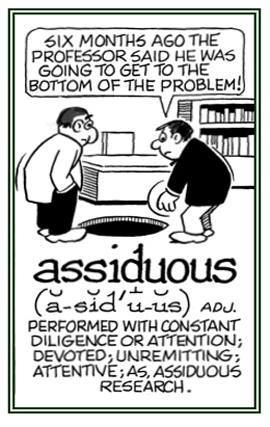
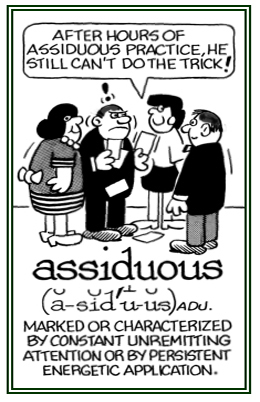
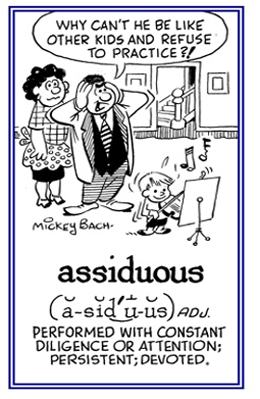
assiduous (adjective), more assiduous, most assiduous
1. Relating to being constant in application or attention; unremittingly diligent: Shirley was an assiduous worker who strived for perfection.
2. A reference to working diligently at a task and persevering to achieve an objective: Max was always doing assiduous researches for his chemistry projects so he could have the best possible results.
© ALL rights are reserved.
© ALL rights are reserved.
© ALL rights are reserved.
Go to this Word A Day Revisited Index
2. A reference to working diligently at a task and persevering to achieve an objective: Max was always doing assiduous researches for his chemistry projects so he could have the best possible results.
Bob was an assiduous student in high school and that's why he graduated as an honor student.
3. Etymology: From Latin assiduus, "busy, incessant, and continually" from assidere, "to sit down to"; therefore, "constantly occupied" at one's work.
Go to this Word A Day Revisited Index
for a list of additional Mickey Bach illustrations.
assiduously (adverb), more assiduously, most assiduously
1. With care and persistence: As a part-time cartoonist, Mickey Bach assiduously drew cartoons for many years that illustrated characters involved with words that often helped readers in newspapers to have a better comprehension of the vocabulary that was being presented.
2. Characterized by being determined in one's efforts: Jack LaLane worked assiduously for many years as a fitness expert to develop studios, exercise equipment, and showing his extraordinary strength on TV shows by swimming to Catalina Island from Los Angeles by pulling a boat with people in it as he swam.
2. Characterized by being determined in one's efforts: Jack LaLane worked assiduously for many years as a fitness expert to develop studios, exercise equipment, and showing his extraordinary strength on TV shows by swimming to Catalina Island from Los Angeles by pulling a boat with people in it as he swam.
Being constantly devoted or tenaciously and obstinately continuing with something despite problems or difficulties: Developing new approaches to presenting information on the internet often requires assiduousness and patience.
1. A judicial inquest, or the verdict of the jurors involved.
2. An ordinance regulating weights and measures and the weights and prices of articles of consumption.
3. Periodic judicial proceedings held until 1971 in the counties of England and Wales and presided over by itinerant judges.
2. An ordinance regulating weights and measures and the weights and prices of articles of consumption.
3. Periodic judicial proceedings held until 1971 in the counties of England and Wales and presided over by itinerant judges.
They were replaced by the Crown Courts.
4. Etymology: from Old French asise, "session", from asseoir, "to cause to sit"; from Latin assidere, "to sit beside" (and thus to assist in the office of a judge), from ad-, "to" + sedere, "to sit.".
besiege (verb), besieges; besieged; besieging
1. To surround a building, a city, etc. with soldiers and to try to take control of it: The military besieged the castle for several days before taking possession of it.
2. To gather around someone is a way that is disturbing, annoying, or aggressive, etc.: The political candidate was besieged by reporters of newspapers and TV when he announced that he would not be running for office.
3. To overwhelm a person with too many questions or requests for something: The sales department was besieged with hundreds of customers who wanted to know why the store ran out of computers so quickly on the first day of the special reduction in prices.
2. To gather around someone is a way that is disturbing, annoying, or aggressive, etc.: The political candidate was besieged by reporters of newspapers and TV when he announced that he would not be running for office.
3. To overwhelm a person with too many questions or requests for something: The sales department was besieged with hundreds of customers who wanted to know why the store ran out of computers so quickly on the first day of the special reduction in prices.
besieged (adjective), more besieged, most besieged
Descriptive of a place that is surrounded by military forces: Thousands of people have been fleeing from besieged towns in Syria.
1. The surrounding of a stronghold with armed forces in order to bring about its capture or surrender: So many places are under besiegements by terrorist groups or those who are struggling to overcome such groups.
2. A crowd that is harassing somebody or an organization in an oppressive way with insistent demands or complaints: The office of the theater was finding it very difficult to provide enough tickets for all of the fans during their besiegements because there were too many who were striving to get tickets to see the popular movie star who was making a personal appearance when the film was over.
2. A crowd that is harassing somebody or an organization in an oppressive way with insistent demands or complaints: The office of the theater was finding it very difficult to provide enough tickets for all of the fans during their besiegements because there were too many who were striving to get tickets to see the popular movie star who was making a personal appearance when the film was over.
Someone who is part of a group crowding around the winner of a competition; for example, a winner of an international sports event: Greg was just one of many besiegers who wanted to get the autograph of the winner of several sports events during the Olympic Games.
dispossess (verb), dispossesses; dispossessed; dispossessing
To force a person, or people, to give up the ownership of a house, land, or other property: The new dictator of the country dispossessed many people of their land and homes.
