
se-
(Latin: aside, apart from, without, by itself, by one's self)
2. To admit affiliates of all races or ethnic groups equally; especially, by force of law: The Civil Rights movement in the United States made significant gains when it was able to desegregate many schools, lunch counters, etc.
2. To become separated or disunited.
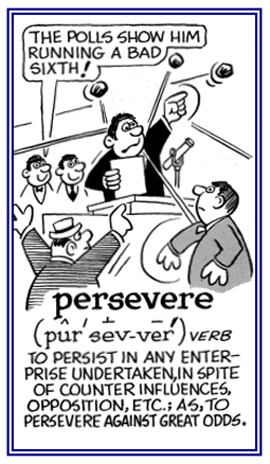
2. To strive steadily and be resolved and to maintain one's efforts; usually, over a long period and despite problems or difficulties: Glenda persevered in her university studies and graduated at the top of her class.
3. Etymology: from Old French perseverer, from Latin perseverare, "to continue steadfastly, to persist"; from persevereus, "very strict, earnest", from per-, "thoroughly" + severus, "strict".
Go to this Word A Day Revisited Index
so you can see more of Mickey Bach's cartoons.
"While in Amsterdam, Smyth became convinced that the scriptures require believers' baptism, not infant baptism. Since Smyth had not been baptized in the way he felt was correct, he baptized himself, then baptized the other members of the church he was leading."
2. Etymology: from Latin se-, "one's self" + baptista, "a baptizer".
2. To withdraw formally from a union, fellowship, or association; especially, from a political or religious organization.
2. Etymology: from Latin secessionem, from the stem of secedere. "secede" which consists of se-, "apart" + cedere. "to go".
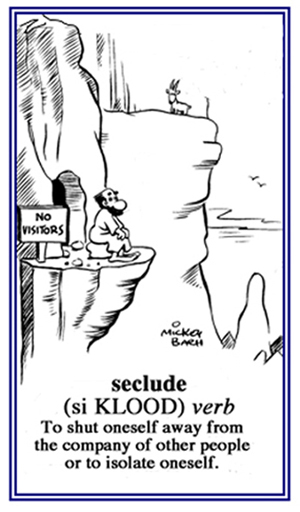
2. To make a place very private and quiet by isolating it from anyone else: Jerome secluded a home deep in the forest where nobody ever goes and lives as a hermit who has no contact with other individuals.
3. Etymology: from Latin secludere, "to shut off, to keep out"; from se, "apart" + claudere, "to shut".
Go to this Word A Day Revisited Index
so you can see more of Mickey Bach's cartoons.
2. A place of concealment or a private location: Little Tommy had his own spot of seclusion, which was behind the door of the closet in his room!
2. Etymology: existing from about 1423, secretee, "quality of being secret"; from Old French secré, a variant of secret which is from Latin secretus, "set apart, withdrawn, hidden"; originally the past participle of secernere, "to set apart"; which came from se-, "without, apart" with the extended meaning of "on one's own".
2. Keeping information hidden from other people or to very few people and consequently quiet and secluded: "They lived in a secret location of the suburbs."
3. A special or unusual way of doing something to achieve a good result: "She shared her beauty secrets with the small group."
4. Something which cannot be explained: "There are many secrets of the universe and even of many aspects of nature here on Earth."
5. Etymology: anything that is secret is "separated" from others; hence, "put out of the way, hidden".
The word comes via Old French secret from Latin secretus, an adjectival use of the past participle of secernere, "to separate". This was a compound verb formed from the prefix se-, "apart" and cernere, "to separate".
From the 16th to the 18th centuries, secret was used as a verb, meaning "to hide", but it was then altered to secrete, based on the model of Latin secretus.
2. In the United States, an official who advises the President in various fields and who is selected by the President and is in charge of a particular department of the government; such as, Attorney General, Secretary of Agriculture, Secretary of Commerce, Secretary of Education, Secretary of Energy, Secretary of Health and Human Services, Secretary of Housing and Urban Development, Secretary of Labor, Secretary of State, Secretary of Interior, Secretary of Treasury, Secretary of Transportation, and the Secretary of Veterans Affairs. Is anyone missing?
3. Etymology: "a person entrusted with secrets", from Medieval Latin secretarius, "clerk, notary, confidential officer, confidant"; from Latin secretum, "a secret".
The meaning, "a person who keeps records, writes letters, etc."; originally, for a king, was first recorded in about 1400.
2. Free from risk of loss; safe: "Her papers were secure in the safe deposit box."
3. Free from the risk of being intercepted or listened to by unauthorized people: "Only one telephone line in the embassy was secure."
4. Free from fear, anxiety, or doubt.
5. Not likely to fail or give way; stable: "She used a secure stepladder when she wanted to get objects from her high bookcase."
6. Firmly fastened: such as, a secure lock.
7. Reliable; dependable: "He always tried to make secure investments."
8. Assured; certain: "With three soccer goals in the first period, they had a secure victory; but somehow they lost the game."
8. Archaic, being careless or overconfident.
9. Etymology: "without care," from Latin securus, "without care, safe"; from secura, which came from se, "free from" + cura, "care".
Meaning "firmly fixed" (of material things) is from 1841, on the notion of "affording grounds for confidence". Security is attested from 1432, from Latin securitas, from securus.
2. To make tight, to fasten, to make firm.
3. To obtain or to acquire possession of something.
