Scientologist
An adherent or practitioner of Scientology; a member of the "Church of Scientology".
Scientology
A system of beliefs based on the study of knowledge and claiming to develop the highest potentialities of its members; founded in 1951 by L. Ron Hubbard (b. 1911).
sciolism
(s) (noun), sciolisms
(pl)
1. A pretension of having knowledge or being well informed about something; all of which is really deceiving: Such people as palm readers, clairvoyants, crystal ball experts, and readers of tea leaves are just a few examples of individuals who are considered to be practitioners of
sciolisms.
2. Etymology: from Latin
sciolus, "having knowledge"; from
scire, "to know".
 © ALL rights are reserved.
Go to this Word A Day Revisited Index
so you can see more of Mickey Bach's cartoons.
sciolist
(s) (noun), sciolists
(pl)
1. A person who presents superficial or inadequate knowledge about something: "A sciolist usually proclaims himself or herself to be an expert regarding a subject, but who actually has very little real understanding or intellectual comprehension about the issue."
2. Etymology: from Late Latin
sciolus which came from earlier Latin
scius, "knowing"; from
scio, "I know" and
scire, "to know".
"If the language can be improved in regularity, so as to be more easily acquired by our own citizens and by foreigners, and thus be rendered a more useful instrument for the propagation of science, arts, civilization, and Christianity; if it can be rescued from the mischievous influence of sciolists, and that dabbling spirit of innovation, which is perpetually disturbing its settled usages and filling it with anomalies; if, in short, our vernacular language can be redeemed from corruptions, and our philology and literature from degradation; it would be a source of great satisfaction to me to be one among the instruments of promoting these valuable objectives."
— from the introduction to
An American Dictionary of the English Language by Noah Webster, LL.D.;
Published by George and Charles Merriam; Springfield, Mass.; 1857.
sciolistic
(adjective), more sciolistic, most sciolistic
A reference to anyone who takes part in some activity and who gives the impression that he or she has knowledge about it: The fortune teller made some sciolistic predictions about Jim's future which never happened.
soil science
(s) (noun) (no pl)
The scientific study of the formation, properties, distribution, and classification of soil as a natural resource: Part of his geology classes included a seminar on soil science which involved many different aspects of earth.
subconsciously
(adverb), more subconsciously, most subconsciously
In a manner that lacks alertness, or with imperfect or feeble awareness, of what is going on.
translational scientific research
(s) (noun), translational scientific researches
(pl)
Translational Scientific Research is generally described as the process of applying ideas, insights, and discoveries generated through basic knowledge inquiry to the treatment or prevention of disease or injury: The value of
Translational Scientific Research is usually determined on the basis of the likelihood that completion of exploratory or developmental research objectives will move towards effective objectives.
The most important aspect of Translational Research is the working from the laboratory to the clinic, and from the clinic back to the laboratory.
Translational Scientific Research is, therefore, an inherently collaborative and interdisciplinary area of medical research.
Special information about
Transitional Scientific Research is available here.
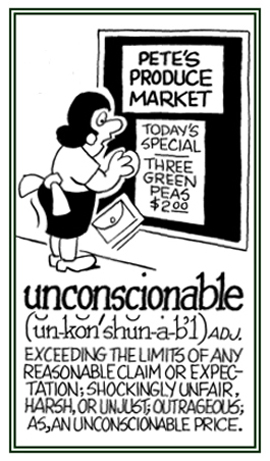
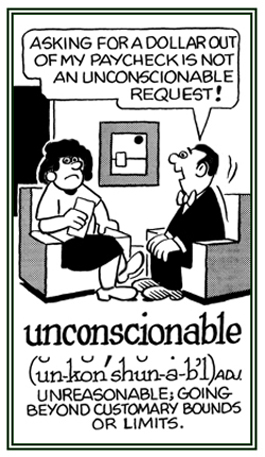
unconscionable
(adjective), more unconscionable, most unconscionable
1. A reference to a person who is unscrupulous; unreasonably grasping, extortionate, harsh, etc.: The
unconscionable criminal was ruthless and cruel when he went into the bank to rob it of money and hit the female guard on the head with his gun.
2. Relating to something which is outrageous and beyond reason: The fees for the childcare center in Tim's town were considered to be quite
unconscionable and not affordable by most families.
3. Etymology: from Latin
un-, "not" + conscionable, from
conscientia, "knowledge"; from
conscire; "to know well"; from
com-, "together" +
scire, "to know" +
able, "ability".
 © ALL rights are reserved.
 © ALL rights are reserved.
Go to this Word A Day Revisited Index
so you can see more of Mickey Bach's cartoons.
unconscious
(adjective), more unconscious, most unconscious)
1. Relating to not knowing within oneself; unaware, heedless: In psychology, an unconscious situation that applies to mental or psychic processes of which a person is not aware of but which has a powerful effect on his or her attitudes and behaviors.
2. A reference to not being realized or known as existing in oneself.
5. Etymology: from un-, "not" + conscious or not "knowing" or "not being aware".
unconsciousness
(s) (noun), unconsciousnesses
(pl)
1. A condition that lacks normal awareness of oneself or his or her environment:
Unconsciousness is an abnormal state involving the inability that a person has of responding to sensory stimuli which can be a result of injury, illness, shock, or some other bodily disorder.
A deep, prolonged unconsciousness is known as a coma.
unscientific
(adjective), more unscientific, most unscientific
1. Relating to not adhering to the principles of science: Unscientific research is a process that results when someone is not consistent or logical when he or she is investigating something and not acquiring the proper results.
2. Characteristic of lacking sufficient knowledge about scientific methods: George's unscientific processes were done in illogical ways while he was investigating and striving to acquire an understanding about the animals that exist in the forest.
unscientifically
(adverb), more unscientifically, most unscientifically
A reference to research that is not following, nor compatible, with the methods and principles of science: Adam unscientifically conducted a biological research about fish in the lake near his residence.
Veritas/mores/scientia.
Translation: "Truth/morals/knowledge."
Motto of East Texas Baptist College, Marshall, Texas, USA.
Related articles about science:
"Science Race";
STEM, Part 1;
STEM, Part 2;
Scientific Specialties.
Inter-related cross references, directly or indirectly, involving word units meaning "know, knowledge; learn, learning":
cogni-;
discip-;
gno-;
histor-;
intellect-;
learn, know;
math-;
sap-;
sopho-.

