
pudend-, puden-, pudic-
(Latin: originally, "that which one should be ashamed of"; the external organs of generation; from pudere "to cause shame".)
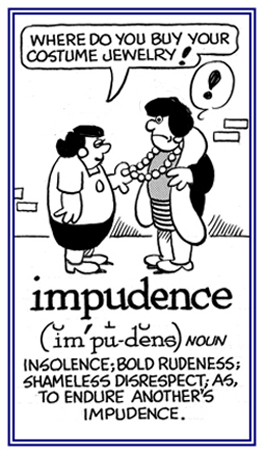
1. An offensively bold behavior; insolence, cheekiness: Tommy was punished for his impudence when his mother told him to quit watching TV and go to bed.
2. A lack of modesty; a disrespectful and a smart-aleck or a shameless comment: Patricia expressed an impudence when she told Leslie that he was wearing such muddy shoes into the store when shopping.
© ALL rights are reserved.
Go to this Word A Day Revisited Index
2. A lack of modesty; a disrespectful and a smart-aleck or a shameless comment: Patricia expressed an impudence when she told Leslie that he was wearing such muddy shoes into the store when shopping.
Go to this Word A Day Revisited Index
so you can see more of Mickey Bach's cartoons.
impudent (adjective), more impudent, most impudent
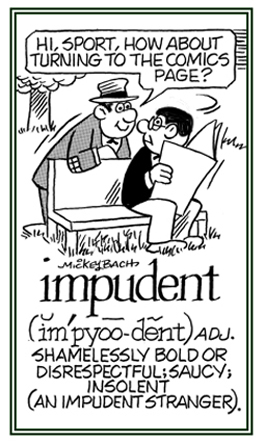
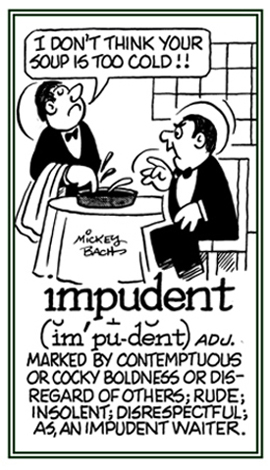
1. A reference to someone who shows a lack of respect and is rude: Because little Susi was so impudent and sassy towards her mother, she was sent straight to her room without dinner.
2. Characterized by offensive boldness and being insolent or impertinent: Deborah scolded her son for his impudent behavior at the dinner table.
© ALL rights are reserved.
© ALL rights are reserved.
Go to this Word A Day Revisited Index
2. Characterized by offensive boldness and being insolent or impertinent: Deborah scolded her son for his impudent behavior at the dinner table.
Go to this Word A Day Revisited Index
so you can see more of Mickey Bach's cartoons.
impudently (adverb), more impudently, most impudently
A reference to how someone's manner is insensible and shamelessly indecent: Mark impudently behaved himself in an uncaring manner when he was told by the cashier of the store that he should not eat any of the cookies before he has paid for them.
1. The lack of modesty or shame; immodesty, shamelessness: Carl's impudicity went to an extreme when he went to see a movie about prostitutes and their activities.
2. Etymology: from Latin impudicitia, from impudicus "shameless", from in-, "not" + pudere "to be ashamed".
2. Etymology: from Latin impudicitia, from impudicus "shameless", from in-, "not" + pudere "to be ashamed".
1. Having a quick and sharp awareness, either to the action of external objects, or to impressions upon the mind and feelings: In the story Mary was reading, the main character was a Mimosa pudica, being highly susceptible and strongly affected by others.
2. In mechanics, the ability of being easily moved or affected: The thermometer Jack had placed outside his kitchen window could be termed as a Mimosa pudica because it was extremely sensitive to the heat or to the coolness of the outside temperatures.
3. In chemistry and photography, something that can be readily affected by certain appropriate agents: When silver chloride or bromide comes in contact with certain organic substances, it is extremely sensitive to actinic rays, and can be described as a Mimosa pudica.
4. A very responsive sensation: When Tina was sleeping, her parents thought she was a Mimosa pudica because she was extremely susceptible to irritations, like touching or wind, causing her muscles to move instantly or even waking her up!
5. Sensitive fern; an American and Australian fern (Onoclea sensibilis): The Mimosa pudica, which grows in tropical areas, has thorns with very responsive and fragile grey-green leaves that fold inward to the touch and which sag at night.
6. In physics, a very sensitive gas flame: In Jack's science class at school, a Mimosa pudica was activated when the pressure was suitably adjusted to the gas blaze so that it was exceedingly responsive to sounds which caused it to roar, to flare, or to become suddenly shortened or even quenched by some slight sounds caused by certain vibrations.
2. In mechanics, the ability of being easily moved or affected: The thermometer Jack had placed outside his kitchen window could be termed as a Mimosa pudica because it was extremely sensitive to the heat or to the coolness of the outside temperatures.
3. In chemistry and photography, something that can be readily affected by certain appropriate agents: When silver chloride or bromide comes in contact with certain organic substances, it is extremely sensitive to actinic rays, and can be described as a Mimosa pudica.
4. A very responsive sensation: When Tina was sleeping, her parents thought she was a Mimosa pudica because she was extremely susceptible to irritations, like touching or wind, causing her muscles to move instantly or even waking her up!
5. Sensitive fern; an American and Australian fern (Onoclea sensibilis): The Mimosa pudica, which grows in tropical areas, has thorns with very responsive and fragile grey-green leaves that fold inward to the touch and which sag at night.
6. In physics, a very sensitive gas flame: In Jack's science class at school, a Mimosa pudica was activated when the pressure was suitably adjusted to the gas blaze so that it was exceedingly responsive to sounds which caused it to roar, to flare, or to become suddenly shortened or even quenched by some slight sounds caused by certain vibrations.
Modesty; bashfulness; prudishness; shame: Andrew had a strong pudency not to take showers with other men after playing football, so he waited until he got home to take his bath.
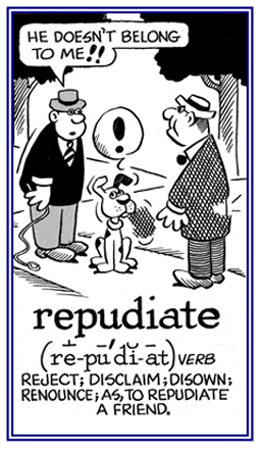
repudiate (verb), repudiates; repudiated; repudiating
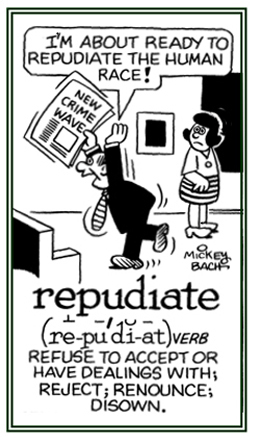
1. To disapprove of something formally and strongly and to renounce any connection with it: Adam repudiates the accusation that he had anything to do with the repair job that was done on the car.
2. To refuse to accept; especially, to reject as unauthorized or as having no binding force: Jerome repudiated the contract that was offered to him by the company.
3. Etymology: from Latin repudiare, "to reject"; from re-, "back, away" + pudere, "to cause shame".
© ALL rights are reserved.
© ALL rights are reserved.
Go to this Word A Day Revisited Index
2. To refuse to accept; especially, to reject as unauthorized or as having no binding force: Jerome repudiated the contract that was offered to him by the company.
3. Etymology: from Latin repudiare, "to reject"; from re-, "back, away" + pudere, "to cause shame".
Go to this Word A Day Revisited Index
so you can see more of Mickey Bach's cartoons.
1. The refusal to accept or to support something or to reject anything or someone: As a senator, Hank's statements are a repudiation of the government's policies.
2. No acknowledgement by the public authorities regarding the legality of payments for a contract or public debt when they consider it wrong: The repudiations for the cost of the new city street in front of city hall have been delayed until authorities have fully determined if the charges are valid.
2. No acknowledgement by the public authorities regarding the legality of payments for a contract or public debt when they consider it wrong: The repudiations for the cost of the new city street in front of city hall have been delayed until authorities have fully determined if the charges are valid.
Someone who refuses to accept any action or situation which he or she rejects: George is often a repudiationist of President Trump's pro, then negative, then pro inconsistent policies.
repudiative (adjective), more repudiative, most repudiative
1. A reference to the emphatic dismissal of something or someone; rejective: A veto can be considered to be a repudiative act.
In the story Susan was reading, the father decided on repudiative action against his son Jeff and disowned him after the money was stolen from the safe in the library.
2. Descriptive of rejecting with disapproval or condemnation: Many people are repudiative of President Trump's political or economic positions.
1. Someone who refuses to accept, especially as to reject as unauthorized or as having no binding force: At the meeting and after the chairman had scrutinized the contract, he presented himself as the repudiator and rejected it as being a fake!
2. Anyone who rejects as untrue or unjust: The repudiator turned out to be a young woman who denied having stolen the dress at the shop because she wasn't there at the time when it happened.
2. Anyone who rejects as untrue or unjust: The repudiator turned out to be a young woman who denied having stolen the dress at the shop because she wasn't there at the time when it happened.
A business agreement that permits the aggrieved or disappointed party to terminate the fulfillment of a contract in addition to entitling that person to sue for damages: James finally had a written and binding rental agreement set up with a young couple, but after many months of not receiving any money, James decided that a repudiator breach had to be put into effect.
<img src="/img/left_arrow_sm.gif" alt="" /> <img src="/img/right_arrow_sm.gif" alt="" />
Showing 1 page of 12 main-word entries or main-word-entry groups.