
pon-, posit-, pos-, -poning, -poned, -ponency, -ponent, -ponement, -pound
(Latin: to place, to put, to set; placement, positioning)
2. Anyone who manipulates or places limbs and body parts in a particular fashion: Gary, the posturer, assisted the studio artists by directing the models to move and to place their arms and legs in special positions.
2. Those who have a frame of mind that affects their behavior and overall attitude: In church, the posturists, including Carolyn and Lesley, presented an attitude of prayer and worship.
3. People who assume or who take exaggerated attitudes by placing their bodies in unusual stances: There was a crowd of posturists sitting in the street in front of the bank with their arms folded across their chests and demanding that the wealthy pay more taxes.
If a litigant predisposes a judge, the judge has an inclination in that person's favor before the trial begins.
2. To be susceptible to an unhealthy condition or disease: Karla's medical history suggested that she was predisposed to bronchial infections during the winter.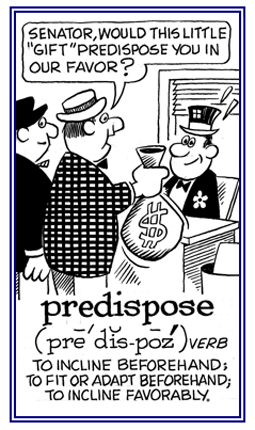
Go to this Word A Day Revisited Index
so you can see more of Mickey Bach's cartoons.
Based on Hope's childhood experiences, it would seem she has a predisposition to laughter and fun.
Brian had a latent predisposition to a disease which could be activated by stress.
2. To place a word, or words, before another one in a sentence: When writing a formal letter, be sure to prepose the title of the addressee correctly.
3. To make an advanced arrangement: Mr. and Mrs. Lawson's plans preposed Susan's suggestion that they go together to the ice rink the following day.
In the sentence, "Please put the glass on the table", the word "on" is a preposition that indicates the relationship of the "glass" with the "table".
In "It will be time to catch the train in one hour", "in" is the preposition.
2. A word that, when combined with pronouns, nouns, or noun phrases, indicates a position in time or spaces, motions, agencies, relationships, or purposes: Prepositions govern their objects by deciding which words or phrases their objects may be associated with. "The houses by the road were all sold yesterday." "Road" is the object of the preposition and "by" determines that "road" will be associated with "houses". 3. Etymology: from Latin praepositionem, praepositio, "a putting before", from praepositus, past participle of praeponere, "to put before"; from prae, "before" + ponere "to put, to place, to set".2. Concerning a grammatical construction that is followed by a noun or a pronoun either of which may be made of two or more elements and have modifiers: A prepositional phrase that describes a noun or a pronoun is identified as adjectival.
Examples of adjectival prepositional phrases include the following:
The painting in the corner is my favorite.
They flew a plane with twin engines.
The person on the corner with his hand raised is her brother. [with two prepositional phrases functioning as adjectives]
The ice in the lemonade cooled the drink.
She saw the movie with her friend.
Jacob checked under the couch and chair as he tried to find the coins that he dropped.
Prepositionally modifying a verb:
We sat on the park bench. (Sat where?)He should arrive within the hour. (Arrive when?)
Except for the border, the quilt was finished. (Was finished to what extent?)
Prepositionally modifying an adverb:
He left early in the morning. (Early when?)A sentence that contains more than one adverbial phrase, and both of them prepositionally modify the same word [climbed]: During the cool morning hours, they climbed to the summit. (Climbed when? Climbed where?)
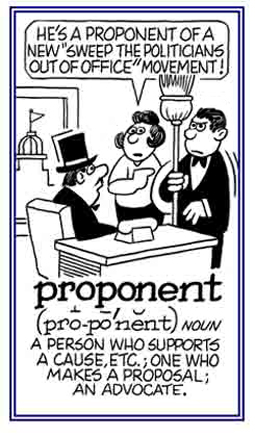
2. In law, to put forward or to present a case before a jury or judicial magistrate: Mrs. Dawson, the lawyer, sought to propone the innocence of Janice, her client, before the jury.
Go to this Word A Day Revisited Index
so you can see more of Mickey Bach's cartoons.
2. A suggestion or offer for unification or marriage: Irving made a romantic proposal of marriage over a candlelight dinner.
At the board meeting, the chairperson of the committee, Mr. McMahon, made the proposal that the two businesses be unified.
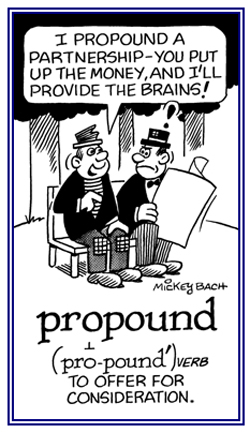
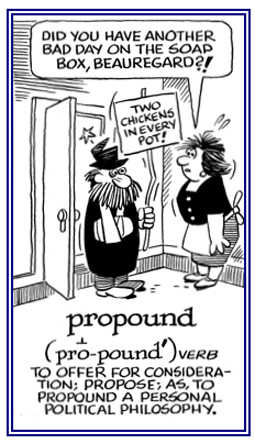
3. The act of putting forth an idea for consideration and discussion: The heavy rain storms and flooding led to a proposal that the city drains be cleaned.The teacher, Mrs. Richison, proposed an outline of reading to be done by her students during the school break.
2. To make an offer of marriage or of joining properties: When he proposed marriage to her, Dwight also proposed that their two households be united.3. To recommend or to suggest an individual for a position or employment: It was considered a conflict of interest for Mayor Jones to propose his brother for the new library board.
2. A recommendation regarding laws or changing of laws that citizens may vote on: At the time of the fall election, there were two new propositions on the ballot regarding road improvements.
3. An indecent or offensive idea or offer: Dudley's proposition, that the accountant cheat on the tax forms, was rejected.
Go to this Word A Day Revisited Index
so you can see more of Mickey Bach's cartoons.
Related word families intertwined with "to place, placing, to put; to add; to stay; to attach" word units: fix-; prosth-; stato-; the-, thes-.

