
oper-, opus
(Latin: work)
2. Marked by willingness to cooperate; compliant: "She was a cooperative patient."
3. Of, relating to, or formed as an enterprise or organization jointly owned or managed by those who use its facilities or services: "The residents lived in cooperative apartment buildings."
2. Neither practical nor workable: The old toaster in Mary's kitchen was inoperable and did not function anymore, even after her brother tried to fix it.
2.Ineffective or unenforceable: not effective or no longer valid or able to be enforced.
2. Etymology: "in practice" from obsolete ure, "work, practice, exercise", or "use"; said to be from Old French uevre, oeuvre "to work"; from Latin "opera" or "opus".
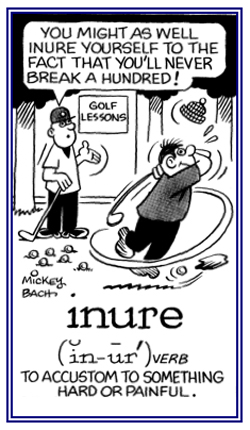
Go to this Word A Day Revisited Index
so you can see more of Mickey Bach's cartoons.
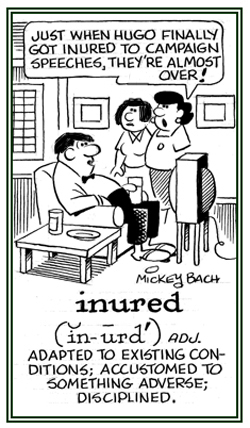
Go to this Word A Day Revisited Index
so you can see more of Mickey Bach's cartoons.
A Masterpiece, second to none, The best; Therefore, I am!
The grammatical structure is not correct: Magnus should be Magnum, secundus should be secundum and optimus should be optimum.
This was a hand-lettered sign in George E. Ohr's pottery shop (BILOLXI ART POTTERY) in Biloxi, Mississippi (1895-1905).
Ohr made pottery that featured rims that had been crumpled like the edges of a burlap bag and pitchers that seemed deliberately twisted and vases warped as if melted in the kiln.
The colors of his works exploded with color; vivid reds juxtaposed with gunmetal grays, olive greens splattered across bright oranges, and royal blues mottled on mustard yellows and he created fantastic shapes glazed with wild colors in his "Pot-Ohr-E".
Ohr once said, "I am the apostle of individuality, the brother of the human race, but I must be myself and I want every vase of mine to be itself."
In 1909, claiming he hadn't sold even one of his mud babies in more than 25 years, Ohr closed his shop.
Although he was just 52, he never threw another pot. When he inherited a comfortable sum after his parents died, he devoted the rest of his life to enhancing his reputation as a "looney".
Still confident that the time would come when his work would be recognized, Ohr died of throat cancer at the age of 60 in 1918. Now, the same pots scorned a century ago sell from $20,000 to $60,000 each. Today, Ohr is hailed as a "clay prophet" and "the Picasso of art pottery."
The administrative personnel, executives, or staff working in such a place.
2. The quarters in which a commercial, professional, or government organization carries out its activities.3. A duty or function assigned to or assumed by a person.
4. A position of authority, duty, or trust given to someone, as in a government or corporation; such as, the office of vice president.
5. A major executive division of a government or subdivision of a governmental department; for example, the U.S. Patent Office.
6. The prescribed order or form of a Christian church service, or of daily prayers.
A religious rite or service prescribed by ecclesiastical authorities.
7. Etymology: from about the mid-13th century, "a post, an employment to which certain duties are attached"; from Latin officium, "service, duty, function, business"; literally, "work-doing", from ops, opis, "power, might, abundance, means" (related to opus, "work") + the stem of facere, "to do, to perform".
The salesman told Jim that the car radio would be operable even if the engine was turned off.
2. Pertaining to the possibility of putting something into practice: doable: After talking about the day's activities, Jill and Thomas figured out an operable plan of getting everything done without stress.
3. Relating to the treatment by a surgical procedure with a reasonable degree of safety and chance of success: Dr. Hathaway told Mrs. Green that the kind of cancer she had was operable and very simple to remove and that she shouldn't be frightened or worried at all.
2. To perform surgery.
3. To exert an influence; such as, forces operating on the economy.
4. To produce a desired or proper effect;for example, a drug that operates quickly.
5. To carry on a military or naval action or campaign.
6. To conduct business in an irregular or devious manner; such as, drug dealers operating in residential and school areas.
