
nov-, novo-, novi-
(Latin: new, recent)
Never be afraid to try something new. Remember, amateurs built the Ark. Professionals built the Titanic.
—Author Unknown
innovate (verb), innovates; innovated; innovating
1. To begin or to introduce something new as if it were done the first time.
2. To make recent modifications with anything that has already been provided.
2. To make recent modifications with anything that has already been provided.
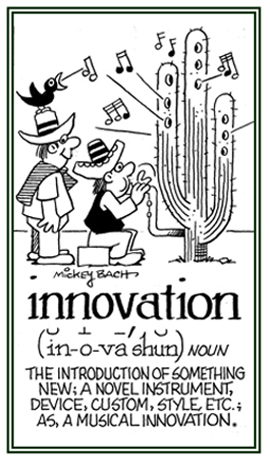
1. The act or process of inventing or introducing something new: Jack was interested in the credit the bank was offering to businesses to encourage innovations in the area of furniture design for the physically handicapped.
2. A new invention or a new way of doing anything: Before the innovation of computers, people used simple manual or electric typewriters to write their documents.
© ALL rights are reserved.

© ALL rights are reserved.

© ALL rights are reserved.

© ALL rights are reserved.
© ALL rights are reserved.
Go to this Word A Day Revisited Index
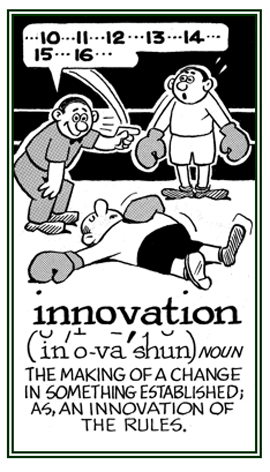
2. A new invention or a new way of doing anything: Before the innovation of computers, people used simple manual or electric typewriters to write their documents.
Go to this Word A Day Revisited Index
so you can see more of Mickey Bach's cartoons.
1. Someone who helps to open up a new line of research or technology or art.
2. Anyone who introduces changes and new ideas.
3. A person who begins or introduces anything new, or as if for, the first time.
2. Anyone who introduces changes and new ideas.
3. A person who begins or introduces anything new, or as if for, the first time.
news (used as a singular) (noun)
1. Information about recent events or developments; Lenora talked to the medical doctor and the news about her mother is good.
2. A presentation about current events or the presentation of a report on recent or new events in a newspaper or other periodicals or on the radio or television.
3. Someone, or something, that happened recently and which is considered as being of current interest to people in general.
4. Something which was previously unknown about a person that now has been revealed: Harry's winning of the lottery was surprise news to his brother.
5. Etymology: from Latin nova "news"; literally, "new things".
2. A presentation about current events or the presentation of a report on recent or new events in a newspaper or other periodicals or on the radio or television.
3. Someone, or something, that happened recently and which is considered as being of current interest to people in general.
4. Something which was previously unknown about a person that now has been revealed: Harry's winning of the lottery was surprise news to his brother.
5. Etymology: from Latin nova "news"; literally, "new things".
Radio and television programs that are dedicated to presenting news bulletins about current events which have happened in recent times.
Non nova sed nove. (Latin proverb)
Translation: "Not new things but in a new way."
1. A star that suddenly increases dramatically in brightness and then fades to its original luminosity over a short period of months or years.
2. Etymology: from Latin nova, "new" (star); feminine of Latin novus, "new".
2. Etymology: from Latin nova, "new" (star); feminine of Latin novus, "new".
Something that is new and, yet, old at the same time.
1. A fictitious prose narrative of considerable length and complexity, portraying characters and usually presenting a sequential organization of action and scenes.
2. A fictional prose work with a relatively long and often complex plot, usually divided into chapters, in which the story traditionally develops through the thoughts and actions of its characters.
3. Etymology: the meaning of "fictitious narrative" came from Italian novella, "short story"; but originally it meant "new story" from Latin novella, "new things" based on Middle French novelle, then French nouvelle, a form of novellus.
2. A fictional prose work with a relatively long and often complex plot, usually divided into chapters, in which the story traditionally develops through the thoughts and actions of its characters.
3. Etymology: the meaning of "fictitious narrative" came from Italian novella, "short story"; but originally it meant "new story" from Latin novella, "new things" based on Middle French novelle, then French nouvelle, a form of novellus.
novel (adjective), more novel, most novel
1. A reference to being new and different, often in an interesting, unusual, or inventive way.
2. Relating to that which is strikingly new, unusual, or different; of recent origin or introduction; not ancient; new; hence, out of the ordinary course; unusual; strange; surprising.
2. Relating to that which is strikingly new, unusual, or different; of recent origin or introduction; not ancient; new; hence, out of the ordinary course; unusual; strange; surprising.
Everything at its first occurrence is considered to be new; that is, novel or which is so much out of the ordinary course of existence so as to strike people with surprise.
3. Etymology: "new, strange, unusual"; from Middle French novel, "new, fresh, recent"; from French nouveau, nouvelle; from Old French, which came from Latin novellus, "new, young, recent"; diminutive of novus "new".
A brief novel or a long short story: Since Trisha didn't have much time, she was reading a novelette instead of a full novel or a large written story about imaginary or partly imaginary characters and events.
A person who writes novels or stories in books about many subjects and people: Grace is a novelist who has been creating and publishing many fictions for several years.
novelistic (adjective), more novelistic, most novelistic
A reference to writing which is like a novel: Tom's students were assigned to write novelistic stories in his English class.
novelize (verb), novelizes; novelized; novelizing
1. To make or to render something new: Sarina was novelizing a her trip to European countries which she did last summer.
2. To turn a writing into fiction or to fictionalize: Joshua novelized his personal life as a refugee in a book.
2. To turn a writing into fiction or to fictionalize: Joshua novelized his personal life as a refugee in a book.
1. Something that is new, original, and different which is interesting or exciting, even though it is often for only a short time.
2. Something new and unusual; an innovation.
3. A small inexpensive toy, ornament, piece of jewelry, or trinket.
2. Something new and unusual; an innovation.
3. A small inexpensive toy, ornament, piece of jewelry, or trinket.
Cross references of word families related to: "new, recent": cen-, ceno-; ne-, neo-.

Showing page 1 out of 2 pages of 30 main-word entries or main-word-entry groups.