
magni-, magn-; magna
(Latin: large, big, great; much, abundant)
magnipotent (adjective), more magnipotent, most magnipotent
1. Referring to the condition of having supreme power: In the short story Susan read, the fairy queen was described as magnipotent and had sovereignty and jurisdiction over the land of the elves and pixies.
2. Descriptive of a great power or of having significant ability to control or to influence people or things: Henry was a politician who had magnipotent skills and personality when he was presenting his proposals to the mayor of his city.
2. Descriptive of a great power or of having significant ability to control or to influence people or things: Henry was a politician who had magnipotent skills and personality when he was presenting his proposals to the mayor of his city.
A portable, hand-held microscope: A magniscope is especially helpful for classroom or outdoor use and some are advertised as having a battery-powered light source, a one-hand operation of focus and light with a removable base and equipment storage compartment, and it can be used as a monocular, loupe, or simple magnifier.
magnisonant (adjective); more magnisonant, most magnisonant
Regarding a person's behavior to be great, important, or arrogant: Mary's great aunt behaved in a very highfalutin or magnisonant way when she was invited to eat at an acquaintance's home and she said that she only dined in restaurants with five stars!
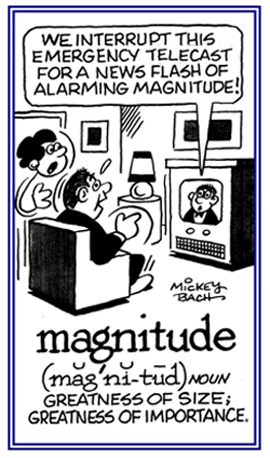
1. The quality or fact of being great, in various senses as in the physical sense, great size, or extent: Mr. Smith's students were speechless with the magnitude of the science assignment he presented to them and which was due in two weeks.
2. Loudness and the intensity or extreme volume of sounds: Sometimes the magnitude of the orchestra in the small theater significantly disturbed some members of the audience.
3. Greatness of character, rank, or position; also as a humorous title of address: Mr. Smith, the owner of the large company, had duties and responsibilities of such magnitudes that he had to hire additional experts to help him accomplish them.
4. A reference to immaterial things with a great degree of importance: Professor Williams is a scientist of considerable magnitude and eminence.
5. The intrinsic size of an earthquake or underground explosion: The magnitude of the tremors were impossible to endure for the people who lived in the affected area.
© ALL rights are reserved.

© ALL rights are reserved.
Go to this Word A Day Revisited Index
2. Loudness and the intensity or extreme volume of sounds: Sometimes the magnitude of the orchestra in the small theater significantly disturbed some members of the audience.
3. Greatness of character, rank, or position; also as a humorous title of address: Mr. Smith, the owner of the large company, had duties and responsibilities of such magnitudes that he had to hire additional experts to help him accomplish them.
4. A reference to immaterial things with a great degree of importance: Professor Williams is a scientist of considerable magnitude and eminence.
5. The intrinsic size of an earthquake or underground explosion: The magnitude of the tremors were impossible to endure for the people who lived in the affected area.
Go to this Word A Day Revisited Index
so you can see more of Mickey Bach's cartoons.
magnitudinous (adjective); more magnitudinous, most magnitudinous
Characterizing the quality of significance, greatness in size or amount: Doug had not eaten all day and so he had a magnitudinous appetite in the evening and he had the misconception that he could eat everything on the menu at the restaurant when he had dinner there with his wife that evening!
magnocellular (adjective) (not comparable)
Regarding neurons with large cell bodies: The magnocellular system, shown by research and current studies, might have a specific involvement in deficits in reading which are related to dyslexia.
A dinosaur or large lizard: The nomenclature, Magnosaurus, is no longer recognized by scientists because they found that it described an animal that was previously given another name which is "Megalosaurus", named by the German paleontologist Friedrich von Huene in 1932.
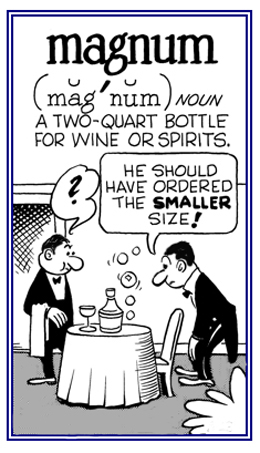
A large bottle for wine, spirits, etc. that is twice the standard size and usually contains two quarts: The magnum was the quantity of liquor that Mr. Big was trying to consume in the restaurant.
© ALL rights are reserved.
Go to this Word A Day Revisited Index
Go to this Word A Day Revisited Index
so you can see more of Mickey Bach's cartoons.
1. One of several kinds of large cooking plums: The magnum bonum plum is a unique type of fruit and magnum bonum can also be applied to health foods and a cultivated variety of potato, for example.
2. Etymology: magnum bonum "a great good", "a large good thing"; from classical Latin magnum, neuter singular of magnus, "great" plus bonum, neuter singular of bonus, "good" after classical Latin summum bonum, "highest good", the "chief or supreme good".
2. Etymology: magnum bonum "a great good", "a large good thing"; from classical Latin magnum, neuter singular of magnus, "great" plus bonum, neuter singular of bonus, "good" after classical Latin summum bonum, "highest good", the "chief or supreme good".
An artist's, writer's, or composer's greatest individual work: Tom's last novel was his magnum opus and masterpiece!
Non est magnus pumilio, licet in monte constiterit; colossus magnitudinem suam servabit, etiam si steterit in puteo. (Latin proverb)
Translation: "A dwarf is not tall, even though he stand on a mountain; a colossus keeps his height, even though he stand in a well."
From Seneca, Ad Lucilium Epis (c. A.D. 65).
