
luco-, luc-, luci-, lux, -lucence, -lucent
(Latin: light, lights, shine, shines, shining)
Alenda lux ubi orta libertas.
Where light has arisen there liberty should be sustained.
Motto of Davidson College, Davidson, North Carolina, USA and Community College of Beaver County, Monaca, Pennsylvania, USA.
Anno lucis.
In the year of light, computed by adding 4 000 years to A.D. [anno Domini].
Used by Freemasonary.
antelucan (adjective)
1. Being before light; a word applied to assemblies of Christians, in ancient times of persecution.
2. Held or done before light in the morning: "The couple went for an antelucan walk today."
2. Held or done before light in the morning: "The couple went for an antelucan walk today."
antelucidate (verb), antelucidates; antelucidated; antelucidating
To work by candle-light before day light: "Before electricity came into use, some people antelucidated prior to the rising of the sun."
circumlucid (adjective), more circumlucid, most circumlucid
Bright on every side: The circumlucid worm is easily visible at night.
elucid (adjective)
A reference to that which gives out light: "Henry always carries a very small elucid device (flashlight) in his pocket that was even smaller than the little finger on either of his hands."
elucidate (verb), elucidates; elucidated; elucidating
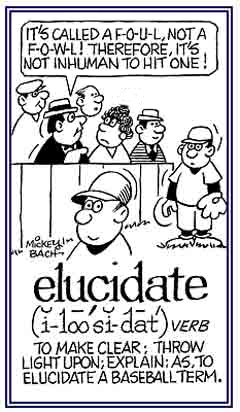
To make clear or to explain; especially, something that is hard to understand: The administrative official was asked to elucidate the government's policies regarding how new jobs would be created.

© ALL rights are reserved.
© ALL rights are reserved.
Go to this Word A Day Revisited Index
When Kim was asked to explain why she didn't go to the meeting, she declined to elucidate further.
Synonyms that clarify what elucidate means include the following: to explain, to explicate, to expound, to illuminate, to spell out, and to interpret.
Go to this Word A Day Revisited Index
for a list of additional Mickey Bach illustrations.
The act of explaining or clarifying by making something plain or easier for others to comprehend: The reporter was asked to provide more elucidations so people could understand what he was writing about.

© ALL rights are reserved.
Go to this Word A Day Revisited Index
Here is a cartoon that is actually presented as a verb; however, it is used here to help illustrate what the noun means.
Go to this Word A Day Revisited Index
for a list of additional Mickey Bach illustrations.
elucidative (adjective)
A reference or description of something that is informative and which functions to instruct, to enlighten, or to inform.
Fiat lux.
Let there be light.
As seen in the Vulgate, Genesis, I, 3. Motto of Rollins College, Winter Park, Florida, USA; and Atlantic Union College, South Lancaster, Massachusetts, USA.
illucidate (verb), illucidates; illucidated; illucidating
To shed light upon; to make clear, clear up; elucidate.
Something that throws light upon something.
lucent (adjective)
1. Giving off light; shining; softly bright or radiant: "Tonight we saw a beautiful lucent moon".
2. Translucent or clear.
3. Shining with a glowing light.
2. Translucent or clear.
3. Shining with a glowing light.
lucicole (verb), lucicoles; lucicoled; lucicoling: light
Living in open, well-lit habitats..
lucicolous (adjective), more lucicolous, most lucicolous
Pertaining to life in open areas that have plenty of light.
Etymologically related "light, shine, glow" word families: ethero-; fulg-; lumen-, lum-; luna, luni-; lustr-; phengo-; pheno-; phospho-; photo-; scinti-, scintill-; splendo-.
